




A light bulb, a capacitor and a battery are connected together as shown here, with switch S initially open. When S is closed, which one of the following is true?
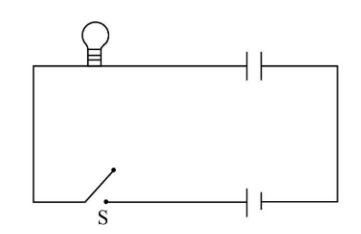
(1) The bulb will light up for some time interval after the capacitor starts charging
(2) The bulb will light up when the capacitor is fully charged
(3) The bulb will not light up at all
(4) The bulb will light up and go off at regular intervals
Answer
 Verified
588.6k+ views
Hint:Capacitor is a device that is used to store electric charge, and it supplies back the charge to the circuit whenever required. The capacitor does not allow current to pass through it, which means the current flow at the fully charged condition of a capacitor is zero.
Complete step by step answer:
It is given that initially, switch S is open, which means the circuit is not complete as a result of which there will be no current flow.
When switch S is closed, the given circuit is completed, the current starts flowing by the flow of charge from the negative terminal to the positive terminal. Initially, the current flowing through the capacitor is charging the capacitor due to current being passed through it, and the bulb will start glowing. But after some time, the capacitor will be fully charged, and we know that flow of current through a fully charged capacitor is zero. This means that now the capacitor will not allow current to pass through it; due to this, no current will reach the bulb, and hence bulb will not glow.
Therefore, based on the above explanation, we can say that the bulb will light up for some time interval after the capacitor starts charging when switch S is closed, and option (1) is correct.
Note: The capacity of a capacitor to store charge is termed as its capacitance and measured in Farad. The capacitor has an insulating layer that does not allow direct current to pass through it, allowing alternating current to pass through it with no resistance.
Complete step by step answer:
It is given that initially, switch S is open, which means the circuit is not complete as a result of which there will be no current flow.
When switch S is closed, the given circuit is completed, the current starts flowing by the flow of charge from the negative terminal to the positive terminal. Initially, the current flowing through the capacitor is charging the capacitor due to current being passed through it, and the bulb will start glowing. But after some time, the capacitor will be fully charged, and we know that flow of current through a fully charged capacitor is zero. This means that now the capacitor will not allow current to pass through it; due to this, no current will reach the bulb, and hence bulb will not glow.
Therefore, based on the above explanation, we can say that the bulb will light up for some time interval after the capacitor starts charging when switch S is closed, and option (1) is correct.
Note: The capacity of a capacitor to store charge is termed as its capacitance and measured in Farad. The capacitor has an insulating layer that does not allow direct current to pass through it, allowing alternating current to pass through it with no resistance.
Recently Updated Pages
Basicity of sulphurous acid and sulphuric acid are

Master Class 10 English: Engaging Questions & Answers for Success
Master Class 10 Social Science: Engaging Questions & Answers for Success
Master Class 10 Computer Science: Engaging Questions & Answers for Success
Class 10 Question and Answer - Your Ultimate Solutions Guide
Master Class 10 General Knowledge: Engaging Questions & Answers for Success
Trending doubts
Who is known as the "Little Master" in Indian cricket history?
A boat goes 24 km upstream and 28 km downstream in class 10 maths CBSE
Who Won 36 Oscar Awards? Record Holder Revealed
Why is there a time difference of about 5 hours between class 10 social science CBSE
Explain the Treaty of Vienna of 1815 class 10 social science CBSE
What is the median of the first 10 natural numbers class 10 maths CBSE