




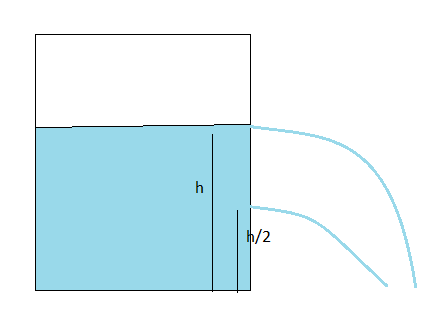
A large tank filled with water to a height $h$ is to be emptied through a small hole at the bottom. The ratio of time taken for the level of water to fall from $h$ to $\dfrac{h}{2}$ and from $\dfrac{h}{2}$ to $0$ is
A.$\sqrt 2 $
B.$\dfrac{1}{{\sqrt 2 }}$
C.$\sqrt 2 - 1$
D.$\dfrac{1}{{\sqrt 2 - 1}}$
Answer
 Verified
564.9k+ views
Hint: Torricelli’s theorem states that the velocity v of a fluid flowing through a small hole at the bottom of a tank filled to a depth will have the same speed just like a body falling freely from a height $h$.
Using Torricelli’s theorem we can derive the relation for time and height and in general, for a cylindrical container, time to empty a tank is directly proportional to the difference of square root of initial height and the square root of final height.
Formula Used:
The ratio of time taken for the level of water to fall from a height $h$ to $\dfrac{h}{2}$ and from $\dfrac{h}{2}$ to $0$
is given as
$\dfrac{{{t_1}}}{{{t_2}}} = \dfrac{{\sqrt h - \sqrt {\dfrac{h}{2}} }}{{\sqrt {\dfrac{h}{2}} }} \ldots ..\left( {\because t \propto \sqrt {{h_1}} - \sqrt {{h_2}} } \right)$
Complete answer:
Given that,
Case I:
Initial height, \[{h_1} = {\text{ }}h\]
Final height, \[{h_2} = \dfrac{h}{2}\]
Case II:
Initial height, \[h{'_1} = \dfrac{h}{2}\]
Final height, \[h{'_2} = {\text{ }}0\]
Now according to Torricelli’s theorem, the velocity of water through a small hole is given as
$v = \sqrt {2gh} $
$\therefore \dfrac{{dh}}{{dt}} = \sqrt {2gh} $
By integrating this we get
$t = \mathop \smallint \nolimits_0^h \dfrac{{dh}}{{\sqrt {2gh} }}$
$t\; = \;\sqrt {\dfrac{{2h}}{g}} $
This equation represents the time of flight.
Using this we can derive the relation for the level of water to fall from height $\dfrac{h}{2}$ to $0$
i.e., ${t_1} = \sqrt {\dfrac{2}{g}} \left( {\sqrt {\left( {{h_1}} \right)} - \sqrt {\left( {{h_2}} \right)} \;} \right) = \sqrt {\dfrac{2}{g}} \left( {\sqrt {\left( h \right)} - \sqrt {\left( {\dfrac{h}{2}} \right)} \;} \right)$…… (1)
Similarly, for case II, we get
${t_2} = \sqrt {\dfrac{2}{g}} \left( {\sqrt {\left( {h{'_1}} \right)} - \sqrt {\left( {h{'_2}} \right)} \;} \right) = \sqrt {\dfrac{2}{g}} \left( {\sqrt {\left( {\dfrac{h}{2}} \right)} - \sqrt {\left( 0 \right)} \;} \right)$……(2)
By dividing equations 1 and 2 we get
$\dfrac{{{t_1}}}{{{t_2}}} = \dfrac{{\sqrt {\dfrac{2}{g}} \left( {\sqrt {\left( h \right)} - \sqrt {\left( {\dfrac{h}{2}} \right)} \;} \right){\text{}}}}{{\sqrt {\dfrac{2}{g}} \left( {\sqrt {\left( {\dfrac{h}{2}} \right)} \;} \right)}} = \dfrac{{\sqrt 1 - \sqrt {\left( {\dfrac{1}{2}} \right)} }}{{\sqrt {\left( {\dfrac{1}{2}} \right)} }}$
$\dfrac{{{t_1}}}{{{t_2}}} = \dfrac{{\left( {\dfrac{{\sqrt 2 - 1}}{{\sqrt 2 }}} \right)}}{{1/\sqrt 2 }} = \sqrt 2 - 1$
Therefore, Option (C) is correct.
Note:
For this problem, we must note that Torricelli’s theorem and Bernoulli’s principle are only applicable for incompressible and non-viscous fluids like water.
Torricelli’s theorem is a special case of Bernoulli’s principle which states that the sum of kinetic energy, pressure energy, and potential energy per unit volume of an incompressible, non-viscous fluid moving in a streamlined irrotational flow will remain constant along a streamline.
Using Torricelli’s theorem we can derive the relation for time and height and in general, for a cylindrical container, time to empty a tank is directly proportional to the difference of square root of initial height and the square root of final height.
Formula Used:
The ratio of time taken for the level of water to fall from a height $h$ to $\dfrac{h}{2}$ and from $\dfrac{h}{2}$ to $0$
is given as
$\dfrac{{{t_1}}}{{{t_2}}} = \dfrac{{\sqrt h - \sqrt {\dfrac{h}{2}} }}{{\sqrt {\dfrac{h}{2}} }} \ldots ..\left( {\because t \propto \sqrt {{h_1}} - \sqrt {{h_2}} } \right)$
Complete answer:
Given that,
Case I:
Initial height, \[{h_1} = {\text{ }}h\]
Final height, \[{h_2} = \dfrac{h}{2}\]
Case II:
Initial height, \[h{'_1} = \dfrac{h}{2}\]
Final height, \[h{'_2} = {\text{ }}0\]
Now according to Torricelli’s theorem, the velocity of water through a small hole is given as
$v = \sqrt {2gh} $
$\therefore \dfrac{{dh}}{{dt}} = \sqrt {2gh} $
By integrating this we get
$t = \mathop \smallint \nolimits_0^h \dfrac{{dh}}{{\sqrt {2gh} }}$
$t\; = \;\sqrt {\dfrac{{2h}}{g}} $
This equation represents the time of flight.
Using this we can derive the relation for the level of water to fall from height $\dfrac{h}{2}$ to $0$
i.e., ${t_1} = \sqrt {\dfrac{2}{g}} \left( {\sqrt {\left( {{h_1}} \right)} - \sqrt {\left( {{h_2}} \right)} \;} \right) = \sqrt {\dfrac{2}{g}} \left( {\sqrt {\left( h \right)} - \sqrt {\left( {\dfrac{h}{2}} \right)} \;} \right)$…… (1)
Similarly, for case II, we get
${t_2} = \sqrt {\dfrac{2}{g}} \left( {\sqrt {\left( {h{'_1}} \right)} - \sqrt {\left( {h{'_2}} \right)} \;} \right) = \sqrt {\dfrac{2}{g}} \left( {\sqrt {\left( {\dfrac{h}{2}} \right)} - \sqrt {\left( 0 \right)} \;} \right)$……(2)
By dividing equations 1 and 2 we get
$\dfrac{{{t_1}}}{{{t_2}}} = \dfrac{{\sqrt {\dfrac{2}{g}} \left( {\sqrt {\left( h \right)} - \sqrt {\left( {\dfrac{h}{2}} \right)} \;} \right){\text{}}}}{{\sqrt {\dfrac{2}{g}} \left( {\sqrt {\left( {\dfrac{h}{2}} \right)} \;} \right)}} = \dfrac{{\sqrt 1 - \sqrt {\left( {\dfrac{1}{2}} \right)} }}{{\sqrt {\left( {\dfrac{1}{2}} \right)} }}$
$\dfrac{{{t_1}}}{{{t_2}}} = \dfrac{{\left( {\dfrac{{\sqrt 2 - 1}}{{\sqrt 2 }}} \right)}}{{1/\sqrt 2 }} = \sqrt 2 - 1$
Therefore, Option (C) is correct.
Note:
For this problem, we must note that Torricelli’s theorem and Bernoulli’s principle are only applicable for incompressible and non-viscous fluids like water.
Torricelli’s theorem is a special case of Bernoulli’s principle which states that the sum of kinetic energy, pressure energy, and potential energy per unit volume of an incompressible, non-viscous fluid moving in a streamlined irrotational flow will remain constant along a streamline.
Recently Updated Pages
If x a + bt + ct2 where x is in meters and t is in class 11 physics CBSE

A car covers the first half distance between two places class 11 physics CBSE
The resultant of two vectors overrightarrow P and overrightarrow class 11 physics CBSE
Find the value of cos 135 class 11 maths CBSE
A mass M is held in place by an applied force F and class 11 physics CBSE
A solution of glucose in water is labelled as 10 dfracwv class 11 chemistry CBSE
Trending doubts
One Metric ton is equal to kg A 10000 B 1000 C 100 class 11 physics CBSE
Find the value of the expression given below sin 30circ class 11 maths CBSE
What do you mean by retardation What is its SI uni class 11 physics CBSE
Draw a diagram of nephron and explain its structur class 11 biology CBSE
10 examples of friction in our daily life
Difference between physical and chemical change class 11 chemistry CBSE