




A ladder of \['x'\] meters long is laid against a wall making an angle \['\theta '\] with the ground. If we want to directly find the distance between the foot of ladder and the foot of the wall, which trigonometric ratio should be considered?
(a) \[\sin \theta \]
(b) \[\cos \theta \]
(c) \[\tan \theta \]
(d) \[\cot \theta \]
Answer
 Verified
577.2k+ views
Hint: We solve this problem first by diagram as shown below.
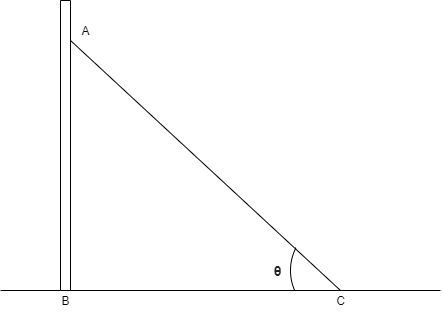
Now, we use the formulas of trigonometric ratios to find which trigonometric ratio is suitable for directly finding the value of ‘BC’ using the value of ‘AC’. The formulas of trigonometric ratios are
\[\cos \theta =\dfrac{\text{adjacent side}}{\text{hypotenuse}}\]
\[\sin \theta =\dfrac{\text{opposite side}}{\text{hypotenuse}}\]
\[\tan \theta =\dfrac{\text{opposite side}}{\text{adjacent side}}\]
\[\cot \theta =\dfrac{\text{adjacent side}}{\text{opposite side}}\]
Complete step by step answer:
We are given the height of the ladder as \['x'\] meters.
Here, we can take the height of ladder from the figure as
\[\Rightarrow AC=x\]
We are asked to find the trigonometric ratio that is suitable for directly measuring the length ‘BC’.
Now, let us go one by one trigonometric ratios.
We know that the formula of trigonometric ratio \[\cos \theta \] is given as
\[\cos \theta =\dfrac{\text{adjacent side}}{\text{hypotenuse}}\]
By using the formula for the figure shown above we get
\[\begin{align}
& \Rightarrow \cos \theta =\dfrac{BC}{AC} \\
& \Rightarrow BC=AC.\cos \theta \\
\end{align}\]
Here, we can see that the length of ‘BC’ is calculated directly. So, we can say that \[\cos \theta \] is suitable.
Similarly let us go for \[\sin \theta \].
We know that the formula of trigonometric ratio \[\sin \theta \] is given as
\[\sin \theta =\dfrac{\text{opposite side}}{\text{hypotenuse}}\]
By using the formula for the figure shown above we get
\[\begin{align}
& \Rightarrow \sin \theta =\dfrac{AB}{AC} \\
& \Rightarrow AB=AC.\sin \theta \\
\end{align}\]
Here, we can see that the length of ‘BC’ cannot be calculated directly. So, we can say that \[\sin \theta \] is not suitable.
Similarly let us go for \[\tan \theta \].
We know that the formula of trigonometric ratio \[\sin \theta \] is given as
\[\tan \theta =\dfrac{\text{opposite side}}{\text{adjacent side}}\]
By using the formula for the figure shown above we get
\[\Rightarrow \tan \theta =\dfrac{AB}{BC}\]
Here, we can see that the length of ‘BC’ cannot be calculated directly. So, we can say that \[\tan \theta \] is not suitable.
Similarly let us go for \[\cot \theta \].
We know that the formula of trigonometric ratio \[\sin \theta \] is given as
\[\cot \theta =\dfrac{\text{adjacent side}}{\text{opposite side}}\]
By using the formula for the figure shown above we get
\[\Rightarrow \cot \theta =\dfrac{BC}{AB}\]
Here, we can see that the length of ‘BC’ cannot be calculated directly. So, we can say that \[\cot \theta \] is not suitable.
Therefore, we can conclude that the suitable trigonometric ratio is \[\cos \theta \].
So, the correct answer is “Option b”.
Note: Students may make mistakes in giving the answer. We need to find the suitable trigonometric ratio so that we can calculate the length ‘BC’ directly which means there should be no need for other length to be found to get length of ‘BC’. Here, all trigonometric ratios can lead to answers but other than \[\cos \theta \] remaining ratios need some other length to be found to get the length of ‘BC’ which is not required. So, the answer is only \[\cos \theta \]. This part needs to be taken care of.
Now, we use the formulas of trigonometric ratios to find which trigonometric ratio is suitable for directly finding the value of ‘BC’ using the value of ‘AC’. The formulas of trigonometric ratios are
\[\cos \theta =\dfrac{\text{adjacent side}}{\text{hypotenuse}}\]
\[\sin \theta =\dfrac{\text{opposite side}}{\text{hypotenuse}}\]
\[\tan \theta =\dfrac{\text{opposite side}}{\text{adjacent side}}\]
\[\cot \theta =\dfrac{\text{adjacent side}}{\text{opposite side}}\]
Complete step by step answer:
We are given the height of the ladder as \['x'\] meters.
Here, we can take the height of ladder from the figure as
\[\Rightarrow AC=x\]
We are asked to find the trigonometric ratio that is suitable for directly measuring the length ‘BC’.
Now, let us go one by one trigonometric ratios.
We know that the formula of trigonometric ratio \[\cos \theta \] is given as
\[\cos \theta =\dfrac{\text{adjacent side}}{\text{hypotenuse}}\]
By using the formula for the figure shown above we get
\[\begin{align}
& \Rightarrow \cos \theta =\dfrac{BC}{AC} \\
& \Rightarrow BC=AC.\cos \theta \\
\end{align}\]
Here, we can see that the length of ‘BC’ is calculated directly. So, we can say that \[\cos \theta \] is suitable.
Similarly let us go for \[\sin \theta \].
We know that the formula of trigonometric ratio \[\sin \theta \] is given as
\[\sin \theta =\dfrac{\text{opposite side}}{\text{hypotenuse}}\]
By using the formula for the figure shown above we get
\[\begin{align}
& \Rightarrow \sin \theta =\dfrac{AB}{AC} \\
& \Rightarrow AB=AC.\sin \theta \\
\end{align}\]
Here, we can see that the length of ‘BC’ cannot be calculated directly. So, we can say that \[\sin \theta \] is not suitable.
Similarly let us go for \[\tan \theta \].
We know that the formula of trigonometric ratio \[\sin \theta \] is given as
\[\tan \theta =\dfrac{\text{opposite side}}{\text{adjacent side}}\]
By using the formula for the figure shown above we get
\[\Rightarrow \tan \theta =\dfrac{AB}{BC}\]
Here, we can see that the length of ‘BC’ cannot be calculated directly. So, we can say that \[\tan \theta \] is not suitable.
Similarly let us go for \[\cot \theta \].
We know that the formula of trigonometric ratio \[\sin \theta \] is given as
\[\cot \theta =\dfrac{\text{adjacent side}}{\text{opposite side}}\]
By using the formula for the figure shown above we get
\[\Rightarrow \cot \theta =\dfrac{BC}{AB}\]
Here, we can see that the length of ‘BC’ cannot be calculated directly. So, we can say that \[\cot \theta \] is not suitable.
Therefore, we can conclude that the suitable trigonometric ratio is \[\cos \theta \].
So, the correct answer is “Option b”.
Note: Students may make mistakes in giving the answer. We need to find the suitable trigonometric ratio so that we can calculate the length ‘BC’ directly which means there should be no need for other length to be found to get length of ‘BC’. Here, all trigonometric ratios can lead to answers but other than \[\cos \theta \] remaining ratios need some other length to be found to get the length of ‘BC’ which is not required. So, the answer is only \[\cos \theta \]. This part needs to be taken care of.
Recently Updated Pages
Master Class 10 Computer Science: Engaging Questions & Answers for Success

Master Class 10 General Knowledge: Engaging Questions & Answers for Success
Master Class 10 English: Engaging Questions & Answers for Success
Master Class 10 Social Science: Engaging Questions & Answers for Success
Master Class 10 Maths: Engaging Questions & Answers for Success
Master Class 10 Science: Engaging Questions & Answers for Success
Trending doubts
What is the median of the first 10 natural numbers class 10 maths CBSE
Which women's tennis player has 24 Grand Slam singles titles?
Who is the Brand Ambassador of Incredible India?
Why is there a time difference of about 5 hours between class 10 social science CBSE
Write a letter to the principal requesting him to grant class 10 english CBSE
State and prove converse of BPT Basic Proportionality class 10 maths CBSE