




A ladder $9{\text{m}}$ long reaches a point $9{\text{m}}$ below the top of a vertical flagstaff. From the foot of the ladder, the elevation of the flagstaff is ${60^ \circ }$. What is the height of the flagstaff?
A.$9{\text{m}}$
B.$10.5{\text{m}}$
C.$13.5{\text{m}}$
D.$15{\text{m}}$
Answer
 Verified
594k+ views
Hint: Here, the total length of the flagstaff (BC) will be the sum of the length from the top of the flagstaff to the point $9{\text{m}}$ below the top of a vertical flagstaff (DC) and the length below this point (BD). So here since the angle of elevation is bisected by the ladder in half then $\angle BAD = {30^ \circ }$. Then use the sine ratio $\sin \theta = \dfrac{P}{H}$ where P is perpendicular and H is hypotenuse in triangle ABD to find the value of BD and then add it to CD to get the answer.
Complete step-by-step answer:
Let AD be the ladder whose length=$9{\text{m}}$ and it reaches at point D which is $9{\text{m}}$below the top of a vertical flagstaff BC. It is given that $\angle BAC = {60^ \circ }$ which means $\angle BAD = \angle CAD = {30^ \circ }$
We have to find BC. Let BD=h cm so we can say that BC=BC+DC-- (i)
Now we have to find BD.
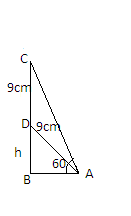
In triangle ABD, $\sin \theta = \dfrac{{BD}}{{AD}}$ because we know that $\sin \theta = \dfrac{P}{H}$ where P is perpendicular and H is hypotenuse.
On putting the given values, we get-
$ \Rightarrow \sin {30^ \circ } = \dfrac{h}{9}$
We know that $\sin {30^ \circ } = \dfrac{1}{2}$
So on putting this value, we get-
$ \Rightarrow \dfrac{1}{2} = \dfrac{h}{9}$
On rearranging, we get-
$ \Rightarrow h = \dfrac{9}{2} = 4.5$m
On putting this value and value of CD in eq. (i), we get-
$ \Rightarrow $ BC=$4.5 + 9 = 13.5$ m
The correct answer is option C.
Note: Here, in triangle ABD we have not taken the angle as $\cos \theta $ or $\tan \theta $ because in both their ratios the base comes in the denominator, and in triangle ABD, we do not know the value of the base AB.
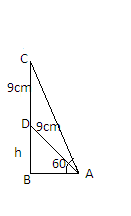
Here $\cos \theta = \dfrac{B}{H} = \dfrac{{AB}}{{AD}}$ but here we do not know the value of AB and we have to find BC which cannot be found using this.
When we are solving such a question, we always use the angle which can be used to find the unknown value using the known value like- here in the question, we have used the known value (AD) to get the value of BD.
Complete step-by-step answer:
Let AD be the ladder whose length=$9{\text{m}}$ and it reaches at point D which is $9{\text{m}}$below the top of a vertical flagstaff BC. It is given that $\angle BAC = {60^ \circ }$ which means $\angle BAD = \angle CAD = {30^ \circ }$
We have to find BC. Let BD=h cm so we can say that BC=BC+DC-- (i)
Now we have to find BD.
In triangle ABD, $\sin \theta = \dfrac{{BD}}{{AD}}$ because we know that $\sin \theta = \dfrac{P}{H}$ where P is perpendicular and H is hypotenuse.
On putting the given values, we get-
$ \Rightarrow \sin {30^ \circ } = \dfrac{h}{9}$
We know that $\sin {30^ \circ } = \dfrac{1}{2}$
So on putting this value, we get-
$ \Rightarrow \dfrac{1}{2} = \dfrac{h}{9}$
On rearranging, we get-
$ \Rightarrow h = \dfrac{9}{2} = 4.5$m
On putting this value and value of CD in eq. (i), we get-
$ \Rightarrow $ BC=$4.5 + 9 = 13.5$ m
The correct answer is option C.
Note: Here, in triangle ABD we have not taken the angle as $\cos \theta $ or $\tan \theta $ because in both their ratios the base comes in the denominator, and in triangle ABD, we do not know the value of the base AB.
Here $\cos \theta = \dfrac{B}{H} = \dfrac{{AB}}{{AD}}$ but here we do not know the value of AB and we have to find BC which cannot be found using this.
When we are solving such a question, we always use the angle which can be used to find the unknown value using the known value like- here in the question, we have used the known value (AD) to get the value of BD.
Recently Updated Pages
Master Class 12 Business Studies: Engaging Questions & Answers for Success

Master Class 12 Biology: Engaging Questions & Answers for Success
Master Class 12 Chemistry: Engaging Questions & Answers for Success
Class 12 Question and Answer - Your Ultimate Solutions Guide
Master Class 11 Social Science: Engaging Questions & Answers for Success
Master Class 11 English: Engaging Questions & Answers for Success
Trending doubts
Explain the Treaty of Vienna of 1815 class 10 social science CBSE
Who Won 36 Oscar Awards? Record Holder Revealed
What is the median of the first 10 natural numbers class 10 maths CBSE
Why is it 530 pm in india when it is 1200 afternoon class 10 social science CBSE
Why is there a time difference of about 5 hours between class 10 social science CBSE
What is the full form of POSCO class 10 social science CBSE