




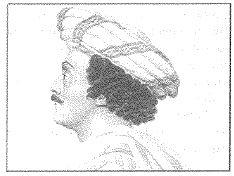
(a) Identify the person in the given picture and name the organisation formed by him.
(b) Mention his contribution to the growth of Indian National movement.
(c) How did the socio-religious reform movements of the 19th century act as pioneers of Indian Nationalism?
Answer
 Verified
531k+ views
Hint: This person was one of the founders of the Brahmo Sabha, the forerunner of the Brahmo Samaj, an Indian subcontinent social-religious reform movement. The Mughal emperor Akbar II bestowed the title of Raja upon him.
Complete answer:
a) Raja Rammohan Roy is the individual in the picture. He established the Brahmo Sabha in 1828, which later became the Brahmo Samaj.
b) He created the Brahmo Samaj, which rejected idol worship and emphasised prayer, reflection, morality, and strengthening the ties of unity among men of all faiths and creeds. He was a solution to the caste system's rigidity. He expressed his displeasure with limits on press rights.
c) The 19th-century social and religious reform movements were significant for the growth of Indian nationalism. The influence of western education, which resulted in a logical, humanitarian, and scientific approach to life, convinced educated Indians of the need to change their religion and culture. Almost every section of Indian society was affected by these revolutions. These campaigns aimed to abolish caste, child marriage, dowry, purdah, sati, and infanticide in the social sphere. These reform efforts fought social superstitions, idolatry, polytheism, and hereditary priesthood in the religious sphere. Human liberty and social inclusion were struggled for in these protests.
Note: Brahmo Samaj (founded by Raja Rammohan Roy), Arya Samaj (founded by Swami Dayanand Saraswati), Ramakrishna Mission (founded by Swami Vivekanand), and Satya Shodhak Samaj (founded by Jyotiba Phule) were all important reform movements.
Complete answer:
a) Raja Rammohan Roy is the individual in the picture. He established the Brahmo Sabha in 1828, which later became the Brahmo Samaj.
b) He created the Brahmo Samaj, which rejected idol worship and emphasised prayer, reflection, morality, and strengthening the ties of unity among men of all faiths and creeds. He was a solution to the caste system's rigidity. He expressed his displeasure with limits on press rights.
c) The 19th-century social and religious reform movements were significant for the growth of Indian nationalism. The influence of western education, which resulted in a logical, humanitarian, and scientific approach to life, convinced educated Indians of the need to change their religion and culture. Almost every section of Indian society was affected by these revolutions. These campaigns aimed to abolish caste, child marriage, dowry, purdah, sati, and infanticide in the social sphere. These reform efforts fought social superstitions, idolatry, polytheism, and hereditary priesthood in the religious sphere. Human liberty and social inclusion were struggled for in these protests.
Note: Brahmo Samaj (founded by Raja Rammohan Roy), Arya Samaj (founded by Swami Dayanand Saraswati), Ramakrishna Mission (founded by Swami Vivekanand), and Satya Shodhak Samaj (founded by Jyotiba Phule) were all important reform movements.

Recently Updated Pages
Master Class 6 Maths: Engaging Questions & Answers for Success

Master Class 6 English: Engaging Questions & Answers for Success
Master Class 6 Science: Engaging Questions & Answers for Success
Class 6 Question and Answer - Your Ultimate Solutions Guide
Master Class 6 Social Science: Engaging Questions & Answers for Success
Master Class 9 General Knowledge: Engaging Questions & Answers for Success
Trending doubts
Give 10 examples for herbs , shrubs , climbers , creepers
How many millions make a billion class 6 maths CBSE
What is the capital city of Australia? A) Sydney B) Melbourne C) Brisbane D) Canberra
What is the shape of Earth A Circle B Square C Sphere class 6 social science CBSE
The planet nearest to earth is A Mercury B Venus C class 6 social science CBSE
What are the main physical divisions of India class 6 social science CBSE