




A hot-air balloon consists of a basket, one passenger, and some cargo. Let the total mass be M. even though there is an upward lift force on the balloon, the balloon is initially accelerating downwards at a rate of g/3. Find the upward lift force in terms of the initial total weight Mg.
(A) 2Mg/3
(B) 3Mg/3
(C) 4Mg/3
(D) 5Mg/3
Answer
 Verified
591.3k+ views
Hint:Balloon of total mass M when in air, the downward force Mg acts due to its weight. From Newton's third law, every reaction has an equal and opposite reaction. So, there will be an upward force or lift force on the balloon. So, lift force = Mg, when the balloon is at rest but when the balloon is in motion then, $\sum\limits_{}^{} {F = Ma} $.
Complete step by step answer:
The Free body diagram of the problem is shown in fig 1
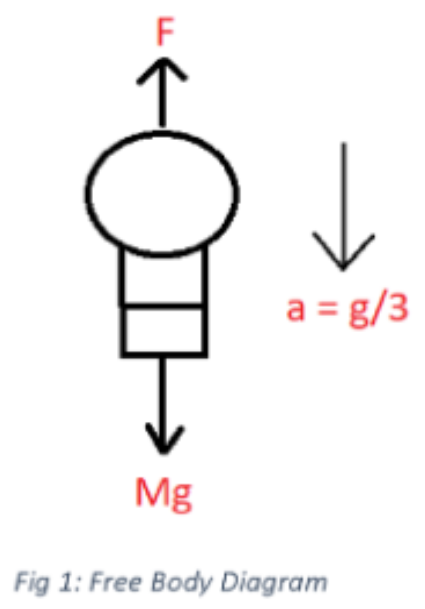
Let, upward lift force be F.
Motion of the balloon is downwards with a = g/3
So, $\sum\limits_{}^{} {{F_y} = Ma} $
$
Mg - F = Ma \\
\Rightarrow F = M(g - a) \\
\Rightarrow F = M(g - \dfrac{g}{3}) \\
\therefore F = \dfrac{{2Mg}}{3} \\
$
So, upward lift force,\[F = \dfrac{{2Mg}}{3}\]. Thus,the correct answer is (A).
Additional information:
If motion of the balloon is upwards with an acceleration a then, $\sum\limits_{}^{} {{F_y} = Ma} $
$
F - Mg = Ma \\
\Rightarrow F = M(g + a) \\
$
Then uplift force will become $M(g + a)$.
Note:Remember that according to Newton’s law, the net force acting on a body is always equal to the net mass of the body into the acceleration of the body. Also apply the sign convention according to the direction of motion of a body.
Complete step by step answer:
The Free body diagram of the problem is shown in fig 1
Let, upward lift force be F.
Motion of the balloon is downwards with a = g/3
So, $\sum\limits_{}^{} {{F_y} = Ma} $
$
Mg - F = Ma \\
\Rightarrow F = M(g - a) \\
\Rightarrow F = M(g - \dfrac{g}{3}) \\
\therefore F = \dfrac{{2Mg}}{3} \\
$
So, upward lift force,\[F = \dfrac{{2Mg}}{3}\]. Thus,the correct answer is (A).
Additional information:
If motion of the balloon is upwards with an acceleration a then, $\sum\limits_{}^{} {{F_y} = Ma} $
$
F - Mg = Ma \\
\Rightarrow F = M(g + a) \\
$
Then uplift force will become $M(g + a)$.
Note:Remember that according to Newton’s law, the net force acting on a body is always equal to the net mass of the body into the acceleration of the body. Also apply the sign convention according to the direction of motion of a body.
Recently Updated Pages
Basicity of sulphurous acid and sulphuric acid are

Master Class 11 Business Studies: Engaging Questions & Answers for Success
Master Class 11 Computer Science: Engaging Questions & Answers for Success
Master Class 11 Economics: Engaging Questions & Answers for Success
Master Class 11 Social Science: Engaging Questions & Answers for Success
Master Class 11 English: Engaging Questions & Answers for Success
Trending doubts
One Metric ton is equal to kg A 10000 B 1000 C 100 class 11 physics CBSE
The largest wind power cluster is located in the state class 11 social science CBSE
Explain zero factorial class 11 maths CBSE
State and prove Bernoullis theorem class 11 physics CBSE
What steps did the French revolutionaries take to create class 11 social science CBSE
Which among the following are examples of coming together class 11 social science CBSE