




A horizontal straight wire 10 m long extending from east to west is falling with a speed of $5.0\; ms^{-1}$, at right angles to the horizontal component of the earth’s magnetic field $0.30\times 10^{-4}\; WBm^{-2}$.
A.)What is the instantaneous value of the emf induced in the wire?
B.)What is the direction of the emf?
C.)Which end of the wire is at the higher electric potential?
Answer
 Verified
547k+ views
Hint: When the wire will be falling, we will be able to observe emf getting induced in the wire due to the horizontal component of the earth’s magnetic field. This emf induced can be calculated using the formula $e=Blvsin\theta$, where $e$ is the emf induced, B is the magnetic field, $l$ is the length of straight conductor, $v$ is its velocity and $\theta$ is the angle velocity vector makes with the direction of the magnetic field.
Once we successfully find the emf induced, we can use Fleming's right hand rule to find out the direction of current and the side having higher potential.
Complete step by step solution:
It has been given that the wire of length, $l=10\;m$ extending from east to west is falling with a speed, $v=5\;ms^{-1}$ at right angles to the earth’s magnetic field, $B=0.30\times 10^{-4}\;WBm^{-2}$. We can demonstrate the given situation with the help of following figure,
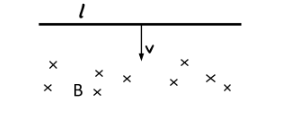
A.)Now, we can find the emf induced in the wire using the formula, $e=Blvsin\theta$, where $e$ is the emf induced, B is the magnetic field, $l$ is the length of straight conductor, $v$ is its velocity and $\theta$ is the angle velocity vector makes with the direction of the magnetic field.
Putting the values in the formula, and taking $\theta=90^{\circ}$ as it is given that the wire is falling at right angles to the magnetic field.
we get, $e=0.30\times 10^{-4}\times 10\times 5\; sin90^{\circ}=15\times 10^{-4}$ volts
Hence, the emf induced is $15\times 10^{-4}$ volts.
B.)We now have to find out the direction of the emf induced and for that we will use the Fleming’s right hand rule in which whenever a conductor is moved into an electromagnetic field, an emf is induced across the conductor and all can be illustrated using the right hand’s finger where the thumb denotes the motion, fore finger the magnetic field and middle finger denotes the current induced all mutually perpendicular to each other. The conditions here can be illustrated as follows,
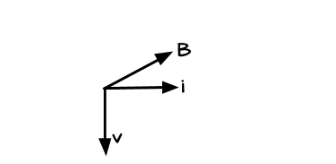
The direction of the magnetic field is into the plane, and the velocity vector is towards south, so we can clearly see that the direction of current or the emf induced will be from west to east.
Hence the direction of emf is from west to east.
C.)Since, we have already found out the direction of current, which is flowing from west to east. We also know that current always flows from higher potential difference towards lower potential difference. So, the west side of the wire will have higher potential difference.
Hence the west end of wire is at higher potential.
Note:
One must have a proper knowledge and implementation of Fleming’s right hand rule, the basics of current flow and knowledge of Faraday’s law. The point where we are likely to commit mistakes is in understanding the angle between the velocity vector and the direction of the magnetic field.
Once we successfully find the emf induced, we can use Fleming's right hand rule to find out the direction of current and the side having higher potential.
Complete step by step solution:
It has been given that the wire of length, $l=10\;m$ extending from east to west is falling with a speed, $v=5\;ms^{-1}$ at right angles to the earth’s magnetic field, $B=0.30\times 10^{-4}\;WBm^{-2}$. We can demonstrate the given situation with the help of following figure,
A.)Now, we can find the emf induced in the wire using the formula, $e=Blvsin\theta$, where $e$ is the emf induced, B is the magnetic field, $l$ is the length of straight conductor, $v$ is its velocity and $\theta$ is the angle velocity vector makes with the direction of the magnetic field.
Putting the values in the formula, and taking $\theta=90^{\circ}$ as it is given that the wire is falling at right angles to the magnetic field.
we get, $e=0.30\times 10^{-4}\times 10\times 5\; sin90^{\circ}=15\times 10^{-4}$ volts
Hence, the emf induced is $15\times 10^{-4}$ volts.
B.)We now have to find out the direction of the emf induced and for that we will use the Fleming’s right hand rule in which whenever a conductor is moved into an electromagnetic field, an emf is induced across the conductor and all can be illustrated using the right hand’s finger where the thumb denotes the motion, fore finger the magnetic field and middle finger denotes the current induced all mutually perpendicular to each other. The conditions here can be illustrated as follows,
The direction of the magnetic field is into the plane, and the velocity vector is towards south, so we can clearly see that the direction of current or the emf induced will be from west to east.
Hence the direction of emf is from west to east.
C.)Since, we have already found out the direction of current, which is flowing from west to east. We also know that current always flows from higher potential difference towards lower potential difference. So, the west side of the wire will have higher potential difference.
Hence the west end of wire is at higher potential.
Note:
One must have a proper knowledge and implementation of Fleming’s right hand rule, the basics of current flow and knowledge of Faraday’s law. The point where we are likely to commit mistakes is in understanding the angle between the velocity vector and the direction of the magnetic field.
Recently Updated Pages
Master Class 12 Business Studies: Engaging Questions & Answers for Success

Master Class 12 Biology: Engaging Questions & Answers for Success
Master Class 12 Chemistry: Engaging Questions & Answers for Success
Class 12 Question and Answer - Your Ultimate Solutions Guide
Master Class 11 Social Science: Engaging Questions & Answers for Success
Master Class 11 English: Engaging Questions & Answers for Success
Trending doubts
Which are the Top 10 Largest Countries of the World?
Draw a labelled sketch of the human eye class 12 physics CBSE
Name the crygenes that control cotton bollworm and class 12 biology CBSE
Differentiate between homogeneous and heterogeneous class 12 chemistry CBSE
Ribosomal RNA is actively synthesised in A Nucleoplasm class 12 biology CBSE
How many molecules of ATP and NADPH are required information class 12 biology CBSE