




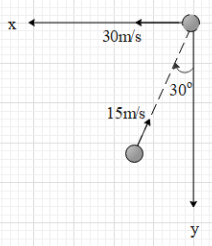
A hockey player receives a corner shot a speed of $15m{{s}^{-1}}$ at angle ${{30}^{\circ }}$ with y-axis and then shoots the ball along x-axis with the speed $30m{{s}^{-1}}$, if the mass of the ball is 150g and it remains in contact with the hockey stick for 0.01s, the force exerted on the ball along x-axis is:
A. 281 N
B. 187.5 N
C. 562.5 N
D. 375 N
Answer
 Verified
569.7k+ views
Hint:Force is defined as the change momentum of a body power time. Calculate the initial and final momentums of the ball along the x-axis. Then calculate the change in momentum of the ball along the x-axis. Later, divide the change in momentum by the time for which the ball is in contact.
Formula used:
$F=\dfrac{\Delta P}{t}$,
where F is the applied force on the body for time t, $\Delta P$ is the change in momentum of the body.
$P=mu$,
where P is the momentum of a body of mass m and moving with velocity u.
Complete step by step answer:
Force is defined as the change in momentum of a body power time. If the momentum of a body changes by $\Delta P$ in time t, then the force applied on it for time t is given as $F=\dfrac{\Delta P}{t}$
$F=\dfrac{\Delta P}{t}$ ….. (i)
It is sad that we are supposed to find the force exerted on the ball along the x-axis.
Let us find the initial momentum of the ball along the x-axis. It is given that the mass of the ball is $m=150g=0.15kg$ and its initial velocity is$15m{{s}^{-1}}$. We can see in the figure that this velocity makes an angle of ${{60}^{\circ }}$ with the x-axis. Therefore, the initial velocity of the ball along x-axis is,
${{u}_{x}}=15\cos {{60}^{\circ }}\\
\Rightarrow{{u}_{x}} =15\times \dfrac{1}{2}\\
\Rightarrow{{u}_{x}} =7.5m{{s}^{-1}}$.
But we see that the velocity is along the negative x-axis.
${{u}_{x}}=-7.5m{{s}^{-1}}$
This means that initial momentum of the ball along x-axis is,
${{P}_{i}}=m{{u}_{x}}\\
\Rightarrow{{P}_{i}} =(0.15)(-7.5)\\
\Rightarrow{{P}_{i}} =-1.125kgm{{s}^{-1}}$.
It is said that the ball is in contact with the stick for a time $t=0.01s$. This means that force is exerted for a time $t=0.01s$. Then the ball travels with the velocity of ${{v}_{x}}=30m{{s}^{-1}}$ along the positive x-axis.
This means that the final momentum of the ball is,
${{P}_{f}}=m{{v}_{x}}\\
\Rightarrow{{P}_{f}} =(0.15)(30)\\
\Rightarrow{{P}_{f}} =4.5kgm{{s}^{-1}}$.
Therefore, the change in the momentum of the ball along x-axis is,
$\Delta P={{P}_{f}}-{{P}_{i}}\\
\Rightarrow\Delta P =4.5-(-1.125)\\
\Rightarrow\Delta P =5.625kgm{{s}^{-1}}$
Then the force exerted on the ball along x-axis is equal to
$F=\dfrac{\Delta P}{t}\\
\Rightarrow F =\dfrac{5.625}{0.01}\\
\therefore F =562.5N$.
Hence, the correct option is C.
Note:The change is momentum of a body is defined to be impulse produced in the body. From the equation (i), we can write that the impulse in the body is equal to $\Delta P=Ft$. This means that impulse produced in a body is equal to the product of force applied on it and the time for which the force is applied.
Formula used:
$F=\dfrac{\Delta P}{t}$,
where F is the applied force on the body for time t, $\Delta P$ is the change in momentum of the body.
$P=mu$,
where P is the momentum of a body of mass m and moving with velocity u.
Complete step by step answer:
Force is defined as the change in momentum of a body power time. If the momentum of a body changes by $\Delta P$ in time t, then the force applied on it for time t is given as $F=\dfrac{\Delta P}{t}$
$F=\dfrac{\Delta P}{t}$ ….. (i)
It is sad that we are supposed to find the force exerted on the ball along the x-axis.
Let us find the initial momentum of the ball along the x-axis. It is given that the mass of the ball is $m=150g=0.15kg$ and its initial velocity is$15m{{s}^{-1}}$. We can see in the figure that this velocity makes an angle of ${{60}^{\circ }}$ with the x-axis. Therefore, the initial velocity of the ball along x-axis is,
${{u}_{x}}=15\cos {{60}^{\circ }}\\
\Rightarrow{{u}_{x}} =15\times \dfrac{1}{2}\\
\Rightarrow{{u}_{x}} =7.5m{{s}^{-1}}$.
But we see that the velocity is along the negative x-axis.
${{u}_{x}}=-7.5m{{s}^{-1}}$
This means that initial momentum of the ball along x-axis is,
${{P}_{i}}=m{{u}_{x}}\\
\Rightarrow{{P}_{i}} =(0.15)(-7.5)\\
\Rightarrow{{P}_{i}} =-1.125kgm{{s}^{-1}}$.
It is said that the ball is in contact with the stick for a time $t=0.01s$. This means that force is exerted for a time $t=0.01s$. Then the ball travels with the velocity of ${{v}_{x}}=30m{{s}^{-1}}$ along the positive x-axis.
This means that the final momentum of the ball is,
${{P}_{f}}=m{{v}_{x}}\\
\Rightarrow{{P}_{f}} =(0.15)(30)\\
\Rightarrow{{P}_{f}} =4.5kgm{{s}^{-1}}$.
Therefore, the change in the momentum of the ball along x-axis is,
$\Delta P={{P}_{f}}-{{P}_{i}}\\
\Rightarrow\Delta P =4.5-(-1.125)\\
\Rightarrow\Delta P =5.625kgm{{s}^{-1}}$
Then the force exerted on the ball along x-axis is equal to
$F=\dfrac{\Delta P}{t}\\
\Rightarrow F =\dfrac{5.625}{0.01}\\
\therefore F =562.5N$.
Hence, the correct option is C.
Note:The change is momentum of a body is defined to be impulse produced in the body. From the equation (i), we can write that the impulse in the body is equal to $\Delta P=Ft$. This means that impulse produced in a body is equal to the product of force applied on it and the time for which the force is applied.
Recently Updated Pages
Master Class 11 Business Studies: Engaging Questions & Answers for Success

Master Class 11 Computer Science: Engaging Questions & Answers for Success
Master Class 11 Economics: Engaging Questions & Answers for Success
Master Class 11 Social Science: Engaging Questions & Answers for Success
Master Class 11 English: Engaging Questions & Answers for Success
Master Class 11 Chemistry: Engaging Questions & Answers for Success
Trending doubts
Draw a diagram of nephron and explain its structur class 11 biology CBSE
Explain zero factorial class 11 maths CBSE
Chemical formula of Bleaching powder is A Ca2OCl2 B class 11 chemistry CBSE
Name the part of the brain responsible for the precision class 11 biology CBSE
The growth of tendril in pea plants is due to AEffect class 11 biology CBSE
One Metric ton is equal to kg A 10000 B 1000 C 100 class 11 physics CBSE