




A helium nucleus is moving in a circular path of radius $0.8m$. If it takes $2\text{ }sec$ to complete one revolution, then what is the magnetic field produced at the centre of the circle?
A. ${{\mu }_{0}}\times {{10}^{-19}}\,T$
B. $\dfrac{{{10}^{-19}}}{{{\mu }_{0}}}\,T$
C. $2\times {{10}^{-19}}\,T$
D. $\dfrac{2\times {{10}^{-19}}}{{{\mu }_{0}}}\,T$
Answer
 Verified
614.7k+ views
Hint: A moving charge produces a magnetic field. Helium nucleus has two protons. Charge moving in a circle is equivalent to current in a circular loop. Use the formula of magnetic field due to circular loop to obtain the magnetic field produced due to helium nucleus.
Formula used:
Magnetic field at centre of a current carrying loop, $B=\dfrac{{{\mu }_{0}}NI}{2r}$
Complete step by step answer:
A helium nucleus has two protons. Charge on each proton is $e=1.6\times {{10}^{-19}}C$. Therefore charge on helium nucleus is $2e$. Charge moving in a circle produces a magnetic field which is equivalent to magnetic field produced by a circular current carrying loop.
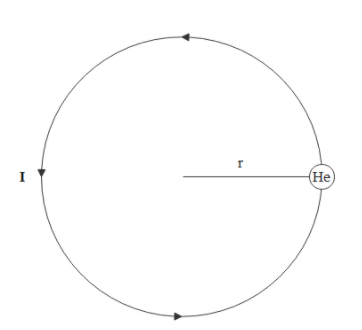
Magnitude of magnetic field at centre of a current carrying loop is given by,
$B=\dfrac{{{\mu }_{0}}NI}{2r}$
Where N is the number of turns, I is the current and r is the radius of the circle.
Since, the Helium nucleus takes $2\text{ }sec$ to complete one revolution. This means charge per unit time i.e. current due to helium nucleus is
$I=q/t=\dfrac{2e}{2}=e=1.6\times {{10}^{-19}}A$
Number of turns, $N=1$
Helium nucleus is moving in a circular path of radius $r=0.8m$.
Therefore, substituting these values, we get
$B=\dfrac{{{\mu }_{0}}\times 1\times \left( 1.6\times {{10}^{-19}} \right)}{2\times 0.8}={{\mu }_{0}}\times {{10}^{-19}}\,T$
The magnetic field produced due to oriting of helium nucleus at centre is ${{\mu }_{0}}\times {{10}^{-19}}\,T$ which is option A.
Hence, A is the correct option.
Note:
As static charge produces electric field, the charge in motion produces magnetic field.
Magnetic field is not produced if charge is not moving but electric field is still generated due to a charge. The circular motion of the nucleus of an atom produces a magnetic field as does electrical current flowing through a wire.
Formula used:
Magnetic field at centre of a current carrying loop, $B=\dfrac{{{\mu }_{0}}NI}{2r}$
Complete step by step answer:
A helium nucleus has two protons. Charge on each proton is $e=1.6\times {{10}^{-19}}C$. Therefore charge on helium nucleus is $2e$. Charge moving in a circle produces a magnetic field which is equivalent to magnetic field produced by a circular current carrying loop.
Magnitude of magnetic field at centre of a current carrying loop is given by,
$B=\dfrac{{{\mu }_{0}}NI}{2r}$
Where N is the number of turns, I is the current and r is the radius of the circle.
Since, the Helium nucleus takes $2\text{ }sec$ to complete one revolution. This means charge per unit time i.e. current due to helium nucleus is
$I=q/t=\dfrac{2e}{2}=e=1.6\times {{10}^{-19}}A$
Number of turns, $N=1$
Helium nucleus is moving in a circular path of radius $r=0.8m$.
Therefore, substituting these values, we get
$B=\dfrac{{{\mu }_{0}}\times 1\times \left( 1.6\times {{10}^{-19}} \right)}{2\times 0.8}={{\mu }_{0}}\times {{10}^{-19}}\,T$
The magnetic field produced due to oriting of helium nucleus at centre is ${{\mu }_{0}}\times {{10}^{-19}}\,T$ which is option A.
Hence, A is the correct option.
Note:
As static charge produces electric field, the charge in motion produces magnetic field.
Magnetic field is not produced if charge is not moving but electric field is still generated due to a charge. The circular motion of the nucleus of an atom produces a magnetic field as does electrical current flowing through a wire.
Recently Updated Pages
Master Class 12 Economics: Engaging Questions & Answers for Success

Master Class 12 English: Engaging Questions & Answers for Success
Master Class 12 Social Science: Engaging Questions & Answers for Success
Master Class 12 Maths: Engaging Questions & Answers for Success
Master Class 12 Physics: Engaging Questions & Answers for Success
Master Class 9 General Knowledge: Engaging Questions & Answers for Success
Trending doubts
One Metric ton is equal to kg A 10000 B 1000 C 100 class 11 physics CBSE
Difference Between Prokaryotic Cells and Eukaryotic Cells
Two of the body parts which do not appear in MRI are class 11 biology CBSE
1 ton equals to A 100 kg B 1000 kg C 10 kg D 10000 class 11 physics CBSE
Draw a diagram of nephron and explain its structur class 11 biology CBSE
10 examples of friction in our daily life