




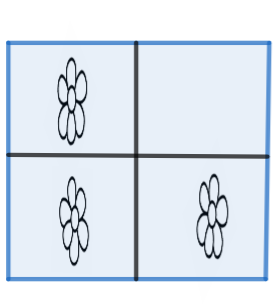
A handkerchief is divided into four squares. Each part is to be embroidered with a flower. How much is the design of the flower?
Answer
 Verified
523.8k+ views
Hint: In this problem, we are given a diagram of a handkerchief which is divided into four squares and each part is to be embroidered with a flower. We have to find how many parts of the flower. We can see that the kerchief is divided into four parts in which we have 3 parts and the design of the flower. We can write them in mathematical terms, i.e. in fraction which will be the answer.
Complete step by step answer:
Here we are given a diagram of a handkerchief which is divided into four squares and each part is to be embroidered with a flower. We have to find how many parts of the flower.
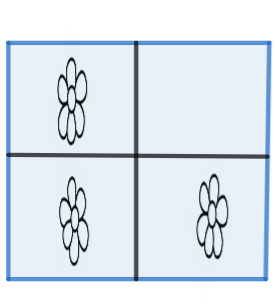
We can see that there are four divisions in which 3 parts have the design of the flower.
We can now write it as 3 out of four, such as
\[\Rightarrow \dfrac{3}{4}\]
Therefore, 3 out of 4 parts have the design of the flower to be embroidered.
Note: We should remember, here we have used the term fraction, which means part of the whole, which is denoted as \[\dfrac{a}{b}\], where b is the total parts and a is the parts used. Here we have 4 divisions in which three are used, then we can write it in the fraction form.
Complete step by step answer:
Here we are given a diagram of a handkerchief which is divided into four squares and each part is to be embroidered with a flower. We have to find how many parts of the flower.
We can see that there are four divisions in which 3 parts have the design of the flower.
We can now write it as 3 out of four, such as
\[\Rightarrow \dfrac{3}{4}\]
Therefore, 3 out of 4 parts have the design of the flower to be embroidered.
Note: We should remember, here we have used the term fraction, which means part of the whole, which is denoted as \[\dfrac{a}{b}\], where b is the total parts and a is the parts used. Here we have 4 divisions in which three are used, then we can write it in the fraction form.

Recently Updated Pages
Basicity of sulphurous acid and sulphuric acid are

Master Class 11 Business Studies: Engaging Questions & Answers for Success
Master Class 11 Computer Science: Engaging Questions & Answers for Success
Master Class 11 Economics: Engaging Questions & Answers for Success
Master Class 12 English: Engaging Questions & Answers for Success
Master Class 12 Social Science: Engaging Questions & Answers for Success
Trending doubts
What is the capital city of Australia? A) Sydney B) Melbourne C) Brisbane D) Canberra
How many millions make a billion class 6 maths CBSE
Give 10 examples for herbs , shrubs , climbers , creepers
The planet nearest to earth is A Mercury B Venus C class 6 social science CBSE
Which country first gave women the right to vote?
Who is known as the "Little Master" in Indian cricket history?