




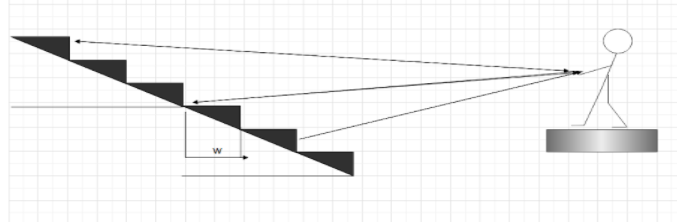
A handclap on stage in an amphitheatre sends out sound waves that scatter from terraces of width \[w=0.75\text{ }m\]. The sound returns to the stage as a periodic series of pulses, one from each terrace; the parade of pulses sounds like a played note. (a) Assuming that all the rays in the figure are horizontal, find the frequency at which the pulses return (that is, the frequency of the perceived note). (b) If the width w of the terraces were smaller, would the frequency be higher or lower?
Answer
 Verified
550.2k+ views
Hint: Since the returning pulse rays are assumed to be horizontal, the frequency could be calculated by using the inverse relation with time period. So first we have to find the time period using the simple relation with distance and speed of sound.
Complete answer:
We know that the speed of sound in air,
\[v=343\text{ }m{{s}^{-1}}\]
(a) Since the amphitheatre is made up of terraces of width,
\[w=0.75\text{ }m\]
There is a difference in the amount of time taken by each pulse ray. That is why, the parade of pulses sounds like a played note and this time lag is clearly heard by the person who clapped.
This time period can be calculated by the formula,
\[T=\dfrac{2w}{v}\]
Substituting the values, we get,
\[\begin{align}
& T=\dfrac{2\times 0.75}{343} \\
& \Rightarrow T=4.37\times {{10}^{-3}}\text{ }s \\
\end{align}\]
Since frequency is inversely proportional to time period, we could write,
\[\begin{align}
& f=\dfrac{1}{T} \\
& \Rightarrow f=\dfrac{1}{0.00437} \\
& \therefore f=228.83\text{ }Hz \\
\end{align}\]
(b) We know that frequency is inversely proportional to the time period. That is,
\[f=\dfrac{1}{T}\]
Which becomes,
\[\begin{align}
& f=\dfrac{1}{\left( \dfrac{2w}{v} \right)} \\
& \Rightarrow f=\dfrac{v}{2w} \\
\end{align}\]
Since we found out that frequency is inversely proportional to width of the terrace, when the width of the terrace decreases, the frequency of the pulse will be higher.
Note:
Since the speed of sound to be taken is not given in the question, we could use the speed of sound in dry air at 20 degree Celsius, which is \[343\text{ }m{{s}^{-1}}\]. It could also be taken as \[330\text{ }m{{s}^{-1}}\] and \[340\text{ }m{{s}^{-1}}\] depending on the question.
Complete answer:
We know that the speed of sound in air,
\[v=343\text{ }m{{s}^{-1}}\]
(a) Since the amphitheatre is made up of terraces of width,
\[w=0.75\text{ }m\]
There is a difference in the amount of time taken by each pulse ray. That is why, the parade of pulses sounds like a played note and this time lag is clearly heard by the person who clapped.
This time period can be calculated by the formula,
\[T=\dfrac{2w}{v}\]
Substituting the values, we get,
\[\begin{align}
& T=\dfrac{2\times 0.75}{343} \\
& \Rightarrow T=4.37\times {{10}^{-3}}\text{ }s \\
\end{align}\]
Since frequency is inversely proportional to time period, we could write,
\[\begin{align}
& f=\dfrac{1}{T} \\
& \Rightarrow f=\dfrac{1}{0.00437} \\
& \therefore f=228.83\text{ }Hz \\
\end{align}\]
(b) We know that frequency is inversely proportional to the time period. That is,
\[f=\dfrac{1}{T}\]
Which becomes,
\[\begin{align}
& f=\dfrac{1}{\left( \dfrac{2w}{v} \right)} \\
& \Rightarrow f=\dfrac{v}{2w} \\
\end{align}\]
Since we found out that frequency is inversely proportional to width of the terrace, when the width of the terrace decreases, the frequency of the pulse will be higher.
Note:
Since the speed of sound to be taken is not given in the question, we could use the speed of sound in dry air at 20 degree Celsius, which is \[343\text{ }m{{s}^{-1}}\]. It could also be taken as \[330\text{ }m{{s}^{-1}}\] and \[340\text{ }m{{s}^{-1}}\] depending on the question.
Recently Updated Pages
Master Class 11 Social Science: Engaging Questions & Answers for Success

Master Class 11 Physics: Engaging Questions & Answers for Success
Master Class 11 Maths: Engaging Questions & Answers for Success
Master Class 11 Economics: Engaging Questions & Answers for Success
Master Class 11 Computer Science: Engaging Questions & Answers for Success
Master Class 11 Chemistry: Engaging Questions & Answers for Success
Trending doubts
One Metric ton is equal to kg A 10000 B 1000 C 100 class 11 physics CBSE
There are 720 permutations of the digits 1 2 3 4 5 class 11 maths CBSE
1 Quintal is equal to a 110 kg b 10 kg c 100kg d 1000 class 11 physics CBSE
State and prove Bernoullis theorem class 11 physics CBSE
Difference Between Prokaryotic Cells and Eukaryotic Cells
Which among the following are examples of coming together class 11 social science CBSE