




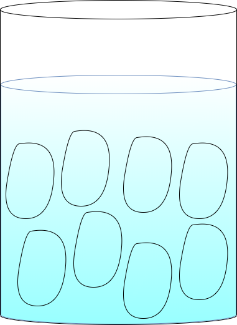
A gulab jamun, contains sugar syrup up to about 30% of its volume. Find approximately how much syrup would be found in 45 gulab jamuns, each shaped like a cylinder with two, hemispherical ends with length 5 cm and diameter 2.8 cm.
Answer
 Verified
612.3k+ views
Hint: In this question remember that gulab jamun is a combination of cylinder with 2 hemispherical ends and to find the 45% amount of syrup in 45 gulab jamun find the volume of each gulab jamun which is equal to volume of cylinder + volume of 2 hemisphere then find the 45% of the total volume of 45 gulab jamuns, using this information will help you to approach the solution.
Complete step-by-step answer:
According to the given question we have gulab jamuns of length 5 cm here gulab jamun is shaped like 1 cylinder with 2 hemispherical ends whose diameter is 2.8 cm so the gulab jamun can be drawn as
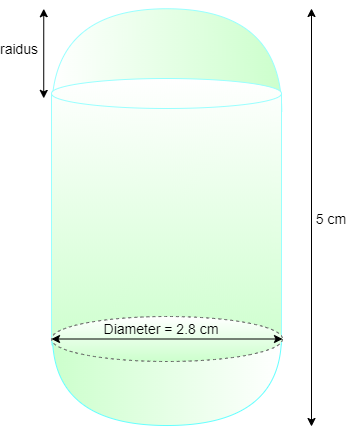
According to the above diagram we can say that the height of cylinder is equal to length of gulab jamun – diameter of hemisphere
So the height of cylinder = 5 – 2.8 (since the sum of radius of 2 ends is equal to the diameter of 1 hemisphere)
Height = 2.2 cm
And radius of hemisphere and cylinder = $\dfrac{{2.8}}{2}$ = 1.4 cm
Now to calculate the volume of gulab jamun we will use the formula of volume of cylinder and volume of hemisphere
Volume of cylinder is given by $\pi {r^2}h$ where h is the height of cylinder
Volume of hemisphere is given as $\dfrac{2}{3}\pi {r^3}$
Since we know that volume of gulab jamun = volume of cylinder + volume of 2 hemisphere
Volume of gulab jamun = $\pi {r^2}h + 2 \times \dfrac{2}{3}\pi {r^3}$
$ \Rightarrow $ Volume of gulab jamun = $\pi {r^2}h + 2 \times \dfrac{2}{3}\pi {r^3}$
Substituting the given values in the above equation
Volume of gulab jamun = $\dfrac{{22}}{7} \times {\left( {1.4} \right)^2}\left( {2.2} \right) + 2 \times \dfrac{2}{3} \times \dfrac{{22}}{7} \times {\left( {1.4} \right)^3}$
$ \Rightarrow $ Volume of gulab jamun = 13.552 + 11.498 = 25.05 $c{m^3}$
Since the volume of 1 gulab jamun is 25.05 $c{m^3}$
Therefore the volume of 45 gulab jamun will be equal to 45 $ \times $ volume of 1 gulab jamun
Substituting the values in the above equation we get
Volume of 45 gulab jamun = 45 $ \times $25.05 = 1127.25 $c{m^3}$
As we know that according to the given information gulab jamun contains 30% of sugar syrup of its volume
Therefore amount of sugar syrup found in 45 gulab jamun = $\dfrac{{30}}{{100}} \times 1127.25$ = 338.17 $c{m^3}$
Hence the amount of sugar syrup found in 45 gulab jamun is 338.17 $c{m^3}$
Note: In the above question we knew that the gulab jamun contains sugar syrup only 30% of its volume so before finding the amount of sugar syrup in gulab jamun we needed the volume of 1 gulab jamun and since the gulab jamun was the combination of cylindrical shape and 2 hemisphere on its both ends. So to find the volume of gulab jamun we found the volume of the cylinder and the 2 hemispheres and used the addition operation on the both volumes. And then we found the volume of 45 gulab jamuns by using the multiplication operation and after that we found the 30% of its volume and at last we got our required answer.
Complete step-by-step answer:
According to the given question we have gulab jamuns of length 5 cm here gulab jamun is shaped like 1 cylinder with 2 hemispherical ends whose diameter is 2.8 cm so the gulab jamun can be drawn as
According to the above diagram we can say that the height of cylinder is equal to length of gulab jamun – diameter of hemisphere
So the height of cylinder = 5 – 2.8 (since the sum of radius of 2 ends is equal to the diameter of 1 hemisphere)
Height = 2.2 cm
And radius of hemisphere and cylinder = $\dfrac{{2.8}}{2}$ = 1.4 cm
Now to calculate the volume of gulab jamun we will use the formula of volume of cylinder and volume of hemisphere
Volume of cylinder is given by $\pi {r^2}h$ where h is the height of cylinder
Volume of hemisphere is given as $\dfrac{2}{3}\pi {r^3}$
Since we know that volume of gulab jamun = volume of cylinder + volume of 2 hemisphere
Volume of gulab jamun = $\pi {r^2}h + 2 \times \dfrac{2}{3}\pi {r^3}$
$ \Rightarrow $ Volume of gulab jamun = $\pi {r^2}h + 2 \times \dfrac{2}{3}\pi {r^3}$
Substituting the given values in the above equation
Volume of gulab jamun = $\dfrac{{22}}{7} \times {\left( {1.4} \right)^2}\left( {2.2} \right) + 2 \times \dfrac{2}{3} \times \dfrac{{22}}{7} \times {\left( {1.4} \right)^3}$
$ \Rightarrow $ Volume of gulab jamun = 13.552 + 11.498 = 25.05 $c{m^3}$
Since the volume of 1 gulab jamun is 25.05 $c{m^3}$
Therefore the volume of 45 gulab jamun will be equal to 45 $ \times $ volume of 1 gulab jamun
Substituting the values in the above equation we get
Volume of 45 gulab jamun = 45 $ \times $25.05 = 1127.25 $c{m^3}$
As we know that according to the given information gulab jamun contains 30% of sugar syrup of its volume
Therefore amount of sugar syrup found in 45 gulab jamun = $\dfrac{{30}}{{100}} \times 1127.25$ = 338.17 $c{m^3}$
Hence the amount of sugar syrup found in 45 gulab jamun is 338.17 $c{m^3}$
Note: In the above question we knew that the gulab jamun contains sugar syrup only 30% of its volume so before finding the amount of sugar syrup in gulab jamun we needed the volume of 1 gulab jamun and since the gulab jamun was the combination of cylindrical shape and 2 hemisphere on its both ends. So to find the volume of gulab jamun we found the volume of the cylinder and the 2 hemispheres and used the addition operation on the both volumes. And then we found the volume of 45 gulab jamuns by using the multiplication operation and after that we found the 30% of its volume and at last we got our required answer.
Recently Updated Pages
Master Class 12 Business Studies: Engaging Questions & Answers for Success

Master Class 12 Biology: Engaging Questions & Answers for Success
Master Class 12 Chemistry: Engaging Questions & Answers for Success
Class 12 Question and Answer - Your Ultimate Solutions Guide
Master Class 11 Social Science: Engaging Questions & Answers for Success
Master Class 11 English: Engaging Questions & Answers for Success
Trending doubts
Explain the Treaty of Vienna of 1815 class 10 social science CBSE
Who Won 36 Oscar Awards? Record Holder Revealed
What is the median of the first 10 natural numbers class 10 maths CBSE
Why is it 530 pm in india when it is 1200 afternoon class 10 social science CBSE
What is the full form of POSCO class 10 social science CBSE
The highest temperature in Karnataka is recorded in class 10 social science CBSE