




A girl is carrying a school bag of 3 kg mass on her bag and moves 200 meters on a levelled road. The work done against the gravitational force will be \[\left( g=10m/{{s}^{2}} \right)\]
\[\begin{align}
& \text{A}\text{. 6}\times \text{1}{{\text{0}}^{3}}J \\
& \text{B}\text{. 6}J \\
& \text{C}\text{. 0}\text{.6}J \\
& \text{D}\text{. zero} \\
\end{align}\]
Answer
 Verified
645k+ views
Hint: In the given question we have asked the work done against the gravitational force. And work done is given as a dot product of force and displacement and we have given the mass and the displacement. But before solving this we will draw the diagram for better understanding. Also the value of g is given as \[g=10m/{{s}^{2}}\].
Formula used: \[W=Fd\cos \theta \]
Complete step by step answer:
According to the question a girl is carrying a bag of mass 3 kg and moves 200m, this 200 meters basically shows us displacement so it will have magnitude and direction. A diagram for the given question is
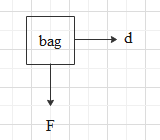
F shows the gravitational force or gravitational pull whereas d shows the displacement. Now as the girl is moving on a levelled road and she is carrying the bag so the displacement for the bag will be the same as the girl. And we can also conclude that the force F and displacement d are in perpendicular direction as the road is levelled or a straight horizontal plane.
Now the work done is given as dot product of force and displacement i.e.
\[W=Fd\cos \theta \]
Where f is the force, d is displacement and θ is the angle between F and D.
Here the angle between F and d is \[90{}^\circ \]and \[\cos 90{}^\circ =0\], hence according to the above equation work done against the gravitational force in carrying the bag is zero.
So, the correct answer is “Option D”.
Note: As all the required data is given therefore mistakenly we can neglect the angle and calculate the work done. Also, work done is mostly just given as a product of displacement and force taking force and displacement parallel or antiparallel, even if a girl was moving along a slope we would have obtained some value for work done.
Formula used: \[W=Fd\cos \theta \]
Complete step by step answer:
According to the question a girl is carrying a bag of mass 3 kg and moves 200m, this 200 meters basically shows us displacement so it will have magnitude and direction. A diagram for the given question is
F shows the gravitational force or gravitational pull whereas d shows the displacement. Now as the girl is moving on a levelled road and she is carrying the bag so the displacement for the bag will be the same as the girl. And we can also conclude that the force F and displacement d are in perpendicular direction as the road is levelled or a straight horizontal plane.
Now the work done is given as dot product of force and displacement i.e.
\[W=Fd\cos \theta \]
Where f is the force, d is displacement and θ is the angle between F and D.
Here the angle between F and d is \[90{}^\circ \]and \[\cos 90{}^\circ =0\], hence according to the above equation work done against the gravitational force in carrying the bag is zero.
So, the correct answer is “Option D”.
Note: As all the required data is given therefore mistakenly we can neglect the angle and calculate the work done. Also, work done is mostly just given as a product of displacement and force taking force and displacement parallel or antiparallel, even if a girl was moving along a slope we would have obtained some value for work done.
Recently Updated Pages
Master Class 11 Social Science: Engaging Questions & Answers for Success

Master Class 11 English: Engaging Questions & Answers for Success
Master Class 11 Accountancy: Engaging Questions & Answers for Success
Master Class 11 Physics: Engaging Questions & Answers for Success
Master Class 11 Computer Science: Engaging Questions & Answers for Success
Master Class 11 Business Studies: Engaging Questions & Answers for Success
Trending doubts
Find the value of the expression given below sin 30circ class 11 maths CBSE
One Metric ton is equal to kg A 10000 B 1000 C 100 class 11 physics CBSE
Draw a diagram of nephron and explain its structur class 11 biology CBSE
10 examples of friction in our daily life
Proton was discovered by A Thomson B Rutherford C Chadwick class 11 chemistry CBSE
The teeth used for biting and cutting food are called class 11 biology CBSE