




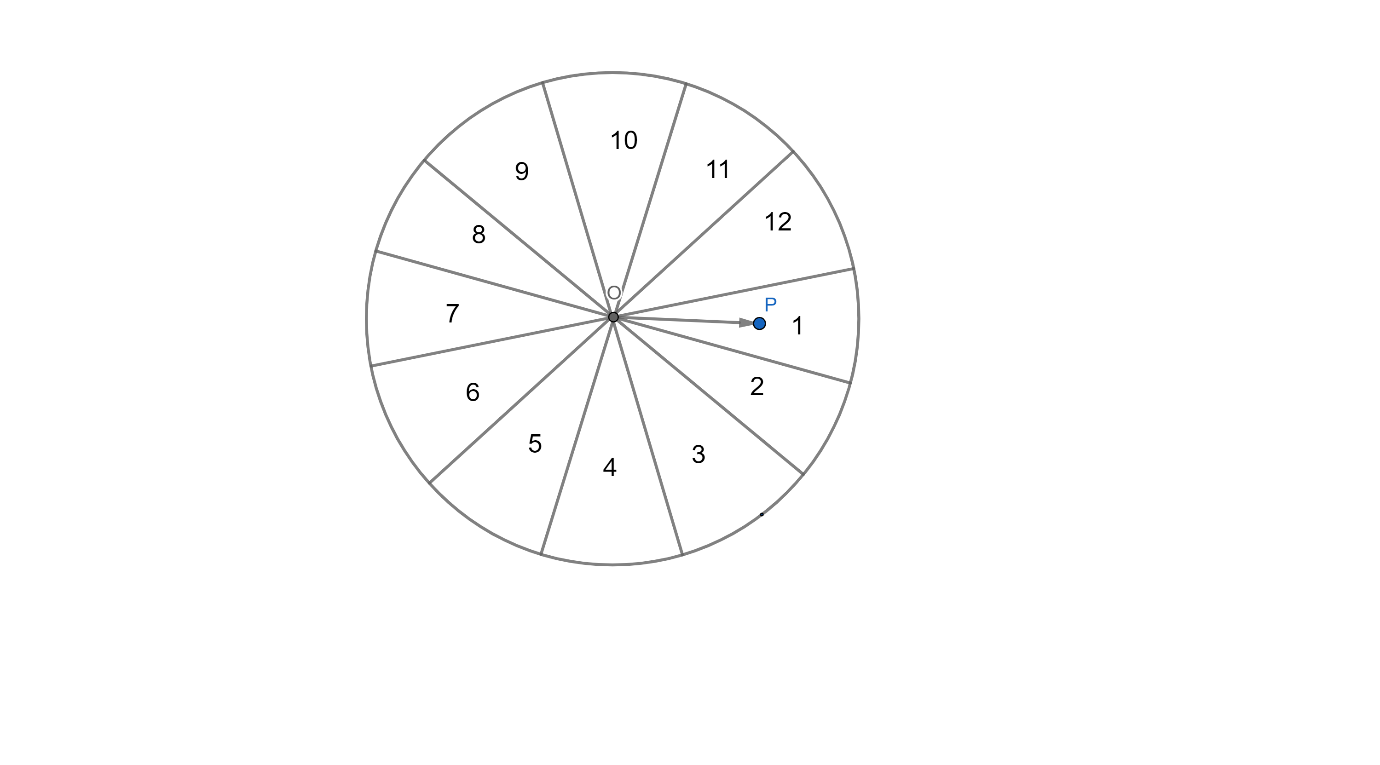
A game of chance consists of spinning an arrow which is equally likely to come to rest pointing to one of the number 1, 2, 3, ……. 12. What is the probability that it will point to:
(a) 10
(b) An odd number
(c) A number which is multiple of 3
(d) An even number
Answer
 Verified
657.3k+ views
Hint: We will find the no. of favourable cases in each case and divide it by the total number of outcomes which is 12. We will use the definition that an even number is divisible by 2 and then all the multiples of it until 12 will be the favourable outcomes for part d, like that we will find the probability.
Complete step-by-step answer:
This is the required figure in which OP is the spinning arrow.
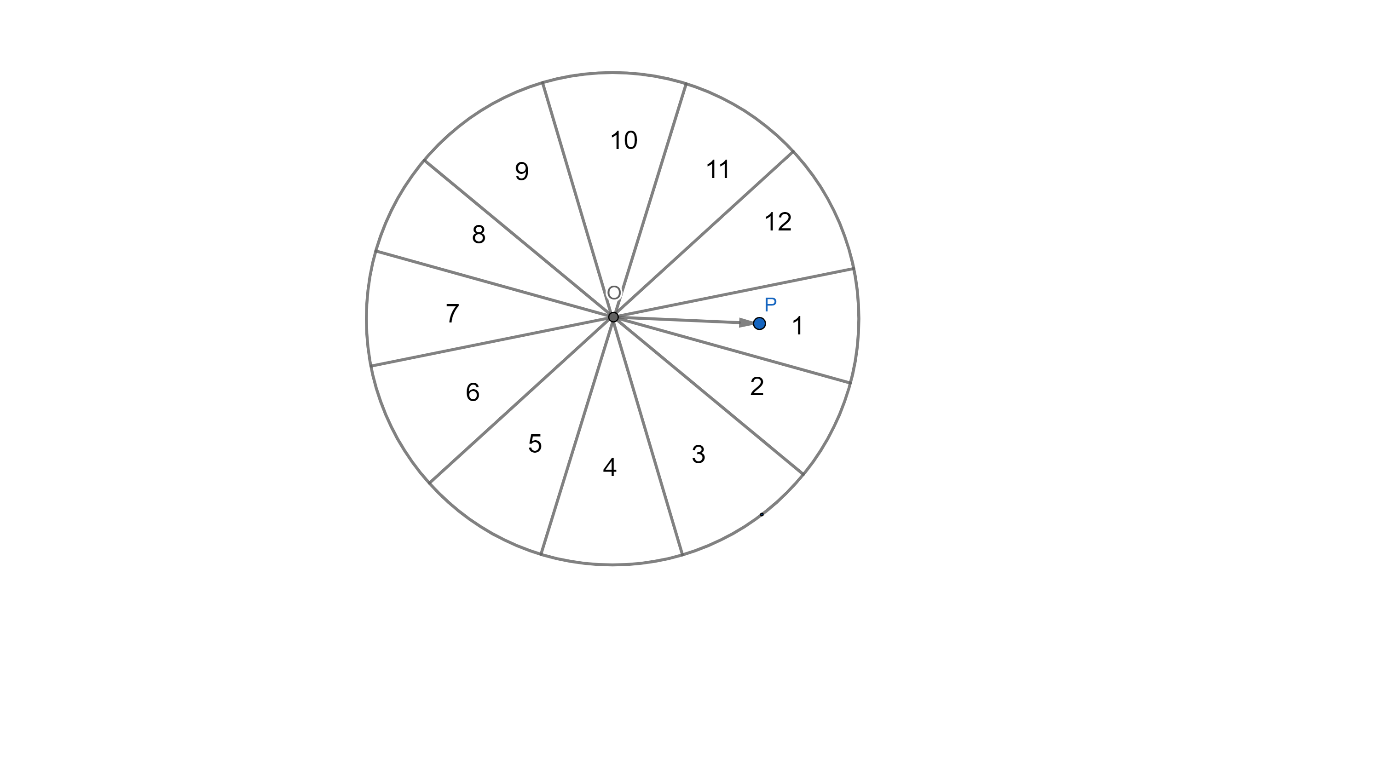
10 is only one number from 1 to 12.
Hence, the number of favourable cases is 1 and the total number of cases is 12.
Therefore,
$\begin{align}
& P=\dfrac{\text{number of favourable case}}{\text{total number of case}} \\
& =\dfrac{1}{12} \\
\end{align}$
Hence, the answer is $\dfrac{1}{12}$
Let’s solve part (b),
The odd numbers from 1 to 12 are: 1, 3, 5, 7, 9, 11.
Hence, the number of favourable cases is 6 and total number of cases is 12.
Therefore,
$\begin{align}
& P=\dfrac{\text{number of favourable case}}{\text{total number of case}} \\
& =\dfrac{6}{12} \\
& =\dfrac{1}{2} \\
\end{align}$
Hence, the answer is $\dfrac{1}{2}$
Let’s solve part (c),
The numbers which are multiple of 3 from 1 to 12 are: 3, 6, 9, 12.
Hence, the number of favourable cases is 4 and total number of cases is 12.
Therefore,
$\begin{align}
& P=\dfrac{\text{number of favourable case}}{\text{total number of case}} \\
& =\dfrac{4}{12} \\
& =\dfrac{1}{3} \\
\end{align}$
Hence, the answer is $\dfrac{1}{3}$
Let’s solve part (d),
The even numbers from 1 to 12 are: 2, 4, 6, 8, 10, 12.
Hence, the number of favourable cases is 6 and total number of cases is 12.
Therefore,
$\begin{align}
& P=\dfrac{\text{number of favourable case}}{\text{total number of case}} \\
& =\dfrac{6}{12} \\
& =\dfrac{1}{2} \\
\end{align}$
Hence, the answer is $\dfrac{1}{2}$
Note: The formula $P=\dfrac{\text{number of favourable case}}{\text{total number of case}}$ for finding probability can be used in any case. One should know the meaning of even and odd numbers to solve this question correctly. An even number is divisible by 2 and an odd number is not.
Complete step-by-step answer:
This is the required figure in which OP is the spinning arrow.
10 is only one number from 1 to 12.
Hence, the number of favourable cases is 1 and the total number of cases is 12.
Therefore,
$\begin{align}
& P=\dfrac{\text{number of favourable case}}{\text{total number of case}} \\
& =\dfrac{1}{12} \\
\end{align}$
Hence, the answer is $\dfrac{1}{12}$
Let’s solve part (b),
The odd numbers from 1 to 12 are: 1, 3, 5, 7, 9, 11.
Hence, the number of favourable cases is 6 and total number of cases is 12.
Therefore,
$\begin{align}
& P=\dfrac{\text{number of favourable case}}{\text{total number of case}} \\
& =\dfrac{6}{12} \\
& =\dfrac{1}{2} \\
\end{align}$
Hence, the answer is $\dfrac{1}{2}$
Let’s solve part (c),
The numbers which are multiple of 3 from 1 to 12 are: 3, 6, 9, 12.
Hence, the number of favourable cases is 4 and total number of cases is 12.
Therefore,
$\begin{align}
& P=\dfrac{\text{number of favourable case}}{\text{total number of case}} \\
& =\dfrac{4}{12} \\
& =\dfrac{1}{3} \\
\end{align}$
Hence, the answer is $\dfrac{1}{3}$
Let’s solve part (d),
The even numbers from 1 to 12 are: 2, 4, 6, 8, 10, 12.
Hence, the number of favourable cases is 6 and total number of cases is 12.
Therefore,
$\begin{align}
& P=\dfrac{\text{number of favourable case}}{\text{total number of case}} \\
& =\dfrac{6}{12} \\
& =\dfrac{1}{2} \\
\end{align}$
Hence, the answer is $\dfrac{1}{2}$
Note: The formula $P=\dfrac{\text{number of favourable case}}{\text{total number of case}}$ for finding probability can be used in any case. One should know the meaning of even and odd numbers to solve this question correctly. An even number is divisible by 2 and an odd number is not.
Recently Updated Pages
Basicity of sulphurous acid and sulphuric acid are

Master Class 12 Economics: Engaging Questions & Answers for Success
Master Class 12 Biology: Engaging Questions & Answers for Success
Master Class 11 English: Engaging Questions & Answers for Success
Master Class 11 Physics: Engaging Questions & Answers for Success
Master Class 11 Computer Science: Engaging Questions & Answers for Success
Trending doubts
What is the Total Duration of Football Match?
In football, which nation is called "La Roja"?
Why is there a time difference of about 5 hours between class 10 social science CBSE
What is the award for the best player at the FIFA World Cup?
Define Potential, Developed, Stock and Reserved resources
Draw the diagram of the sectional view of the human class 10 biology CBSE