




A galvanometer gives full scale deflection with 0.006 A current. By connecting it to a \[4990\,\Omega \] resistance, it can be converted into a voltmeter of range 0-30 V. If connected to a \[\dfrac{{2n}}{{249}}\Omega \] resistance, it becomes an ammeter of range 0-1.5 A. The value of n is:
Answer
 Verified
594.6k+ views
Hint: When the external resistance is connected in series with the galvanometer, the galvanometer works as voltmeter. When the external shunt resistance is connected across the galvanometer, it acts as the ammeter. The potential drop across the parallel circuit remains the same.
Formula used:
Ohm’s law, \[V = IR\],
where, V is the voltage, I is the current and R is the resistance.
Complete step by step answer:
When we connect an external resistance series with a galvanometer, the galvanometer acts as a voltmeter. The circuit connection is as shown in the figure below.
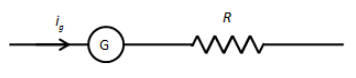
We have given that the galvanometer gives a full scale deflection with 0.006 A current. That means the current through the galvanometer is \[{i_g} = 0.006\,{\text{A}}\].
Let the internal resistance of the galvanometer is r. Now, the potential difference in the above circuit diagram is,
\[V = {i_g}r + {i_g}R\]
\[ \Rightarrow V = {i_g}\left( {r + R} \right)\]
Since the galvanometer is showing the full scale deflection, the maximum voltage across the above circuit is 30 V. Substituting 30 V for V, 0.006 A for \[{i_g}\] and \[4990\,\Omega \] for R in the above equation, we get,
\[30 = \left( {0.006} \right)\left( {r + 4990} \right)\]
\[ \Rightarrow 5000 = r + 4990\]
\[ \Rightarrow r = 5000 - 4990\]
\[ \Rightarrow r = 10\,\Omega \]
Now, we know that the galvanometer can be converted into an ammeter by connecting a shunt resistance across the galvanometer as shown in the figure below.
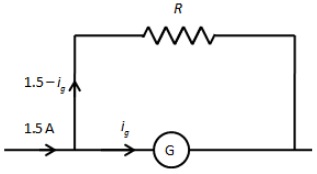
We have given that the range of the ammeter is 1.5 A. Therefore, the total current in the above circuit is 1.5 A, the current in the galvanometer is the same that is \[{i_g}\] and the current through the shunt resistance R is \[1.5 - {i_g}\].
We know that the potential drop across the parallel combination remains the same. Therefore, the potential drop at the upper arm and the lower arm is the same.
\[R\left( {1.5 - {i_g}} \right) = {i_g}r\]
We have given the value of shunt resistance, \[R = \dfrac{{2n}}{{249}}\Omega \].
Substituting \[R = \dfrac{{2n}}{{249}}\Omega \], \[{i_g} = 0.006\,{\text{A}}\] and \[r = 10\,\Omega \] in the above equation, we get,
\[\left( {\dfrac{{2n}}{{249}}} \right)\left( {1.5 - 0.006} \right) = \left( {0.006} \right)\left( {10} \right)\]
\[ \Rightarrow \dfrac{{2n}}{{249}} = 0.040\]
\[ \Rightarrow n = \dfrac{{\left( {0.040} \right)\left( {249} \right)}}{2}\]
\[ \Rightarrow n = 4.98\]
\[ \therefore n \approx 5\]
Thus, the value of n is 5.
Note: In the question, when the galvanometer is converted into the ammeter, the current flow through the circuit is 1.5 A and this is not the current flow through only the galvanometer. If we put the value of n, the value of shunt resistance becomes 0.040 ohm. Thus, the value of shunt resistance must be very small in order to convert the galvanometer into the ammeter.
Formula used:
Ohm’s law, \[V = IR\],
where, V is the voltage, I is the current and R is the resistance.
Complete step by step answer:
When we connect an external resistance series with a galvanometer, the galvanometer acts as a voltmeter. The circuit connection is as shown in the figure below.
We have given that the galvanometer gives a full scale deflection with 0.006 A current. That means the current through the galvanometer is \[{i_g} = 0.006\,{\text{A}}\].
Let the internal resistance of the galvanometer is r. Now, the potential difference in the above circuit diagram is,
\[V = {i_g}r + {i_g}R\]
\[ \Rightarrow V = {i_g}\left( {r + R} \right)\]
Since the galvanometer is showing the full scale deflection, the maximum voltage across the above circuit is 30 V. Substituting 30 V for V, 0.006 A for \[{i_g}\] and \[4990\,\Omega \] for R in the above equation, we get,
\[30 = \left( {0.006} \right)\left( {r + 4990} \right)\]
\[ \Rightarrow 5000 = r + 4990\]
\[ \Rightarrow r = 5000 - 4990\]
\[ \Rightarrow r = 10\,\Omega \]
Now, we know that the galvanometer can be converted into an ammeter by connecting a shunt resistance across the galvanometer as shown in the figure below.
We have given that the range of the ammeter is 1.5 A. Therefore, the total current in the above circuit is 1.5 A, the current in the galvanometer is the same that is \[{i_g}\] and the current through the shunt resistance R is \[1.5 - {i_g}\].
We know that the potential drop across the parallel combination remains the same. Therefore, the potential drop at the upper arm and the lower arm is the same.
\[R\left( {1.5 - {i_g}} \right) = {i_g}r\]
We have given the value of shunt resistance, \[R = \dfrac{{2n}}{{249}}\Omega \].
Substituting \[R = \dfrac{{2n}}{{249}}\Omega \], \[{i_g} = 0.006\,{\text{A}}\] and \[r = 10\,\Omega \] in the above equation, we get,
\[\left( {\dfrac{{2n}}{{249}}} \right)\left( {1.5 - 0.006} \right) = \left( {0.006} \right)\left( {10} \right)\]
\[ \Rightarrow \dfrac{{2n}}{{249}} = 0.040\]
\[ \Rightarrow n = \dfrac{{\left( {0.040} \right)\left( {249} \right)}}{2}\]
\[ \Rightarrow n = 4.98\]
\[ \therefore n \approx 5\]
Thus, the value of n is 5.
Note: In the question, when the galvanometer is converted into the ammeter, the current flow through the circuit is 1.5 A and this is not the current flow through only the galvanometer. If we put the value of n, the value of shunt resistance becomes 0.040 ohm. Thus, the value of shunt resistance must be very small in order to convert the galvanometer into the ammeter.
Recently Updated Pages
Master Class 12 Economics: Engaging Questions & Answers for Success

Master Class 12 English: Engaging Questions & Answers for Success
Master Class 12 Social Science: Engaging Questions & Answers for Success
Master Class 12 Maths: Engaging Questions & Answers for Success
Master Class 12 Physics: Engaging Questions & Answers for Success
Master Class 9 General Knowledge: Engaging Questions & Answers for Success
Trending doubts
Which are the Top 10 Largest Countries of the World?
Draw a labelled sketch of the human eye class 12 physics CBSE
Differentiate between homogeneous and heterogeneous class 12 chemistry CBSE
Why is the cell called the structural and functional class 12 biology CBSE
Draw ray diagrams each showing i myopic eye and ii class 12 physics CBSE
Which is the correct genotypic ratio of mendel dihybrid class 12 biology CBSE