




A fruit has fleshy mesocarp and stony endocarp is
(A) Pome
(B) Berry
(C) Pepo
(D) Drupe
Answer
 Verified
653.1k+ views
Hint: A fruit has fleshy mesocarp and stony endocarp is mango, peach, cherry, and many more. This type of fruit is indehiscent fruit These fruits usually develop from a single carpel, and mostly from flowers with superior ovaries.
Complete step by step answer:
A drupe is a fleshy fruit with thin skin and a seed in the center with a hard covering. Some of the plants inside the hardened stone contain an edible seed. - A drupe is an example of a fruit with a thin epicarp, an indehiscent mesocarp, and a hardened endocarp. The seed inside the covering is edible in some cases like in the case of almonds.
Additional Information: The term fruit is used for the ripened ovary of a plant. It forms a protective covering for the seed and the embryo of a plant. As the seed develops, the fruit also develops.
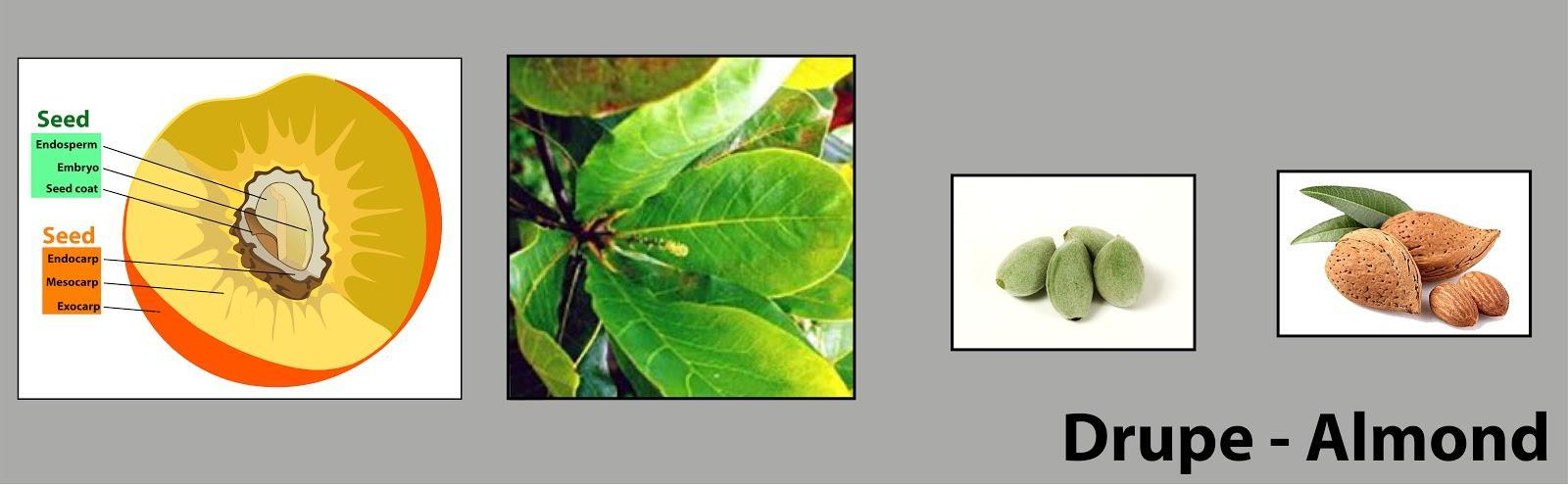
- When the endocarp of the almond fruit is broken, the cotyledons revealed are edible. - Generally, a fruit has three parts - exocarp or the outermost skin/covering, mesocarp or the middle part of the fruit, and the endocarp or the inner part of the fruit. The mesocarp is generally the fleshy and edible part of the fruit. In other cases, the endocarp is the edible part.
- Mango has an edible mesocarp.
- Coconut has an edible endosperm.
Seedless fruits are also present in nature. Parthenocarpy is the process of the natural or artificial production of fruit without fertilization of ovules. For example, seedless bananas and grapes are very common.
So, the correct answer is ‘Drupe’.
Note: Almonds are commonly known as nuts but scientifically are not; they are drupes. Other examples of drupes are pistachio, cherries, plums, etc. Dehiscent fruits release their seeds into the environment readily (like peas) while indehiscent fruits rely on the decay for the spread.
Complete step by step answer:
A drupe is a fleshy fruit with thin skin and a seed in the center with a hard covering. Some of the plants inside the hardened stone contain an edible seed. - A drupe is an example of a fruit with a thin epicarp, an indehiscent mesocarp, and a hardened endocarp. The seed inside the covering is edible in some cases like in the case of almonds.
Additional Information: The term fruit is used for the ripened ovary of a plant. It forms a protective covering for the seed and the embryo of a plant. As the seed develops, the fruit also develops.
- When the endocarp of the almond fruit is broken, the cotyledons revealed are edible. - Generally, a fruit has three parts - exocarp or the outermost skin/covering, mesocarp or the middle part of the fruit, and the endocarp or the inner part of the fruit. The mesocarp is generally the fleshy and edible part of the fruit. In other cases, the endocarp is the edible part.
- Mango has an edible mesocarp.
- Coconut has an edible endosperm.
Seedless fruits are also present in nature. Parthenocarpy is the process of the natural or artificial production of fruit without fertilization of ovules. For example, seedless bananas and grapes are very common.
So, the correct answer is ‘Drupe’.
Note: Almonds are commonly known as nuts but scientifically are not; they are drupes. Other examples of drupes are pistachio, cherries, plums, etc. Dehiscent fruits release their seeds into the environment readily (like peas) while indehiscent fruits rely on the decay for the spread.
Recently Updated Pages
Which will be the least stable resonating structure class 11 chemistry CBSE

How many 5 digit telephone numbers can be construc-class-11-maths-CBSE
How do you find the angle of the resultant vector class 11 physics CBSE
Draw labelled diagram of the following i Gram seed class 11 biology CBSE
1 Quintal is equal to a 110 kg b 10 kg c 100kg d 1000 class 11 physics CBSE
What is the need and importance of classification class 11 biology CBSE
Trending doubts
Find the value of the expression given below sin 30circ class 11 maths CBSE
One Metric ton is equal to kg A 10000 B 1000 C 100 class 11 physics CBSE
10 examples of friction in our daily life
Draw a diagram of a plant cell and label at least eight class 11 biology CBSE
Difference between physical and chemical change class 11 chemistry CBSE
Proton was discovered by A Thomson B Rutherford C Chadwick class 11 chemistry CBSE