




A force of 50N is inclined to the vertical at an angle of ${30^ \circ }$. Find the acceleration it produces in a body of mass 2kg which moves in the horizontal direction.
Answer
 Verified
565.5k+ views
Hint: In order to find the solution to the given question, deduce the components of forces acting on the container with the help of a rough figure. Then find the net force acting on the container using that to find the acceleration produced in the body.
Complete step-by-step solution
We will recreate a rough diagram representing the given system and form components of the forces acting on it then balance them out for better understandings:
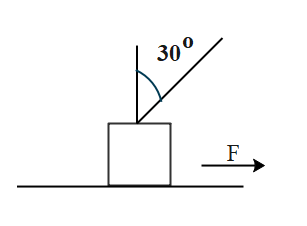
Given:
Force = 50N
Vertical angle $ = {30^ \circ }$
Horizontal angle is given as,
Horizontal angle $ = {90^ \circ } - {30^ \circ } = {60^ \circ }$
Mass of the body = 2kg
We have to calculate the of the body
From balancing the equation of the horizontal force is given as,
$F\cos \theta = ma$
Where ‘F’ is expressed as the force, ‘m’ is the mass and ‘a’ is the acceleration.
Substituting the given values, we get,
$\eqalign{
& \Rightarrow 50 \times \cos 60 = 2 \times a \cr
& \Rightarrow a = \dfrac{{50 \times \cos 60}}{2} \cr
& \therefore a = 12.5m/{s^2} \cr} $
Thus, the acceleration produced by the body of mass 2kg which moves in the horizontal direction is $12.5m/{s^2}$.
Hence, the acceleration produced by the body is $12.5m/{s^2}$.
Note: Force in very simple words can be understood as the interaction between two objects. It is a vector quantity i.e. it consists of magnitude as well as direction associated with it. If more than one force acts on a body then their resultant force is calculated using vector algebra. Acceleration, on the other hand, is mathematically taken as the ratio of velocity and time. Force and acceleration are both directly proportional to each other. They are equal to each other by adding the constant mass. Force, so can be defined mathematically as mass times the acceleration a body or a particle undergoes.
F=ma.
Complete step-by-step solution
We will recreate a rough diagram representing the given system and form components of the forces acting on it then balance them out for better understandings:
Given:
Force = 50N
Vertical angle $ = {30^ \circ }$
Horizontal angle is given as,
Horizontal angle $ = {90^ \circ } - {30^ \circ } = {60^ \circ }$
Mass of the body = 2kg
We have to calculate the of the body
From balancing the equation of the horizontal force is given as,
$F\cos \theta = ma$
Where ‘F’ is expressed as the force, ‘m’ is the mass and ‘a’ is the acceleration.
Substituting the given values, we get,
$\eqalign{
& \Rightarrow 50 \times \cos 60 = 2 \times a \cr
& \Rightarrow a = \dfrac{{50 \times \cos 60}}{2} \cr
& \therefore a = 12.5m/{s^2} \cr} $
Thus, the acceleration produced by the body of mass 2kg which moves in the horizontal direction is $12.5m/{s^2}$.
Hence, the acceleration produced by the body is $12.5m/{s^2}$.
Note: Force in very simple words can be understood as the interaction between two objects. It is a vector quantity i.e. it consists of magnitude as well as direction associated with it. If more than one force acts on a body then their resultant force is calculated using vector algebra. Acceleration, on the other hand, is mathematically taken as the ratio of velocity and time. Force and acceleration are both directly proportional to each other. They are equal to each other by adding the constant mass. Force, so can be defined mathematically as mass times the acceleration a body or a particle undergoes.
F=ma.
Recently Updated Pages
Master Class 11 Computer Science: Engaging Questions & Answers for Success

Master Class 11 Business Studies: Engaging Questions & Answers for Success
Master Class 11 Economics: Engaging Questions & Answers for Success
Master Class 11 English: Engaging Questions & Answers for Success
Master Class 11 Maths: Engaging Questions & Answers for Success
Master Class 11 Biology: Engaging Questions & Answers for Success
Trending doubts
One Metric ton is equal to kg A 10000 B 1000 C 100 class 11 physics CBSE
There are 720 permutations of the digits 1 2 3 4 5 class 11 maths CBSE
Discuss the various forms of bacteria class 11 biology CBSE
Draw a diagram of a plant cell and label at least eight class 11 biology CBSE
State the laws of reflection of light
Explain zero factorial class 11 maths CBSE