




A fitness club offers weights, treadmills and aerobic classes. Fifty members were asked which services they used, and the results were as follows:
18 members use weights and do aerobics
25 members use weights and the treadmill
15 members use the treadmill and do aerobics
10 members do all the three activities
Calculate the number of members using only one of the three services.
A. 0
B. 10
C. 12
D. 18
E. 40
Answer
 Verified
633.9k+ views
Hint: Assign the number of members using weight, treadmill and doing aerobics into three different sets. Generate the conditions given in the question into set operations and use the formulae of set theory using the notations for the assigned sets. Draw a Venn diagram for better visualization of mutually exclusive sets.
Complete step-by-step answer:
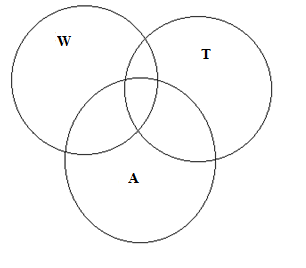
Let us assume the members using weights constitute the set W, the members using the treadmill constitute T and those doing aerobics constitute the set A.
It is given that there are all total 50 members in the fitness centre doing any of the combination of three exercises. Thus, it can be expressed in the form,
$\text{n}\left( \text{W}\bigcup{\text{T}\bigcup{\text{A}}} \right)\text{ = 50
}....\left( \text{i} \right)$
$\text{n}\left( \cdot \right)$ denotes the number of elements in a set.
Again, it is said that 18 members use weights and do aerobics. It is formulated as,
$\text{n}\left( \text{W}\bigcap{\text{A}} \right)\text{ = 18 }....\left( \text{ii} \right)$
Again, it is said that 25 members use weights and treadmill. It is formulated as,
$\text{n}\left( \text{W}\bigcap{\text{T}} \right)\text{ = 25 }....\text{(iii)}$
Again, it is said that 15 members use the treadmill and do aerobics. It is formulated as,
$\text{n}\left( \text{T}\bigcap{\text{A}} \right)\text{ = 15 }....\left( \text{iv} \right)$
Finally, it is said that 10 members take part in all three exercises. Thus,
$\text{n}\left( \text{W}\bigcap{\text{T}\bigcap{\text{A}}} \right)\text{ = 10
}....\left( \text{v} \right)$
We know, from a Venn diagram that, for any two sets A and B, in the presence of a
third set C , $\text{A}\bigcap{\text{B = }\left(
\text{A}\bigcap{\text{B}}\bigcap{\text{C}} \right)\bigcup{\left(
\text{A}\bigcap{\text{B}\bigcap{{{\text{C}}^{^{c}}}}} \right)}}$,
where,${{\text{C}}^{c}}$is the complement of any set C.
Therefore, we can say,
$\text{n}\left( \text{A}\bigcap{\text{B}} \right)\text{ = n}\left(
\text{A}\bigcap{\text{B}}\bigcap{\text{C}} \right)\text{ + n}\left(
\text{A}\bigcap{\text{B}\bigcap{{{\text{C}}^{^{c}}}}} \right)$ (since, the two sets
are mutually exclusive)
Thus, adding (ii), (iii) and (iv), we get,
$\begin{align}
& \text{n}\left( \text{W}\bigcap{\text{A}} \right)\text{ + n}\left(
\text{W}\bigcap{\text{T}} \right)\text{ + n}\left( \text{T}\bigcap{\text{A}}
\right)\text{ = 58} \\
& \Rightarrow \text{ n}\left( \text{W}\bigcap{\text{T}}\bigcap{\text{A}}
\right)\text{ + n}\left( \text{W}\bigcap{{{\text{T}}^{c}}\bigcap{\text{A}}}
\right)\text{ + n}\left( \text{W}\bigcap{\text{T}}\bigcap{\text{A}} \right)\text{ +
n}\left( \text{W}\bigcap{\text{T}\bigcap{{{\text{A}}^{c}}}} \right)\text{ + n}\left(
\text{W}\bigcap{\text{T}}\bigcap{\text{A}} \right)\text{ } \\
& \text{ + n}\left( {{\text{W}}^{c}}\bigcap{\text{T}\bigcap{\text{A}}}
\right)\text{ = 58} \\
& \Rightarrow \text{ n}\left( \text{W}\bigcap{{{\text{T}}^{c}}\bigcap{\text{A}}}
\right)\text{ }+\text{ n}\left( \text{W}\bigcap{\text{T}\bigcap{{{\text{A}}^{c}}}}
\right)\text{ + n}\left( {{\text{W}}^{c}}\bigcap{\text{T}\bigcap{\text{A}}}
\right)\text{ = 58 }-\text{ 3*10 }\left( \because \text{ n}\left(
\text{W}\bigcap{\text{T}}\bigcap{\text{A}} \right)=10 \right) \\
& \therefore \text{ n}\left( \text{W}\bigcap{{{\text{T}}^{c}}\bigcap{\text{A}}}
\right)\text{ }+\text{ n}\left( \text{W}\bigcap{\text{T}\bigcap{{{\text{A}}^{c}}}}
\right)\text{ + n}\left( {{\text{W}}^{c}}\bigcap{\text{T}\bigcap{\text{A}}}
\right)=\text{ }28 \\
\end{align}$Thus, there are 28 members participating in exactly two of the three
exercises.
Thus, it is evident from the Venn diagram, to calculate the number of members
participating in exactly one of the three exercises, we need to subtract the members
who participate exactly in two exercises and all the three exercises from the total
number of members.
$\therefore $Number of members participating in exactly one of the three exercises
$\begin{align}
& =\text{ 58 }-\text{ 28 }-\text{ }10 \\
& =\text{ 12} \\
\end{align}$
Thus, 12 members participate in exactly one of the three exercises.
Note: It is always advisable to draw a Venn diagram to visualize the mutually
exclusive sections of the sets.
Complete step-by-step answer:
Let us assume the members using weights constitute the set W, the members using the treadmill constitute T and those doing aerobics constitute the set A.
It is given that there are all total 50 members in the fitness centre doing any of the combination of three exercises. Thus, it can be expressed in the form,
$\text{n}\left( \text{W}\bigcup{\text{T}\bigcup{\text{A}}} \right)\text{ = 50
}....\left( \text{i} \right)$
$\text{n}\left( \cdot \right)$ denotes the number of elements in a set.
Again, it is said that 18 members use weights and do aerobics. It is formulated as,
$\text{n}\left( \text{W}\bigcap{\text{A}} \right)\text{ = 18 }....\left( \text{ii} \right)$
Again, it is said that 25 members use weights and treadmill. It is formulated as,
$\text{n}\left( \text{W}\bigcap{\text{T}} \right)\text{ = 25 }....\text{(iii)}$
Again, it is said that 15 members use the treadmill and do aerobics. It is formulated as,
$\text{n}\left( \text{T}\bigcap{\text{A}} \right)\text{ = 15 }....\left( \text{iv} \right)$
Finally, it is said that 10 members take part in all three exercises. Thus,
$\text{n}\left( \text{W}\bigcap{\text{T}\bigcap{\text{A}}} \right)\text{ = 10
}....\left( \text{v} \right)$
We know, from a Venn diagram that, for any two sets A and B, in the presence of a
third set C , $\text{A}\bigcap{\text{B = }\left(
\text{A}\bigcap{\text{B}}\bigcap{\text{C}} \right)\bigcup{\left(
\text{A}\bigcap{\text{B}\bigcap{{{\text{C}}^{^{c}}}}} \right)}}$,
where,${{\text{C}}^{c}}$is the complement of any set C.
Therefore, we can say,
$\text{n}\left( \text{A}\bigcap{\text{B}} \right)\text{ = n}\left(
\text{A}\bigcap{\text{B}}\bigcap{\text{C}} \right)\text{ + n}\left(
\text{A}\bigcap{\text{B}\bigcap{{{\text{C}}^{^{c}}}}} \right)$ (since, the two sets
are mutually exclusive)
Thus, adding (ii), (iii) and (iv), we get,
$\begin{align}
& \text{n}\left( \text{W}\bigcap{\text{A}} \right)\text{ + n}\left(
\text{W}\bigcap{\text{T}} \right)\text{ + n}\left( \text{T}\bigcap{\text{A}}
\right)\text{ = 58} \\
& \Rightarrow \text{ n}\left( \text{W}\bigcap{\text{T}}\bigcap{\text{A}}
\right)\text{ + n}\left( \text{W}\bigcap{{{\text{T}}^{c}}\bigcap{\text{A}}}
\right)\text{ + n}\left( \text{W}\bigcap{\text{T}}\bigcap{\text{A}} \right)\text{ +
n}\left( \text{W}\bigcap{\text{T}\bigcap{{{\text{A}}^{c}}}} \right)\text{ + n}\left(
\text{W}\bigcap{\text{T}}\bigcap{\text{A}} \right)\text{ } \\
& \text{ + n}\left( {{\text{W}}^{c}}\bigcap{\text{T}\bigcap{\text{A}}}
\right)\text{ = 58} \\
& \Rightarrow \text{ n}\left( \text{W}\bigcap{{{\text{T}}^{c}}\bigcap{\text{A}}}
\right)\text{ }+\text{ n}\left( \text{W}\bigcap{\text{T}\bigcap{{{\text{A}}^{c}}}}
\right)\text{ + n}\left( {{\text{W}}^{c}}\bigcap{\text{T}\bigcap{\text{A}}}
\right)\text{ = 58 }-\text{ 3*10 }\left( \because \text{ n}\left(
\text{W}\bigcap{\text{T}}\bigcap{\text{A}} \right)=10 \right) \\
& \therefore \text{ n}\left( \text{W}\bigcap{{{\text{T}}^{c}}\bigcap{\text{A}}}
\right)\text{ }+\text{ n}\left( \text{W}\bigcap{\text{T}\bigcap{{{\text{A}}^{c}}}}
\right)\text{ + n}\left( {{\text{W}}^{c}}\bigcap{\text{T}\bigcap{\text{A}}}
\right)=\text{ }28 \\
\end{align}$Thus, there are 28 members participating in exactly two of the three
exercises.
Thus, it is evident from the Venn diagram, to calculate the number of members
participating in exactly one of the three exercises, we need to subtract the members
who participate exactly in two exercises and all the three exercises from the total
number of members.
$\therefore $Number of members participating in exactly one of the three exercises
$\begin{align}
& =\text{ 58 }-\text{ 28 }-\text{ }10 \\
& =\text{ 12} \\
\end{align}$
Thus, 12 members participate in exactly one of the three exercises.
Note: It is always advisable to draw a Venn diagram to visualize the mutually
exclusive sections of the sets.
Recently Updated Pages
Master Class 10 Social Science: Engaging Questions & Answers for Success

Master Class 10 Science: Engaging Questions & Answers for Success
Master Class 10 Maths: Engaging Questions & Answers for Success
Master Class 10 General Knowledge: Engaging Questions & Answers for Success
Master Class 10 Computer Science: Engaging Questions & Answers for Success
Class 10 Question and Answer - Your Ultimate Solutions Guide
Trending doubts
What is the full form of PNG A Petrol Natural Gas B class 10 chemistry CBSE
Explain the Treaty of Vienna of 1815 class 10 social science CBSE
In cricket, how many legal balls are there in a standard over?
Why is there a time difference of about 5 hours between class 10 social science CBSE
Who Won 36 Oscar Awards? Record Holder Revealed
What is the median of the first 10 natural numbers class 10 maths CBSE