




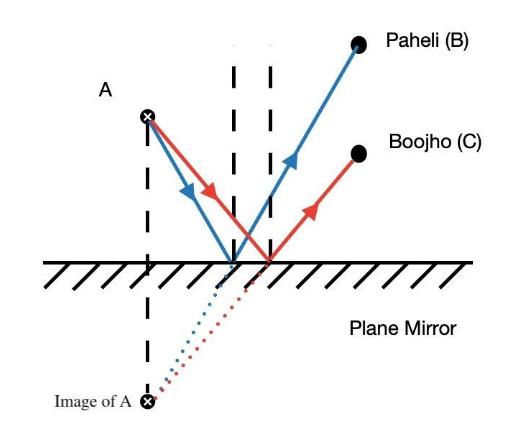
(a) Find out the position of the image of an object situated \[A\] in the plane mirror (in figure 1).
(b) Can Paheli at \[B\] see this image
(c) Can Boojho at \[C\] see this image
(d) When Paheli moves from \[B{\text{ }}to{\text{ }}C,\]where does the image of \[A\] move
Answer
 Verified
615.6k+ views
Hint:To solve any problem with light we have to first see the diagram and have to understand the image formation, then we can solve this. Here paheli, Boojho are two-person; we have to change their position to look for the proper answer to the given answer.
Complete step by step answer:
\[b\]Yes from \[B\] can see this image
\[c\] yes Boojho can see the image form \[C\]
let, u be the distance from object
\[v\] be the distance from image
\[P\] is focal length then,
$\dfrac{1}{v} + \dfrac{1}{u} = \dfrac{1}{f} = 0$
$\because f = \infty {\text{ }}for{\text{ }}plane{\text{ }}mirror$
$\dfrac{1}{u} = - \dfrac{1}{v}$
Taking derivative in both sides,
$ - \dfrac{1}{{{u^2}}}\dot u - \dfrac{1}{{{v^2}}}\dot v = 0 \\
\dot v = \dfrac{{{v^2}}}{{{u^2}}}\dot u \\
\dot v = - \dot u \\
$
$\left[ {\because \dfrac{v}{u} = - 1,\dfrac{{{v^2}}}{{{u^2}}} = 1} \right]$
Object is not moving , so the image will be at the same position.
$\therefore $ If Paheli moves from \[B\] to \[C\] the image will be in the same position.
Note: Always when you are going to observe this problem use diagrams to see the position of the persons. Then you can easily understand the movement of them. By diagram of this question, we can say the following problems. Also here we used the derivatives because here a movement is given to change with a particular distance so we use derivatives.
Complete step by step answer:
\[b\]Yes from \[B\] can see this image
\[c\] yes Boojho can see the image form \[C\]
let, u be the distance from object
\[v\] be the distance from image
\[P\] is focal length then,
$\dfrac{1}{v} + \dfrac{1}{u} = \dfrac{1}{f} = 0$
$\because f = \infty {\text{ }}for{\text{ }}plane{\text{ }}mirror$
$\dfrac{1}{u} = - \dfrac{1}{v}$
Taking derivative in both sides,
$ - \dfrac{1}{{{u^2}}}\dot u - \dfrac{1}{{{v^2}}}\dot v = 0 \\
\dot v = \dfrac{{{v^2}}}{{{u^2}}}\dot u \\
\dot v = - \dot u \\
$
$\left[ {\because \dfrac{v}{u} = - 1,\dfrac{{{v^2}}}{{{u^2}}} = 1} \right]$
Object is not moving , so the image will be at the same position.
$\therefore $ If Paheli moves from \[B\] to \[C\] the image will be in the same position.
Note: Always when you are going to observe this problem use diagrams to see the position of the persons. Then you can easily understand the movement of them. By diagram of this question, we can say the following problems. Also here we used the derivatives because here a movement is given to change with a particular distance so we use derivatives.
Recently Updated Pages
Master Class 12 Business Studies: Engaging Questions & Answers for Success

Master Class 12 Chemistry: Engaging Questions & Answers for Success
Master Class 12 Biology: Engaging Questions & Answers for Success
Class 12 Question and Answer - Your Ultimate Solutions Guide
Master Class 11 Social Science: Engaging Questions & Answers for Success
Master Class 11 Chemistry: Engaging Questions & Answers for Success
Trending doubts
Which are the Top 10 Largest Countries of the World?
Draw a labelled sketch of the human eye class 12 physics CBSE
Name the crygenes that control cotton bollworm and class 12 biology CBSE
Differentiate between homogeneous and heterogeneous class 12 chemistry CBSE
How many molecules of ATP and NADPH are required information class 12 biology CBSE
In a transcription unit the promoter is said to be class 12 biology CBSE