




(a) Find angle of incidence.
(b) Find the angle between the incident and reflected rays.
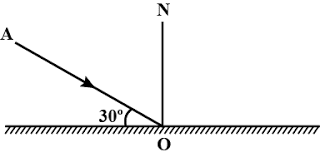
Figure shows an incident ray AO and the normal ON on the plane mirror. The angle which the incident ray AO makes with the mirror is \[{30^0}\].
A. (a) \[{60^0}\] (b) \[{60^0}\]
B. (a) \[{120^0}\] (b) \[{120^0}\]
C. (a) \[{60^0}\] (b) \[{120^0}\]
D. (a) \[{120^0}\] (b) \[{60^0}\]
Answer
 Verified
611.1k+ views
Hint: Angle of incidence is calculated using the acute angle between incident ray and plane mirror. Whereas angle between the incident ray and reflected ray is summation of angle of incidence and angle of reflection.
Complete step by step answer:Given: The acute angle between incident ray and plane of mirror = \[{30^0}\]
Angle of incidence is calculated using the acute angle between incident ray and plane mirror.
The angle of incidence is not the angle made with the surface. It is the angle made with the perpendicular of the surface.
Angle of incidence \[={90^0} - \] acute angle between incident ray and plane of mirror
Angle of incidence = \[{90^0} - {30^0}\]
Angle of incidence = \[{60^0}\]
Whereas angle between the incident ray and reflected ray is summation of angle of incidence and angle of reflection.
Angle of reflection is equal to the angle of incidence for the plane mirror.
So, angle of reflection = \[{60^0}\]
Angle between the incident ray and reflected ray = Angle of incidence + Angle of reflection
Angle between the incident ray and reflected ray = \[{60^0}\]+ \[{60^0}\]
Angle between the incident ray and reflected ray = \[{120^0}\]
Hence option (C) is correct.
i.e. angle of incidence is \[{60^0}\]and angle between the incident ray and reflected ray = \[{120^0}\]
Note:Angle of reflection is equal to the angle of incidence for the plane mirror. This is because when light enters on the plane surface, it reflects without any deviation in the angle. For concave and convex mirrors the angle of incidence and reflection are different. Here, the angle made by ray with respect to the surface of the mirror should not be taken as the angle of incidence.
Complete step by step answer:Given: The acute angle between incident ray and plane of mirror = \[{30^0}\]
Angle of incidence is calculated using the acute angle between incident ray and plane mirror.
The angle of incidence is not the angle made with the surface. It is the angle made with the perpendicular of the surface.
Angle of incidence \[={90^0} - \] acute angle between incident ray and plane of mirror
Angle of incidence = \[{90^0} - {30^0}\]
Angle of incidence = \[{60^0}\]
Whereas angle between the incident ray and reflected ray is summation of angle of incidence and angle of reflection.
Angle of reflection is equal to the angle of incidence for the plane mirror.
So, angle of reflection = \[{60^0}\]
Angle between the incident ray and reflected ray = Angle of incidence + Angle of reflection
Angle between the incident ray and reflected ray = \[{60^0}\]+ \[{60^0}\]
Angle between the incident ray and reflected ray = \[{120^0}\]
Hence option (C) is correct.
i.e. angle of incidence is \[{60^0}\]and angle between the incident ray and reflected ray = \[{120^0}\]
Note:Angle of reflection is equal to the angle of incidence for the plane mirror. This is because when light enters on the plane surface, it reflects without any deviation in the angle. For concave and convex mirrors the angle of incidence and reflection are different. Here, the angle made by ray with respect to the surface of the mirror should not be taken as the angle of incidence.
Recently Updated Pages
Master Class 12 Business Studies: Engaging Questions & Answers for Success

Master Class 12 Chemistry: Engaging Questions & Answers for Success
Master Class 12 Biology: Engaging Questions & Answers for Success
Class 12 Question and Answer - Your Ultimate Solutions Guide
Master Class 11 Social Science: Engaging Questions & Answers for Success
Master Class 11 Chemistry: Engaging Questions & Answers for Success
Trending doubts
Which are the Top 10 Largest Countries of the World?
Draw a labelled sketch of the human eye class 12 physics CBSE
Name the crygenes that control cotton bollworm and class 12 biology CBSE
Differentiate between homogeneous and heterogeneous class 12 chemistry CBSE
How many molecules of ATP and NADPH are required information class 12 biology CBSE
In a transcription unit the promoter is said to be class 12 biology CBSE