




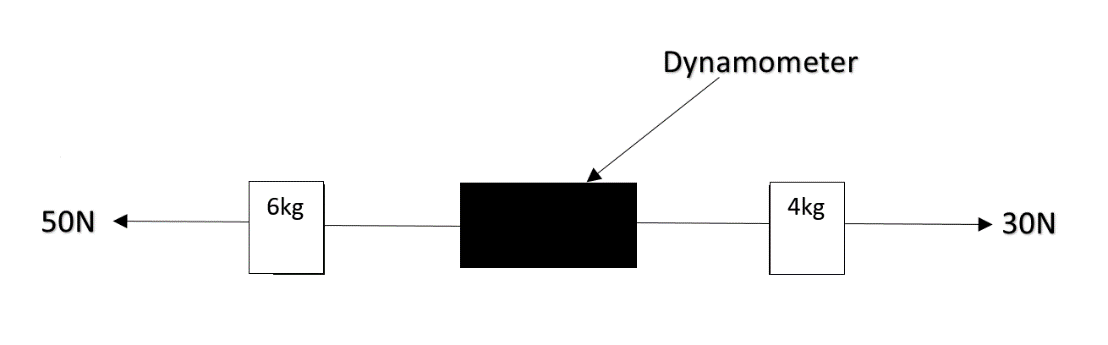
A dynamometer is attached to two blocks of masses 6kg and 4kg as shown in the figure. The reading of the dynamometer is?
A. 18N
B. 28N
C. 38N
D. 48N
Answer
 Verified
589.8k+ views
Hint: As the name itself suggests that it is a device related to ‘dyne’ which is the C.G.S unit of force. A dynamometer is a device which is used to measure the value of force being applied to its ends. When two blocks are attached and force is applied to it, it will experience tension in both ends. Hence the reading of the dynamometer will be the value of tension.
Formula used:
$\sum{F_{x}}=ma$
Complete step by step answer:
Is the value of tension in both the ends equal? Yes, here’s why:
Since we are not given the mass of the dynamometer, hence we have to assume it is very light or massless. Hence the net force is 0 (since $m=0$). Hence the value of forces on its both ends must be the same. That’s why tension is the same on both ends.
Assuming the tension be ‘T’, let's draw the FBD of both blocks separately:
For left block;
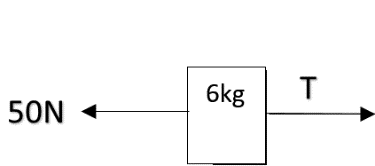
Applying $\sum{F_{x}}=ma$,
50 – T = 6a …………….①
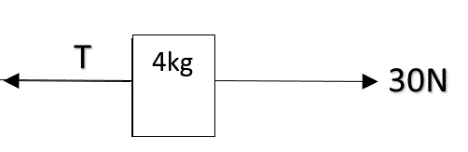
Applying $\sum{F_{x}}=ma$
T – 30 = 4a ………….②
Now, from ②, we get
$a=\dfrac{T-30}{4}$
Putting this value in ①, we get
$50 - T = 6 \times (\dfrac{T-30}{4}) = \dfrac{3T}{2}-45$
Hence, $50 +45 = T + \dfrac{3T}{2}$
$\Rightarrow$ $\dfrac{5T}{2} = 95$
$\therefore$ $T=38N$
Hence option C is correct.
Note:
Sometimes students think that tension in one end is ‘x’ and in the other end is ‘y’, so they straight away mark the answer ‘x-y’. But this is not so. One must realize that it only happens when the net mass of the system is zero or approaches zero. Also sometimes we can get the value of the mass of the dynamometer also. That time we have to consider that too, which will change the answer entirely.
Formula used:
$\sum{F_{x}}=ma$
Complete step by step answer:
Is the value of tension in both the ends equal? Yes, here’s why:
Since we are not given the mass of the dynamometer, hence we have to assume it is very light or massless. Hence the net force is 0 (since $m=0$). Hence the value of forces on its both ends must be the same. That’s why tension is the same on both ends.
Assuming the tension be ‘T’, let's draw the FBD of both blocks separately:
For left block;
Applying $\sum{F_{x}}=ma$,
50 – T = 6a …………….①
Applying $\sum{F_{x}}=ma$
T – 30 = 4a ………….②
Now, from ②, we get
$a=\dfrac{T-30}{4}$
Putting this value in ①, we get
$50 - T = 6 \times (\dfrac{T-30}{4}) = \dfrac{3T}{2}-45$
Hence, $50 +45 = T + \dfrac{3T}{2}$
$\Rightarrow$ $\dfrac{5T}{2} = 95$
$\therefore$ $T=38N$
Hence option C is correct.
Note:
Sometimes students think that tension in one end is ‘x’ and in the other end is ‘y’, so they straight away mark the answer ‘x-y’. But this is not so. One must realize that it only happens when the net mass of the system is zero or approaches zero. Also sometimes we can get the value of the mass of the dynamometer also. That time we have to consider that too, which will change the answer entirely.
Recently Updated Pages
Master Class 11 Social Science: Engaging Questions & Answers for Success

Master Class 11 English: Engaging Questions & Answers for Success
Master Class 11 Accountancy: Engaging Questions & Answers for Success
Master Class 11 Physics: Engaging Questions & Answers for Success
Master Class 11 Computer Science: Engaging Questions & Answers for Success
Master Class 11 Business Studies: Engaging Questions & Answers for Success
Trending doubts
One Metric ton is equal to kg A 10000 B 1000 C 100 class 11 physics CBSE
Find the value of the expression given below sin 30circ class 11 maths CBSE
Draw a diagram of nephron and explain its structur class 11 biology CBSE
10 examples of friction in our daily life
Proton was discovered by A Thomson B Rutherford C Chadwick class 11 chemistry CBSE
The teeth used for biting and cutting food are called class 11 biology CBSE