




(a) Draw a ray diagram to represent a convex mirror. On this diagram mark the principal axis, principal focus F and the centre of curvature C if the focal length of the convex mirror is \[3\,cm\].
(b) An object \[1\,cm\] tall is placed \[30\,cm\] in front of a convex mirror of focal length \[20\,cm\]. Find the size and position of the image formed by the convex mirror.
Answer
 Verified
591.6k+ views
Hint:Study about mirrors and learn about different parts of a mirror. Use the mirror's formula to find the position and property of the image. Principal axis of a mirror is the line joining the centre of curvature, principal focus and midpoint of any mirror.
Formula used:
Mirror’s formula is given by, \[\dfrac{1}{v} + \dfrac{1}{u} = \dfrac{1}{f}\]
where, \[v\]is the image distance, \[u\] is the object distance and \[f\] is the focal length of the mirror.
Magnification in a mirror is given by, \[m = \dfrac{{{h_i}}}{{{h_o}}} = \dfrac{v}{u}\]
where, \[m\] is the magnification of the object, \[{h_i}\] is the image height and \[{h_o}\] is the object height.
Complete step by step answer:
(a) The marked diagram of a convex mirror with focal length \[3cm\] is given below.
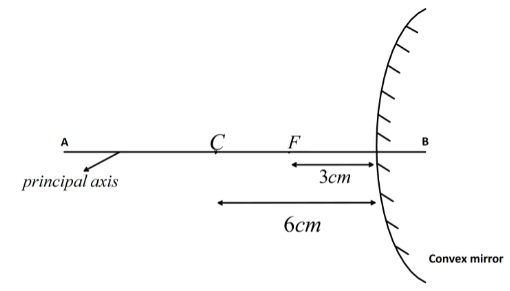
In the figure, AB is the principal axis, F is the principal focus and C is the centre of curvature.
(b) Here we have given an object of length \[{h_o} = 1\,cm\] and distance of the object from the mirror is, \[u = - 30\,cm\] focal length of the given convex mirror is \[f = - 20\,cm\] (Since, it is a mirror). Now, from mirror’s formula we have, \[\dfrac{1}{v} + \dfrac{1}{u} = \dfrac{1}{f}\] where, \[v\] is the image distance, \[u\] is the object distance and \[f\] is the focal length of the mirror.
So, putting the values of object distance \[u = - 30\,cm\] and focal length of the mirror \[f = - 20\,cm\] we have,
\[\dfrac{1}{{ - 30}} + \dfrac{1}{v} = \dfrac{1}{{ - 20}}\]
\[\Rightarrow\dfrac{1}{v} = \dfrac{1}{{30}} - \dfrac{1}{{20}}\]
Simplifying we have,
\[\dfrac{1}{v} = \dfrac{{2 - 3}}{{60}}\]
\[\Rightarrow\dfrac{1}{v} = \dfrac{{ - 1}}{{60}}\]
\[\Rightarrow v = - 60\,cm\]
Now, we know magnification in a mirror is given by, \[m = \dfrac{{{h_i}}}{{{h_o}}} = \dfrac{v}{u}\] where, \[{h_i}\] is the image height and \[{h_o}\] is the object height.
So, putting, object height \[{h_o} = 1\,cm\] object distance \[u = - 30\,cm\] and image distance \[v = - 60\,cm\] we have,
\[\dfrac{{{h_i}}}{1} = \dfrac{{ - 60}}{{ - 30}}\]
\[\therefore {h_i} = 2\,cm\].
Hence, the image will be at a distance of \[60\,cm\] in front of the mirror and the image will be erect, real and magnified twice.
Note: The negative sign implies that the distance is in the left of the mirror. The distance measured to the left of the incident ray is taken to be negative and the distance measured to the right of the incident ray is taken to be always positive. If the image is formed behind the mirror the image will be said to be a virtual image.
Formula used:
Mirror’s formula is given by, \[\dfrac{1}{v} + \dfrac{1}{u} = \dfrac{1}{f}\]
where, \[v\]is the image distance, \[u\] is the object distance and \[f\] is the focal length of the mirror.
Magnification in a mirror is given by, \[m = \dfrac{{{h_i}}}{{{h_o}}} = \dfrac{v}{u}\]
where, \[m\] is the magnification of the object, \[{h_i}\] is the image height and \[{h_o}\] is the object height.
Complete step by step answer:
(a) The marked diagram of a convex mirror with focal length \[3cm\] is given below.
In the figure, AB is the principal axis, F is the principal focus and C is the centre of curvature.
(b) Here we have given an object of length \[{h_o} = 1\,cm\] and distance of the object from the mirror is, \[u = - 30\,cm\] focal length of the given convex mirror is \[f = - 20\,cm\] (Since, it is a mirror). Now, from mirror’s formula we have, \[\dfrac{1}{v} + \dfrac{1}{u} = \dfrac{1}{f}\] where, \[v\] is the image distance, \[u\] is the object distance and \[f\] is the focal length of the mirror.
So, putting the values of object distance \[u = - 30\,cm\] and focal length of the mirror \[f = - 20\,cm\] we have,
\[\dfrac{1}{{ - 30}} + \dfrac{1}{v} = \dfrac{1}{{ - 20}}\]
\[\Rightarrow\dfrac{1}{v} = \dfrac{1}{{30}} - \dfrac{1}{{20}}\]
Simplifying we have,
\[\dfrac{1}{v} = \dfrac{{2 - 3}}{{60}}\]
\[\Rightarrow\dfrac{1}{v} = \dfrac{{ - 1}}{{60}}\]
\[\Rightarrow v = - 60\,cm\]
Now, we know magnification in a mirror is given by, \[m = \dfrac{{{h_i}}}{{{h_o}}} = \dfrac{v}{u}\] where, \[{h_i}\] is the image height and \[{h_o}\] is the object height.
So, putting, object height \[{h_o} = 1\,cm\] object distance \[u = - 30\,cm\] and image distance \[v = - 60\,cm\] we have,
\[\dfrac{{{h_i}}}{1} = \dfrac{{ - 60}}{{ - 30}}\]
\[\therefore {h_i} = 2\,cm\].
Hence, the image will be at a distance of \[60\,cm\] in front of the mirror and the image will be erect, real and magnified twice.
Note: The negative sign implies that the distance is in the left of the mirror. The distance measured to the left of the incident ray is taken to be negative and the distance measured to the right of the incident ray is taken to be always positive. If the image is formed behind the mirror the image will be said to be a virtual image.
Recently Updated Pages
Write any three differences between metals and nonmetals class 10 social science CBSE

Amit standing on a horizontal plane finds a bird flying class 10 maths CBSE
Two circles of radii 5 cm and 3 cm intersect at two class 10 maths CBSE
Solve the following i John and Jivanti together have class 10 maths CBSE
What is the relation between orthocenter circumcentre class 10 maths CBSE
Two plane mirrors are inclined at 70circ A ray incident class 10 physics CBSE
Trending doubts
Explain the Treaty of Vienna of 1815 class 10 social science CBSE
Which country is known as "The land of Fire and Ice"?
1 GB equals how many MB?
10 examples of evaporation in daily life with explanations
What is the full form of POSCO class 10 social science CBSE
Make a sketch of the human nerve cell What function class 10 biology CBSE