




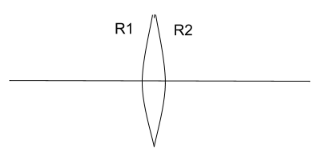
A double convex lens is made of a glass of refractive index 1.55, with both faces of the same radius of curvature. Find the radius of curvature required, if the focal length is 20cm.
Answer
 Verified
627.9k+ views
Hint: We will first consider that the radius of curvature of both the sides will be equal to the required radius of curvature in order to solve this solution further. We will also take in notice that the value of ${R_2}$ will be negative as it resides on the right side of the lens.
Step By Step Answer:
Formula used: $\dfrac{1}{f} = \left( {\mu - 1} \right)\left( {\dfrac{1}{{{R_1}}} - \dfrac{1}{{{R_2}}}} \right)$
Let the radius of curvature of the left side be ${R_1}$.
Let the radius of curvature of the right side be ${R_2}$.
We are asked to find out the value of R by the question.
As it is already mentioned in the question that the radius of curvature of both the sides is the same. So-
$ \Rightarrow {R_1} = {R_2} = R$
We have to find out the value of R.
The value of focal length as per given in the question is 20cm.
The refractive index of the glass, as already known, is given as $\mu = 1.55$.
Now, as we know that the Lens formula in terms of $\mu $ is $\dfrac{1}{f} = \left( {\mu - 1} \right)\left( {\dfrac{1}{{{R_1}}} - \dfrac{1}{{{R_2}}}} \right)$. Applying this formula, we get-
$
\Rightarrow \dfrac{1}{f} = \left( {\mu - 1} \right)\left( {\dfrac{1}{{{R_1}}} - \dfrac{1}{{{R_2}}}} \right) \\
\\
\Rightarrow \dfrac{1}{{20}} = \left( {1.55 - 1} \right)\left( {\dfrac{1}{{{R_1}}} - \dfrac{1}{{{R_2}}}} \right) \\
$
Since we know that ${R_1} = {R_2} = R$ and that ${R_2}$ will be negative (right side of the lens) whereas focal length will be positive (left side of the lens)
$
\Rightarrow \dfrac{1}{{20}} = \left( {1.55 - 1} \right)\left( {\dfrac{1}{R} - \dfrac{1}{{\left( { - R} \right)}}} \right) \\
\\
\Rightarrow \dfrac{1}{{20}} = \left( {0.55} \right)\left( {\dfrac{1}{R} - \dfrac{1}{{\left( { - R} \right)}}} \right) \\
\\
\Rightarrow \dfrac{1}{{20}} = \left( {0.55} \right)\left( {\dfrac{2}{R}} \right) \\
\\
\Rightarrow \dfrac{1}{{20}} = \left( {\dfrac{{1.1}}{R}} \right) \\
\\
\Rightarrow R = 1.1 \times 20 \\
\\
\Rightarrow R = 22cm \\
$
Hence, the required radius of curvature is 22cm.
Note: Refractive index, also known as refractive ratio, measures the stretching of the light ray from one source to the next. If i is the angle of incidence of the vacuum ray (angle of the incoming ray with the perpendicular ray at the surface, called normal), and r is the angle of refraction (angle of the ray between medium and normal), the refractive index n shall be defined as the ratio of the sine to the angular sine of the refractive angle; that is to say $n = \dfrac{{\sin i}}{{\sin r}}$.
Step By Step Answer:
Formula used: $\dfrac{1}{f} = \left( {\mu - 1} \right)\left( {\dfrac{1}{{{R_1}}} - \dfrac{1}{{{R_2}}}} \right)$
Let the radius of curvature of the left side be ${R_1}$.
Let the radius of curvature of the right side be ${R_2}$.
We are asked to find out the value of R by the question.
As it is already mentioned in the question that the radius of curvature of both the sides is the same. So-
$ \Rightarrow {R_1} = {R_2} = R$
We have to find out the value of R.
The value of focal length as per given in the question is 20cm.
The refractive index of the glass, as already known, is given as $\mu = 1.55$.
Now, as we know that the Lens formula in terms of $\mu $ is $\dfrac{1}{f} = \left( {\mu - 1} \right)\left( {\dfrac{1}{{{R_1}}} - \dfrac{1}{{{R_2}}}} \right)$. Applying this formula, we get-
$
\Rightarrow \dfrac{1}{f} = \left( {\mu - 1} \right)\left( {\dfrac{1}{{{R_1}}} - \dfrac{1}{{{R_2}}}} \right) \\
\\
\Rightarrow \dfrac{1}{{20}} = \left( {1.55 - 1} \right)\left( {\dfrac{1}{{{R_1}}} - \dfrac{1}{{{R_2}}}} \right) \\
$
Since we know that ${R_1} = {R_2} = R$ and that ${R_2}$ will be negative (right side of the lens) whereas focal length will be positive (left side of the lens)
$
\Rightarrow \dfrac{1}{{20}} = \left( {1.55 - 1} \right)\left( {\dfrac{1}{R} - \dfrac{1}{{\left( { - R} \right)}}} \right) \\
\\
\Rightarrow \dfrac{1}{{20}} = \left( {0.55} \right)\left( {\dfrac{1}{R} - \dfrac{1}{{\left( { - R} \right)}}} \right) \\
\\
\Rightarrow \dfrac{1}{{20}} = \left( {0.55} \right)\left( {\dfrac{2}{R}} \right) \\
\\
\Rightarrow \dfrac{1}{{20}} = \left( {\dfrac{{1.1}}{R}} \right) \\
\\
\Rightarrow R = 1.1 \times 20 \\
\\
\Rightarrow R = 22cm \\
$
Hence, the required radius of curvature is 22cm.
Note: Refractive index, also known as refractive ratio, measures the stretching of the light ray from one source to the next. If i is the angle of incidence of the vacuum ray (angle of the incoming ray with the perpendicular ray at the surface, called normal), and r is the angle of refraction (angle of the ray between medium and normal), the refractive index n shall be defined as the ratio of the sine to the angular sine of the refractive angle; that is to say $n = \dfrac{{\sin i}}{{\sin r}}$.
Recently Updated Pages
Master Class 12 Business Studies: Engaging Questions & Answers for Success

Master Class 12 Biology: Engaging Questions & Answers for Success
Master Class 12 Chemistry: Engaging Questions & Answers for Success
Class 12 Question and Answer - Your Ultimate Solutions Guide
Master Class 11 Social Science: Engaging Questions & Answers for Success
Master Class 11 English: Engaging Questions & Answers for Success
Trending doubts
Which are the Top 10 Largest Countries of the World?
Draw a labelled sketch of the human eye class 12 physics CBSE
Name the crygenes that control cotton bollworm and class 12 biology CBSE
Differentiate between homogeneous and heterogeneous class 12 chemistry CBSE
Ribosomal RNA is actively synthesised in A Nucleoplasm class 12 biology CBSE
How many molecules of ATP and NADPH are required information class 12 biology CBSE