




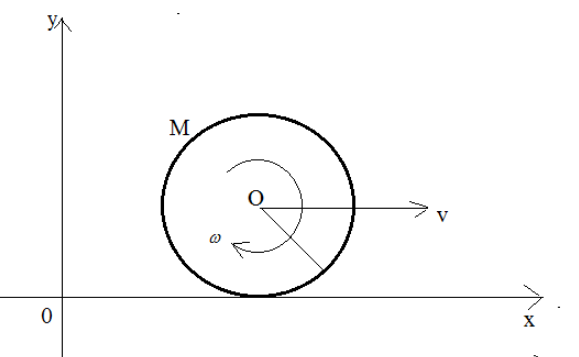
A disc of mass M and radius is rolling with angular speed on a horizontal plane as shown in the figure the magnitude of angular momentum of the disc about the origin O is:
(A) $\dfrac{1}{2}M{R^2}\omega $
(B) $M{R^2}\omega $
(C) $\dfrac{3}{2}M{R^2}\omega $
(D) $2M{R^2}\omega $
Answer
 Verified
604.2k+ views
Hint: In this question, we need to determine the magnitude of angular momentum of the disc about the origin O such that a disc of the disc of mass M and radius is rolling with angular speed $\omega $ on a horizontal plane. For this, we will use the relation between the mass of the disc, radius of the disc and the angular speed of the disc.
Complete step by step answer:
Let the angular momentum about the origin be ${L_0}$ which is given as the summation of the angular momentum with respect to the centre of mass of the disc and angular momentum with respect to the origin. Mathematically, ${L_0} = I\omega + MvR$ where,
I = moment of inertia of the disc
$\omega$ = angular speed of the disc
v = speed of the disc on the plane and,
R = radius of the disc
There is no slipping involved in the motion, i.e. it’s a case of pure rolling, in that case, v = R
Also, the moment of inertia for the rolling disc is given by $I = \dfrac{1}{2}M{R^2}$
Now, substituting values of v and I in the equation ${L_0} = I\omega + MvR$, we get
$
{L_0} = \dfrac{1}{2}M{R^2}\omega + M(R\omega )R \\
\Rightarrow{L_0} = \dfrac{1}{2}M{R^2}\omega + M({R^2}\omega ) \\
\therefore{L_0} = \dfrac{3}{2}M{R^2}\omega \\
$
Hence, the magnitude of angular momentum of the disc about the origin O is $\dfrac{3}{2}M{R^2}\omega $.
Hence,option C is correct.
Note: It is worth noting here that the angular momentum of the translating rotating disc is the sum of the angular momentum due to the origin and due to the centre of mass of the disc.
Complete step by step answer:
Let the angular momentum about the origin be ${L_0}$ which is given as the summation of the angular momentum with respect to the centre of mass of the disc and angular momentum with respect to the origin. Mathematically, ${L_0} = I\omega + MvR$ where,
I = moment of inertia of the disc
$\omega$ = angular speed of the disc
v = speed of the disc on the plane and,
R = radius of the disc
There is no slipping involved in the motion, i.e. it’s a case of pure rolling, in that case, v = R
Also, the moment of inertia for the rolling disc is given by $I = \dfrac{1}{2}M{R^2}$
Now, substituting values of v and I in the equation ${L_0} = I\omega + MvR$, we get
$
{L_0} = \dfrac{1}{2}M{R^2}\omega + M(R\omega )R \\
\Rightarrow{L_0} = \dfrac{1}{2}M{R^2}\omega + M({R^2}\omega ) \\
\therefore{L_0} = \dfrac{3}{2}M{R^2}\omega \\
$
Hence, the magnitude of angular momentum of the disc about the origin O is $\dfrac{3}{2}M{R^2}\omega $.
Hence,option C is correct.
Note: It is worth noting here that the angular momentum of the translating rotating disc is the sum of the angular momentum due to the origin and due to the centre of mass of the disc.
Recently Updated Pages
Master Class 11 Economics: Engaging Questions & Answers for Success

Master Class 11 English: Engaging Questions & Answers for Success
Master Class 11 Maths: Engaging Questions & Answers for Success
Class 11 Question and Answer - Your Ultimate Solutions Guide
Master Class 11 Social Science: Engaging Questions & Answers for Success
Master Class 11 Business Studies: Engaging Questions & Answers for Success
Trending doubts
Differentiate between an exothermic and an endothermic class 11 chemistry CBSE
One Metric ton is equal to kg A 10000 B 1000 C 100 class 11 physics CBSE
There are 720 permutations of the digits 1 2 3 4 5 class 11 maths CBSE
In what year Guru Nanak Dev ji was born A15 April 1469 class 11 social science CBSE
Difference Between Prokaryotic Cells and Eukaryotic Cells
Draw a diagram of a plant cell and label at least eight class 11 biology CBSE