




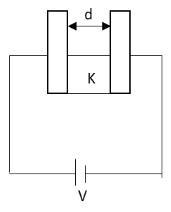
A dielectric slab fills the lower half of a parallel plate capacitor as shown in figure: (Take plate area as \[A\])
A .equivalent capacity of the system is \[\left( {\left( {{\varepsilon _0}A/2d} \right)\left( {1 + K} \right)} \right)\]
B. the net charge of the lower half of the left hand plate is \[1/K\] times the charge on the upper half of the plate
C. net charges on the lower and upper halves of the left hand plate are different
D. the net charge on the lower hand of the left hand plate is \[\dfrac{{K{\varepsilon _0}A}}{{2d}} \times V\]
Answer
 Verified
570.9k+ views
Hint:Use the formula for the capacitance of a parallel plate capacitor. Also use the formula for the charge on the plates of a capacitor. Consider the upper and lower half portions of the capacitor in the figure as two capacitors connected in parallel. Calculate the net capacitance of the two capacitors. Then using the formula for the charge on the capacitor, calculate the charge on the upper and lower halves of the left plate of the capacitor.
Formulae used:
The capacitance \[C\] of a parallel plate capacitor is
\[C = \dfrac{{{\varepsilon _0}A}}{d}\] …… (1)
Here, \[{\varepsilon _0}\] is permittivity of free space, \[A\] is an area of the capacitor and \[d\] is separation between the two plates of the capacitor.
The charge \[Q\] on a capacitor is
\[Q = CV\] …… (2)
Here, \[C\] is capacitance of the capacitor and \[V\] is the potential difference between the plates of the capacitor.
Complete step by step answer:
We have given that a dielectric slab is filled in the lower half portion of a parallel plate capacitor.The upper half and lower half of the given system of capacitor can be considered as the two capacitors in parallel.We have given that the total area of the given capacitor is \[A\]. Hence, the area of the lower half and upper half of the parallel plate capacitor is \[\dfrac{A}{2}\].
Hence, the area of the upper half of the capacitor is
\[{C_1} = \dfrac{{{\varepsilon _0}A}}{{2d}}\]
The area of the lower half portion of the capacitor is
\[{C_2} = \dfrac{{{\varepsilon _0}KA}}{{2d}}\]
Since the two capacitors are in parallel, the equivalent capacitance is
\[{C_{eq}} = {C_1} + {C_2}\]
\[ \Rightarrow {C_{eq}} = \dfrac{{{\varepsilon _0}A}}{{2d}} + \dfrac{{{\varepsilon _0}KA}}{{2d}}\]
\[ \Rightarrow {C_{eq}} = \dfrac{{{\varepsilon _0}A}}{{2d}}\left( {1 + K} \right)\]
Therefore, the equivalent capacitance of the system is \[\dfrac{{{\varepsilon _0}A}}{{2d}}\left( {1 + K} \right)\].
Hence, the option A is correct.
Let us now calculate the charge on the lower half and upper half of the left hand side plate of the capacitor. The potential \[V\] on the lower and upper half of the left hand side capacitor is the same. The charge \[{Q_{LU}}\] on the upper half of the left hand side capacitor is
\[{Q_{LU}} = {C_1}V\]
\[ \Rightarrow {Q_{LU}} = \dfrac{{{\varepsilon _0}AV}}{{2d}}\] ……. (3)
The charge \[{Q_{LL}}\] on the upper half of the left hand side capacitor is
\[{Q_{LL}} = {C_2}V\]
\[ \Rightarrow {Q_{LL}} = \dfrac{{{\varepsilon _0}KAV}}{{2d}}\] …… (4)
Substitute \[{Q_{LU}}\] for \[\dfrac{{{\varepsilon _0}AV}}{{2d}}\] in the above equation.
\[ \Rightarrow {Q_{LL}} = K{Q_{LU}}\]
Therefore, the charge on lower half of the left hand side plate of capacitor is \[K\] times the charge on the upper half of the left hand side plate of capacitor.Hence, the option B is incorrect.From equations (3) and (4), we can say that the charges on lower and upper half of the left hand side plate of the capacitor are different.Hence, the option C is correct.
Rewrite equation (4) as
\[ \Rightarrow {Q_{LL}} = \dfrac{{{\varepsilon _0}KA}}{{2d}} \times V\]
Therefore, the net charge on the lower half of the left plate of the capacitor is \[\dfrac{{{\varepsilon _0}KA}}{{2d}} \times V\].
Hence, the option D is correct.
Hence, the correct options are A, C and D.
Note: One can also explain the option C by another method. One can explain that the upper and lower half of the left plate of the parallel plate capacitor are in parallel. Hence, the potential difference between them is the same and hence, the charge on these two capacitors in parallel must be different.
Formulae used:
The capacitance \[C\] of a parallel plate capacitor is
\[C = \dfrac{{{\varepsilon _0}A}}{d}\] …… (1)
Here, \[{\varepsilon _0}\] is permittivity of free space, \[A\] is an area of the capacitor and \[d\] is separation between the two plates of the capacitor.
The charge \[Q\] on a capacitor is
\[Q = CV\] …… (2)
Here, \[C\] is capacitance of the capacitor and \[V\] is the potential difference between the plates of the capacitor.
Complete step by step answer:
We have given that a dielectric slab is filled in the lower half portion of a parallel plate capacitor.The upper half and lower half of the given system of capacitor can be considered as the two capacitors in parallel.We have given that the total area of the given capacitor is \[A\]. Hence, the area of the lower half and upper half of the parallel plate capacitor is \[\dfrac{A}{2}\].
Hence, the area of the upper half of the capacitor is
\[{C_1} = \dfrac{{{\varepsilon _0}A}}{{2d}}\]
The area of the lower half portion of the capacitor is
\[{C_2} = \dfrac{{{\varepsilon _0}KA}}{{2d}}\]
Since the two capacitors are in parallel, the equivalent capacitance is
\[{C_{eq}} = {C_1} + {C_2}\]
\[ \Rightarrow {C_{eq}} = \dfrac{{{\varepsilon _0}A}}{{2d}} + \dfrac{{{\varepsilon _0}KA}}{{2d}}\]
\[ \Rightarrow {C_{eq}} = \dfrac{{{\varepsilon _0}A}}{{2d}}\left( {1 + K} \right)\]
Therefore, the equivalent capacitance of the system is \[\dfrac{{{\varepsilon _0}A}}{{2d}}\left( {1 + K} \right)\].
Hence, the option A is correct.
Let us now calculate the charge on the lower half and upper half of the left hand side plate of the capacitor. The potential \[V\] on the lower and upper half of the left hand side capacitor is the same. The charge \[{Q_{LU}}\] on the upper half of the left hand side capacitor is
\[{Q_{LU}} = {C_1}V\]
\[ \Rightarrow {Q_{LU}} = \dfrac{{{\varepsilon _0}AV}}{{2d}}\] ……. (3)
The charge \[{Q_{LL}}\] on the upper half of the left hand side capacitor is
\[{Q_{LL}} = {C_2}V\]
\[ \Rightarrow {Q_{LL}} = \dfrac{{{\varepsilon _0}KAV}}{{2d}}\] …… (4)
Substitute \[{Q_{LU}}\] for \[\dfrac{{{\varepsilon _0}AV}}{{2d}}\] in the above equation.
\[ \Rightarrow {Q_{LL}} = K{Q_{LU}}\]
Therefore, the charge on lower half of the left hand side plate of capacitor is \[K\] times the charge on the upper half of the left hand side plate of capacitor.Hence, the option B is incorrect.From equations (3) and (4), we can say that the charges on lower and upper half of the left hand side plate of the capacitor are different.Hence, the option C is correct.
Rewrite equation (4) as
\[ \Rightarrow {Q_{LL}} = \dfrac{{{\varepsilon _0}KA}}{{2d}} \times V\]
Therefore, the net charge on the lower half of the left plate of the capacitor is \[\dfrac{{{\varepsilon _0}KA}}{{2d}} \times V\].
Hence, the option D is correct.
Hence, the correct options are A, C and D.
Note: One can also explain the option C by another method. One can explain that the upper and lower half of the left plate of the parallel plate capacitor are in parallel. Hence, the potential difference between them is the same and hence, the charge on these two capacitors in parallel must be different.
Recently Updated Pages
Basicity of sulphurous acid and sulphuric acid are

Master Class 12 English: Engaging Questions & Answers for Success
Master Class 12 Social Science: Engaging Questions & Answers for Success
Master Class 12 Maths: Engaging Questions & Answers for Success
Master Class 12 Economics: Engaging Questions & Answers for Success
Master Class 12 Physics: Engaging Questions & Answers for Success
Trending doubts
Draw a labelled sketch of the human eye class 12 physics CBSE
Which are the Top 10 Largest Countries of the World?
Draw ray diagrams each showing i myopic eye and ii class 12 physics CBSE
Giving reasons state the signs positive or negative class 12 physics CBSE
Explain esterification reaction with the help of a class 12 chemistry CBSE
What is defined as a solenoid Depict a diagram with class 12 physics CBSE