




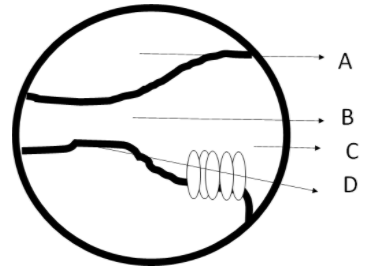
A diagrammatic cross section of a single loop of human cochlea is shown in the given figure.
Which one of the following options correctly represents the names of any three of the labelled parts?
A. A- Endolymph, B- Tectorial membrane, D- Sensory hair cells
B. A- Perilymph, B- Tectorial membrane, C- Endolymph
C. B- Tectorial membrane, C- Perilymph, D- Secretory cells
D. A- Serum, C- Endolymph, D- Sensory hair cells
Answer
 Verified
596.1k+ views
Hint: Endolymph and perilymph are fluids present in the inner ear. The tectorial membrane covers the hair cells. The sensory hair cells percept sound. When the auditory waves set the hair cells in vibration, the sound is transmitted through the auditory nerve to the auditory centre.
Complete answer:
The diagram represents the internal structure of the cochlea. The cochlea consists of three chambers – the scala vestibuli, scala media and the scala tympani. The scala media contains endolymph fluid, while the scala vestibuli and tympani are filled with the perilymph fluid. Thus, the part labelled A is the representative of perilymph and the part labelled C is the endolymph.
The cochlea is divided into three chambers by two membranes – the basilar membrane and the Reissner's membrane. Another membrane known as the tectorial membrane is attached to the basilar membrane. It covers the sensory hair cells and is attached to them. When the tectorial membrane vibrates, it sets the hair cells into vibration and thus contributes to the transmission of sound to the auditory nerve. The structure labelled B represents the tectorial membrane over the sensory hair cells. The vibrations of the hair cells are converted into electrical signals at the auditory centre in the brain, thus, leading to hearing.
Hence, the correct answer is option (B).
Note: The part labeled D represents the sensory hair cells. The organ of Corti is known as the organ of hearing and is present inside the cochlea. The cochlea takes two and a half turns and is in the shape of a shell. It occupies the inner ear space.
Complete answer:
The diagram represents the internal structure of the cochlea. The cochlea consists of three chambers – the scala vestibuli, scala media and the scala tympani. The scala media contains endolymph fluid, while the scala vestibuli and tympani are filled with the perilymph fluid. Thus, the part labelled A is the representative of perilymph and the part labelled C is the endolymph.
The cochlea is divided into three chambers by two membranes – the basilar membrane and the Reissner's membrane. Another membrane known as the tectorial membrane is attached to the basilar membrane. It covers the sensory hair cells and is attached to them. When the tectorial membrane vibrates, it sets the hair cells into vibration and thus contributes to the transmission of sound to the auditory nerve. The structure labelled B represents the tectorial membrane over the sensory hair cells. The vibrations of the hair cells are converted into electrical signals at the auditory centre in the brain, thus, leading to hearing.
Hence, the correct answer is option (B).
Note: The part labeled D represents the sensory hair cells. The organ of Corti is known as the organ of hearing and is present inside the cochlea. The cochlea takes two and a half turns and is in the shape of a shell. It occupies the inner ear space.
Recently Updated Pages
Master Class 11 Social Science: Engaging Questions & Answers for Success

Master Class 11 English: Engaging Questions & Answers for Success
Master Class 11 Maths: Engaging Questions & Answers for Success
Master Class 11 Chemistry: Engaging Questions & Answers for Success
Master Class 11 Biology: Engaging Questions & Answers for Success
Class 11 Question and Answer - Your Ultimate Solutions Guide
Trending doubts
One Metric ton is equal to kg A 10000 B 1000 C 100 class 11 physics CBSE
Difference Between Prokaryotic Cells and Eukaryotic Cells
Find the value of the expression given below sin 30circ class 11 maths CBSE
1 ton equals to A 100 kg B 1000 kg C 10 kg D 10000 class 11 physics CBSE
Two of the body parts which do not appear in MRI are class 11 biology CBSE
Draw a diagram of nephron and explain its structur class 11 biology CBSE