




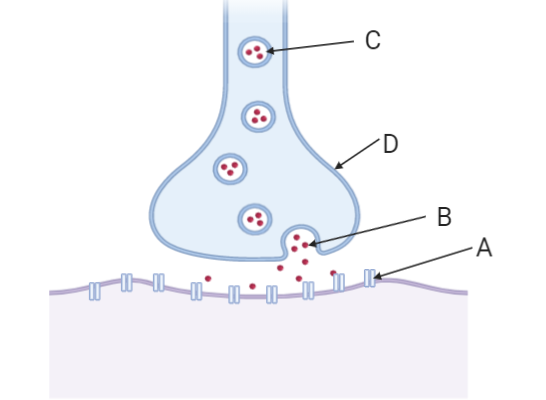
A diagram showing the axon terminal and synapse is given. Identify correctly at least two of:
(a) A- receptor
C- synaptic vesicle
(b) B- synaptic vesicle
D- ${K^ + }$
(c) A- Neurotransmitter
B- Synaptic cleft
(d) C- Neurotransmitter
D- $C{a^{2 + }}$
Answer
 Verified
617.7k+ views
Hint: The picture is showing the axon terminal and synapse. This is used in transmission of nerve impulse from one neuron to another. There are two types of nerve impulse: chemical and electrical impulse. Picture shows the chemical impulse between two neurons.
Complete answer:
Nerve impulse is defined as the transmission of impulse from one neuron to another. There are two kinds of nerve impulse transmission occurs through the synapse between two neurons:
Electrical Nerve impulse: The pre and post membranes are found to be in close proximity to each other in electrical form of transferring of impulse.
Chemical nerve impulse: There is found fluid space between the pre and postsynaptic membrane. This fluid is known as synaptic cleft.
Electrical nerve impulse transmission is faster than chemical nerve impulse transmission.
The picture is showing the chemical nerve impulse transmission between two neurons:
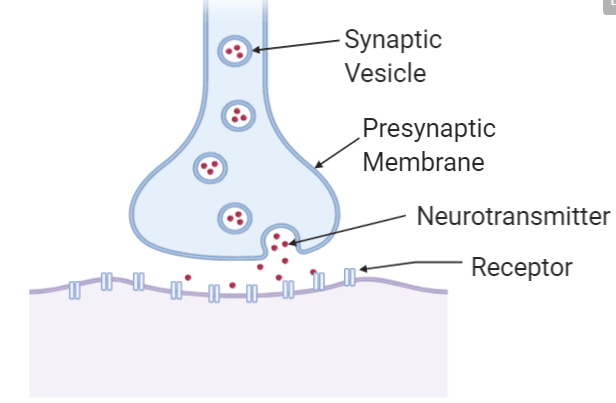
A is the receptor in this image. It allows the ligand to bind to it. Neurotransmitters act as a ligand in this impulse.
B is the neurotransmitter which is released from the synaptic vesicle of the axon terminal. The neurotransmitters are released in the synaptic cleft.
C is a synaptic vesicle in the axon terminal of neurons. Synaptic vesicles store neurotransmitters.
D is a presynaptic membrane.
That’s why A- receptor and C- synaptic vesicles are correctly labelled in the image.
Hence, the answer is “Option A”.
Note: The B arrow is attached to the neurotransmitter. It is not attached to the free space. That’s why the B arrow does not depict synaptic cleft. Synaptic vesicles store the neurotransmitter until they are not released in the synaptic cleft. Receptor present on the postsynaptic membrane is the ligand bind receptor. Because a neurotransmitter acts as a ligand.
Complete answer:
Nerve impulse is defined as the transmission of impulse from one neuron to another. There are two kinds of nerve impulse transmission occurs through the synapse between two neurons:
Electrical Nerve impulse: The pre and post membranes are found to be in close proximity to each other in electrical form of transferring of impulse.
Chemical nerve impulse: There is found fluid space between the pre and postsynaptic membrane. This fluid is known as synaptic cleft.
Electrical nerve impulse transmission is faster than chemical nerve impulse transmission.
The picture is showing the chemical nerve impulse transmission between two neurons:
A is the receptor in this image. It allows the ligand to bind to it. Neurotransmitters act as a ligand in this impulse.
B is the neurotransmitter which is released from the synaptic vesicle of the axon terminal. The neurotransmitters are released in the synaptic cleft.
C is a synaptic vesicle in the axon terminal of neurons. Synaptic vesicles store neurotransmitters.
D is a presynaptic membrane.
That’s why A- receptor and C- synaptic vesicles are correctly labelled in the image.
Hence, the answer is “Option A”.
Note: The B arrow is attached to the neurotransmitter. It is not attached to the free space. That’s why the B arrow does not depict synaptic cleft. Synaptic vesicles store the neurotransmitter until they are not released in the synaptic cleft. Receptor present on the postsynaptic membrane is the ligand bind receptor. Because a neurotransmitter acts as a ligand.
Recently Updated Pages
Basicity of sulphurous acid and sulphuric acid are

Master Class 11 English: Engaging Questions & Answers for Success
Master Class 11 Physics: Engaging Questions & Answers for Success
Master Class 11 Computer Science: Engaging Questions & Answers for Success
Master Class 11 Chemistry: Engaging Questions & Answers for Success
Master Class 11 Social Science: Engaging Questions & Answers for Success
Trending doubts
Difference Between Prokaryotic Cells and Eukaryotic Cells
Two of the body parts which do not appear in MRI are class 11 biology CBSE
One Metric ton is equal to kg A 10000 B 1000 C 100 class 11 physics CBSE
10 examples of friction in our daily life
Draw a diagram of nephron and explain its structur class 11 biology CBSE
What will happen if the mucus is not secreted by the class 11 biology CBSE