




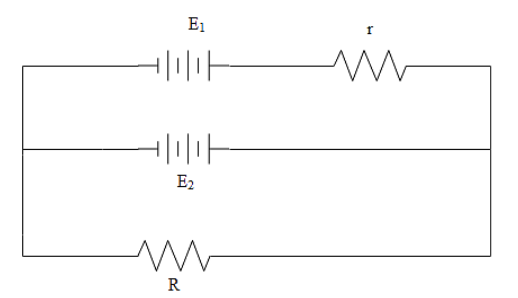
A dc source of emf ${{E}_{1}}=100V$ and internal resistance $r=0.5\Omega $. A storage battery of emf ${{E}_{2}}=90V$ and an external resistance $R$ are connected as shown in the diagram. At which value of $R$, no current will be passing through the battery?
$\begin{align}
& A.5.5 \\
& B.3.5 \\
& C.4.5 \\
& D.2.5 \\
\end{align}$
Answer
 Verified
589.5k+ views
Hint: For the flow of current through the battery to be zero, the ratio of the potential differences of the cell to the resultant resistance across each of the cells. Rearrange the equation and obtain the value of $R$. This information will help you in solving this question.
Complete step by step answer:
As per the question, it has been mentioned that there is no current passing through the battery at a specific value of $R$. In order to find this value, the ratio of the potential differences of the cell to the resultant resistance across each of the cells should be taken. That is,
$\dfrac{{{E}_{1}}}{{{E}_{2}}}=\dfrac{R+r}{R}$
Let us substitute the values in it as per the mentioning in the question,
$\dfrac{100}{90}=\dfrac{R+0.5}{R}$
Simplify the obtained equation which can be shown as,
$\dfrac{10}{9}=\dfrac{R+0.5}{R}$
Now let us rearrange the obtained equation in terms of the external resistance connected. That is we can write that,
$10R=9R+4.5$
That is,
$R=4.5\Omega $
Therefore the question has been answered.
The answer is mentioned as option C.
Note:
Internal resistance is defined to be the opposition given to the flow of current produced by the cells and also the batteries themselves which will cause the creation of heat. Internal resistance can be indicated in Ohms. Electromotive force can be called in short as emf is the energy per unit electric charge that is produced by an energy source. For example, the electric generator or a battery. In this the energy is being converted from one kind to the other one in the generator or the battery. This is like the device does work on the electric charge which is being in the battery itself.
Complete step by step answer:
As per the question, it has been mentioned that there is no current passing through the battery at a specific value of $R$. In order to find this value, the ratio of the potential differences of the cell to the resultant resistance across each of the cells should be taken. That is,
$\dfrac{{{E}_{1}}}{{{E}_{2}}}=\dfrac{R+r}{R}$
Let us substitute the values in it as per the mentioning in the question,
$\dfrac{100}{90}=\dfrac{R+0.5}{R}$
Simplify the obtained equation which can be shown as,
$\dfrac{10}{9}=\dfrac{R+0.5}{R}$
Now let us rearrange the obtained equation in terms of the external resistance connected. That is we can write that,
$10R=9R+4.5$
That is,
$R=4.5\Omega $
Therefore the question has been answered.
The answer is mentioned as option C.
Note:
Internal resistance is defined to be the opposition given to the flow of current produced by the cells and also the batteries themselves which will cause the creation of heat. Internal resistance can be indicated in Ohms. Electromotive force can be called in short as emf is the energy per unit electric charge that is produced by an energy source. For example, the electric generator or a battery. In this the energy is being converted from one kind to the other one in the generator or the battery. This is like the device does work on the electric charge which is being in the battery itself.
Recently Updated Pages
Master Class 11 Business Studies: Engaging Questions & Answers for Success

Master Class 11 Computer Science: Engaging Questions & Answers for Success
Master Class 11 Economics: Engaging Questions & Answers for Success
Master Class 11 Social Science: Engaging Questions & Answers for Success
Master Class 11 English: Engaging Questions & Answers for Success
Master Class 11 Chemistry: Engaging Questions & Answers for Success
Trending doubts
Draw a diagram of nephron and explain its structur class 11 biology CBSE
Explain zero factorial class 11 maths CBSE
Chemical formula of Bleaching powder is A Ca2OCl2 B class 11 chemistry CBSE
Name the part of the brain responsible for the precision class 11 biology CBSE
The growth of tendril in pea plants is due to AEffect class 11 biology CBSE
One Metric ton is equal to kg A 10000 B 1000 C 100 class 11 physics CBSE