




A cylindrical vessel having diameter equal to its height is full of water which is poured into two identical cylindrical vessels with diameter 42 cm and height 21 cm, which are completely filled. Find the diameter of the cylindrical vessel.
Answer
 Verified
630k+ views
Hint: We will first try to find the volume of the cylindrical vessel using the formula for the volume of the cylinder $\pi {{r}^{2}}h$ where $r$ is the radius of the cylinder and $h$ is the height of the cylinder. In the final step we will equate the volume of the given cylinders to find the diameter of the first cylinder.
Complete step-by-step answer:
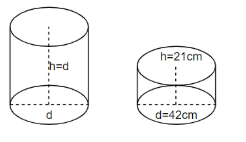
It is given in the question that we have three cylinders out of which the first cylinder has a dimension of equal diameter and equal height and the other two cylinders are identical with a diameter of 42 cm and height of 21 cm. It is also given that the water is poured into the identical cylindrical vessels with the first vessel, and we have to find the diameter of the first cylinder. We know that the volume of any cylinder is given as $\pi {{r}^{2}}h$. We can draw the figure for cylinders as below.
So, the volume of cylinder I is given as $\pi {{r}^{2}}h$. But, we have been given that the diameter of the cylinder is equal to its height, so $d=h$ , and we also know that $d=2r$. So, from these two relations, we can get,
$\begin{align}
& {{V}_{I}}=\pi {{\left( \dfrac{d}{2} \right)}^{2}}\times d \\
& {{V}_{I}}=\dfrac{\pi {{d}^{2}}}{4}\times d \\
& {{V}_{I}}=\dfrac{\pi {{d}^{3}}}{4} \\
\end{align}$
Similarly, the volume of the second cylinder is given as, ${{V}_{II}}=\pi {{r}^{2}}h$. We have the diameter as 42 cm, so its radius is 21 cm. The height given is 21 cm. So, we get the volume as,
$\begin{align}
& {{V}_{II}}=\pi \times {{\left( \dfrac{42}{2} \right)}^{2}}\times 21 \\
& =\dfrac{\pi \times 42\times 42\times 21}{4} \\
\end{align}$
We know that the second and third cylinders are identical, so their volumes can be represented together as,
$\begin{align}
& {{V}_{I}}={{V}_{II}}+{{V}_{III}} \\
& \dfrac{\pi {{d}^{3}}}{4}=\dfrac{2\times \left( 42\times 42\times 21 \right)\times \pi }{4} \\
\end{align}$
Cancelling the similar terms on both the sides, we get,
$\begin{align}
& {{d}^{3}}=42\times 42\times 42 \\
& \Rightarrow {{\left( d \right)}^{3}}={{\left( 42 \right)}^{3}} \\
& \Rightarrow d=42cm \\
\end{align}$
Therefore, the diameter of the first cylindrical vessel is 42 cm.
Note: You can find the radius of the cylindrical vessel first and then find the diameter by multiplying it by 2 as, diameter = 2 $\times $ radius. And the volume of the second cylinder can be written as,
$\begin{align}
& {{V}_{II}}=\pi {{r}^{2}}h \\
& =\pi {{r}^{2}}\left( r \right) \\
& =\pi {{\left( r \right)}^{3}} \\
& =\pi {{\left( 21 \right)}^{3}} \\
\end{align}$
As volume of second and third cylinders are same,
$\begin{align}
& {{V}_{II}}+{{V}_{III}}=2\times \pi {{\left( 21 \right)}^{3}} \\
& {{V}_{I}}=\pi {{r}^{2}}\left( 2r \right) \\
\end{align}$
On equating ${{V}_{I}}$ with ${{V}_{II}}+{{V}_{III}}$ , we get,
$\begin{align}
& {{V}_{I}}={{V}_{II}}+{{V}_{III}} \\
& \pi {{r}^{2}}\left( 2r \right)=2\times \pi {{\left( 21 \right)}^{3}} \\
& {{r}^{3}}={{\left( 21 \right)}^{3}} \\
& r=21cm \\
\end{align}$
So, diameter is $2\times r\Rightarrow 2\times 21\Rightarrow 42cm$.
Complete step-by-step answer:
It is given in the question that we have three cylinders out of which the first cylinder has a dimension of equal diameter and equal height and the other two cylinders are identical with a diameter of 42 cm and height of 21 cm. It is also given that the water is poured into the identical cylindrical vessels with the first vessel, and we have to find the diameter of the first cylinder. We know that the volume of any cylinder is given as $\pi {{r}^{2}}h$. We can draw the figure for cylinders as below.
So, the volume of cylinder I is given as $\pi {{r}^{2}}h$. But, we have been given that the diameter of the cylinder is equal to its height, so $d=h$ , and we also know that $d=2r$. So, from these two relations, we can get,
$\begin{align}
& {{V}_{I}}=\pi {{\left( \dfrac{d}{2} \right)}^{2}}\times d \\
& {{V}_{I}}=\dfrac{\pi {{d}^{2}}}{4}\times d \\
& {{V}_{I}}=\dfrac{\pi {{d}^{3}}}{4} \\
\end{align}$
Similarly, the volume of the second cylinder is given as, ${{V}_{II}}=\pi {{r}^{2}}h$. We have the diameter as 42 cm, so its radius is 21 cm. The height given is 21 cm. So, we get the volume as,
$\begin{align}
& {{V}_{II}}=\pi \times {{\left( \dfrac{42}{2} \right)}^{2}}\times 21 \\
& =\dfrac{\pi \times 42\times 42\times 21}{4} \\
\end{align}$
We know that the second and third cylinders are identical, so their volumes can be represented together as,
$\begin{align}
& {{V}_{I}}={{V}_{II}}+{{V}_{III}} \\
& \dfrac{\pi {{d}^{3}}}{4}=\dfrac{2\times \left( 42\times 42\times 21 \right)\times \pi }{4} \\
\end{align}$
Cancelling the similar terms on both the sides, we get,
$\begin{align}
& {{d}^{3}}=42\times 42\times 42 \\
& \Rightarrow {{\left( d \right)}^{3}}={{\left( 42 \right)}^{3}} \\
& \Rightarrow d=42cm \\
\end{align}$
Therefore, the diameter of the first cylindrical vessel is 42 cm.
Note: You can find the radius of the cylindrical vessel first and then find the diameter by multiplying it by 2 as, diameter = 2 $\times $ radius. And the volume of the second cylinder can be written as,
$\begin{align}
& {{V}_{II}}=\pi {{r}^{2}}h \\
& =\pi {{r}^{2}}\left( r \right) \\
& =\pi {{\left( r \right)}^{3}} \\
& =\pi {{\left( 21 \right)}^{3}} \\
\end{align}$
As volume of second and third cylinders are same,
$\begin{align}
& {{V}_{II}}+{{V}_{III}}=2\times \pi {{\left( 21 \right)}^{3}} \\
& {{V}_{I}}=\pi {{r}^{2}}\left( 2r \right) \\
\end{align}$
On equating ${{V}_{I}}$ with ${{V}_{II}}+{{V}_{III}}$ , we get,
$\begin{align}
& {{V}_{I}}={{V}_{II}}+{{V}_{III}} \\
& \pi {{r}^{2}}\left( 2r \right)=2\times \pi {{\left( 21 \right)}^{3}} \\
& {{r}^{3}}={{\left( 21 \right)}^{3}} \\
& r=21cm \\
\end{align}$
So, diameter is $2\times r\Rightarrow 2\times 21\Rightarrow 42cm$.
Recently Updated Pages
Master Class 10 Social Science: Engaging Questions & Answers for Success

Master Class 10 Science: Engaging Questions & Answers for Success
Master Class 10 Maths: Engaging Questions & Answers for Success
Master Class 10 General Knowledge: Engaging Questions & Answers for Success
Master Class 10 Computer Science: Engaging Questions & Answers for Success
Class 10 Question and Answer - Your Ultimate Solutions Guide
Trending doubts
What is the full form of PNG A Petrol Natural Gas B class 10 chemistry CBSE
Explain the Treaty of Vienna of 1815 class 10 social science CBSE
In cricket, how many legal balls are there in a standard over?
Why is there a time difference of about 5 hours between class 10 social science CBSE
Who Won 36 Oscar Awards? Record Holder Revealed
What is the median of the first 10 natural numbers class 10 maths CBSE