




A cylindrical pillar has a diameter \[56{\text{cm}}\] and is of \[{\text{35m}}\] high. There are \[16\] pillars around the building. Find the cost of painting the curved surface area of all the pillars at the rate of Rs.\[5.50\] per \[{{\text{m}}^{\text{2}}}\] \[56{\text{cm}}\]
Answer
 Verified
654.3k+ views
Hint-Curved surface Area of cylinder =\[2\pi rh\]
Where \[r = \]radius of cylinder \[{\text{35m}}\]
\[h = \]Height of the cylinder.
\[\pi = \dfrac{{22}}{7}\]
Complete step by step solution
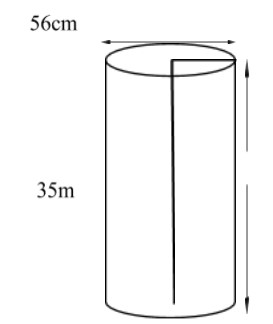
Step 1
Curved surface Area of one of the cylindrical pillar around the building \[ = 2\pi rh\]
Here \[r = \]\[\dfrac{{{\text{diameter}}\,{\kern 1pt} {\text{of}}\,\,{\text{pillar}}}}{{\text{2}}}{\text{ = }}\dfrac{{{\text{35}}}}{{\text{2}}}{\text{m}}\]
\[h = {\kern 1pt} {\kern 1pt} {\kern 1pt} {\kern 1pt} {\kern 1pt} 56{\text{cm = }}\dfrac{{56}}{{100}}{\text{m}}\]
\[\pi = \dfrac{{22}}{7}\]
Hence, curved surface Area of one of the cylindrical pillar around the building \[ = 2\pi rh\]
\[ = 2 \times \dfrac{{22}}{7} \times \dfrac{{35}}{2} \times \dfrac{{56}}{{100}}{{\text{m}}^2}\]
Canceling out 2 from numerator and denominator
\[ = \dfrac{{22}}{7} \times 35 \times \dfrac{{56}}{{100}}{{\text{m}}^2}\]
Since\[7 \times 5 = 35\]
Canceling \[35\]from numerator and \[7\]from denominator by leaving \[5\] in numerator.
We get,
\[ = 22 \times 5 \times \dfrac{{56}}{{100}}{{\text{m}}^2}\]
Since \[5 \times 20 = 100\]
Canceling \[100\]from denominator and \[5\]from numerator by leaving 20 in denominator..
We get
\[ = 22 \times \dfrac{{56}}{{20}}{{\text{m}}^2}\]
Now since\[4 \times 5 = 20{\kern 1pt} {\kern 1pt} {\kern 1pt} {\kern 1pt} \& {\kern 1pt} {\kern 1pt} 4 \times 14 = 56\]
So, Canceling \[20{\kern 1pt} {\kern 1pt} \] from denominator by \[4\] leaving in denominator and \[56\]from numerator by leaving \[14\]in numerator
.
\[ = 22 \times \dfrac{{14}}{5}{{\text{m}}^2}\]
Now no more cancellation possible so simplifying the expression and we get
\[ = \dfrac{{304}}{5}{{\text{m}}^2}\]
Hence Curved surface area of each pillar
\[ = \dfrac{{304}}{5}{{\text{m}}^2}\]
Now cost of painting per \[{{\text{m}}^2} = \]Rs.\[5.5\]
So cost of painting one pillar of curved surface area\[\dfrac{{304}}{5}{{\text{m}}^2}\].\[ = \dfrac{{304}}{5} \times 5.5 = \dfrac{{304}}{5} \times \dfrac{{55}}{{10}}\]
Canceling out 55 from numerator by 5 and leaving 11 in numerator
We get
\[ = \dfrac{{304 \times 11}}{{10}}\]
On simplifying further we get
\[ = 343.4\]
Hence Cost of painting one pillar \[ = \] Rs.\[343.4\]
Cost of painting all 16 pillars \[ = \] Rs.\[343.4 \times 16\]
\[ = \] Rs.\[5494.4\] (On multiplying)
Hence, the cost of painting the curved surface area of all the pillars at the rate of
Rs.\[5.50\]Per \[{{\text{m}}^{\text{2}}}\]\[ = \] Rs.\[5494.4\]
Note:Make sure to use the appropriate formula in accordance to the solution which has to be found out.In this case it is the TSA,so we use the formula given by
Total Surface area of pillar or a cylinder $ = 2\pi rh + 2$(area of base of cylinder)
$ = 2\pi rh + 2\left( {\pi {r^2}} \right) = 2\pi r\left( {h + r} \right)$
Where \[r = \]radius of cylinder \[{\text{35m}}\]
\[h = \]Height of the cylinder.
\[\pi = \dfrac{{22}}{7}\]
Complete step by step solution
Step 1
Curved surface Area of one of the cylindrical pillar around the building \[ = 2\pi rh\]
Here \[r = \]\[\dfrac{{{\text{diameter}}\,{\kern 1pt} {\text{of}}\,\,{\text{pillar}}}}{{\text{2}}}{\text{ = }}\dfrac{{{\text{35}}}}{{\text{2}}}{\text{m}}\]
\[h = {\kern 1pt} {\kern 1pt} {\kern 1pt} {\kern 1pt} {\kern 1pt} 56{\text{cm = }}\dfrac{{56}}{{100}}{\text{m}}\]
\[\pi = \dfrac{{22}}{7}\]
Hence, curved surface Area of one of the cylindrical pillar around the building \[ = 2\pi rh\]
\[ = 2 \times \dfrac{{22}}{7} \times \dfrac{{35}}{2} \times \dfrac{{56}}{{100}}{{\text{m}}^2}\]
Canceling out 2 from numerator and denominator
\[ = \dfrac{{22}}{7} \times 35 \times \dfrac{{56}}{{100}}{{\text{m}}^2}\]
Since\[7 \times 5 = 35\]
Canceling \[35\]from numerator and \[7\]from denominator by leaving \[5\] in numerator.
We get,
\[ = 22 \times 5 \times \dfrac{{56}}{{100}}{{\text{m}}^2}\]
Since \[5 \times 20 = 100\]
Canceling \[100\]from denominator and \[5\]from numerator by leaving 20 in denominator..
We get
\[ = 22 \times \dfrac{{56}}{{20}}{{\text{m}}^2}\]
Now since\[4 \times 5 = 20{\kern 1pt} {\kern 1pt} {\kern 1pt} {\kern 1pt} \& {\kern 1pt} {\kern 1pt} 4 \times 14 = 56\]
So, Canceling \[20{\kern 1pt} {\kern 1pt} \] from denominator by \[4\] leaving in denominator and \[56\]from numerator by leaving \[14\]in numerator
.
\[ = 22 \times \dfrac{{14}}{5}{{\text{m}}^2}\]
Now no more cancellation possible so simplifying the expression and we get
\[ = \dfrac{{304}}{5}{{\text{m}}^2}\]
Hence Curved surface area of each pillar
\[ = \dfrac{{304}}{5}{{\text{m}}^2}\]
Now cost of painting per \[{{\text{m}}^2} = \]Rs.\[5.5\]
So cost of painting one pillar of curved surface area\[\dfrac{{304}}{5}{{\text{m}}^2}\].\[ = \dfrac{{304}}{5} \times 5.5 = \dfrac{{304}}{5} \times \dfrac{{55}}{{10}}\]
Canceling out 55 from numerator by 5 and leaving 11 in numerator
We get
\[ = \dfrac{{304 \times 11}}{{10}}\]
On simplifying further we get
\[ = 343.4\]
Hence Cost of painting one pillar \[ = \] Rs.\[343.4\]
Cost of painting all 16 pillars \[ = \] Rs.\[343.4 \times 16\]
\[ = \] Rs.\[5494.4\] (On multiplying)
Hence, the cost of painting the curved surface area of all the pillars at the rate of
Rs.\[5.50\]Per \[{{\text{m}}^{\text{2}}}\]\[ = \] Rs.\[5494.4\]
Note:Make sure to use the appropriate formula in accordance to the solution which has to be found out.In this case it is the TSA,so we use the formula given by
Total Surface area of pillar or a cylinder $ = 2\pi rh + 2$(area of base of cylinder)
$ = 2\pi rh + 2\left( {\pi {r^2}} \right) = 2\pi r\left( {h + r} \right)$
Recently Updated Pages
Write any three differences between metals and nonmetals class 10 social science CBSE

Amit standing on a horizontal plane finds a bird flying class 10 maths CBSE
Two circles of radii 5 cm and 3 cm intersect at two class 10 maths CBSE
Solve the following i John and Jivanti together have class 10 maths CBSE
What is the relation between orthocenter circumcentre class 10 maths CBSE
Two plane mirrors are inclined at 70circ A ray incident class 10 physics CBSE
Trending doubts
Explain the Treaty of Vienna of 1815 class 10 social science CBSE
Which country is known as "The land of Fire and Ice"?
1 GB equals how many MB?
10 examples of evaporation in daily life with explanations
What is the full form of POSCO class 10 social science CBSE
Make a sketch of the human nerve cell What function class 10 biology CBSE