




A cylinder has radius 5 and height 8. What is the largest distance between any two points on the cylinder?
A) $8\sqrt 2 $
B) $8\sqrt 5 $
C) $\sqrt {41} $
D) $2\sqrt {41} $
E) 13
Answer
 Verified
637.8k+ views
Hint:
We can draw the figure of a cylinder and represent its height and radius. Then we can draw the largest distance from one end to the diametrically opposite side on the other end. This line forms a right-angled triangle with the diameter and height. Then we can find this distance by applying Pythagoras theorem in the triangle thus formed, the length of hypotenuses will be the largest distance between any two points on the cylinder.
Complete step by step solution:
We can draw a diagram of the cylinder with given radius and height.
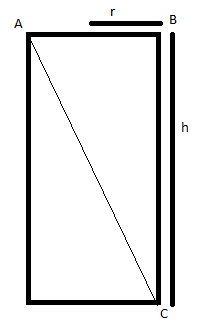
We can draw the largest distance inside the cylinder by connecting the one end of the cylinder with the diametrically opposite side on the other end of the cylinder.
Let AC represent the largest distance.
From the figure, we can see that the largest distance forms a right angles triangle with the height and diameter of the cylinder.
It is given that height of the cylinder is h=8 and radius is r =5.
We know that diameter is twice the radius.
$ \Rightarrow d = 2r$
On substituting value of radius we get,
$ \Rightarrow d = 2 \times 5 = 10$
Now we can consider the right-angled triangle ABC.
By Pythagoras theorem, we get,
$A{C^2} = B{C^2} + A{B^2}$
On substituting the values, we get,
$ \Rightarrow A{C^2} = {h^2} + {d^2}$
On substituting values of h and d we get,
$ \Rightarrow A{C^2} = {8^2} + {10^2}$
On simplifying the square, we get,
$ \Rightarrow A{C^2} = 64 + 100$
On doing the addition, we get,
$ \Rightarrow A{C^2} = 164$
We can write it as the factors of possible perfect squares.
$ \Rightarrow A{C^2} = 4 \times 41$
Now we can take the square root
$ \Rightarrow AC = \sqrt {4 \times 41} $
$ \Rightarrow AC = 2\sqrt {41} $
Therefore, the largest distance inside the given cylinder is $2\sqrt {41} $ .
So, the correct answer is option D.
Note:
The concept of Pythagoras theorem is used to solve this problem. According to Pythagoras theorem, for a right-angled triangle, the sum of the squares of the non-hypotenuse sides will be equal to the square of the hypotenuse. We used this here because the given cylinder is a right circular cylinder. For a right circular cylinder, the diameter and the height will be perpendicular. While taking the square root, we only need to consider the positive square root as distance cannot be negative.
We can draw the figure of a cylinder and represent its height and radius. Then we can draw the largest distance from one end to the diametrically opposite side on the other end. This line forms a right-angled triangle with the diameter and height. Then we can find this distance by applying Pythagoras theorem in the triangle thus formed, the length of hypotenuses will be the largest distance between any two points on the cylinder.
Complete step by step solution:
We can draw a diagram of the cylinder with given radius and height.
We can draw the largest distance inside the cylinder by connecting the one end of the cylinder with the diametrically opposite side on the other end of the cylinder.
Let AC represent the largest distance.
From the figure, we can see that the largest distance forms a right angles triangle with the height and diameter of the cylinder.
It is given that height of the cylinder is h=8 and radius is r =5.
We know that diameter is twice the radius.
$ \Rightarrow d = 2r$
On substituting value of radius we get,
$ \Rightarrow d = 2 \times 5 = 10$
Now we can consider the right-angled triangle ABC.
By Pythagoras theorem, we get,
$A{C^2} = B{C^2} + A{B^2}$
On substituting the values, we get,
$ \Rightarrow A{C^2} = {h^2} + {d^2}$
On substituting values of h and d we get,
$ \Rightarrow A{C^2} = {8^2} + {10^2}$
On simplifying the square, we get,
$ \Rightarrow A{C^2} = 64 + 100$
On doing the addition, we get,
$ \Rightarrow A{C^2} = 164$
We can write it as the factors of possible perfect squares.
$ \Rightarrow A{C^2} = 4 \times 41$
Now we can take the square root
$ \Rightarrow AC = \sqrt {4 \times 41} $
$ \Rightarrow AC = 2\sqrt {41} $
Therefore, the largest distance inside the given cylinder is $2\sqrt {41} $ .
So, the correct answer is option D.
Note:
The concept of Pythagoras theorem is used to solve this problem. According to Pythagoras theorem, for a right-angled triangle, the sum of the squares of the non-hypotenuse sides will be equal to the square of the hypotenuse. We used this here because the given cylinder is a right circular cylinder. For a right circular cylinder, the diameter and the height will be perpendicular. While taking the square root, we only need to consider the positive square root as distance cannot be negative.
Recently Updated Pages
Basicity of sulphurous acid and sulphuric acid are

Master Class 10 Computer Science: Engaging Questions & Answers for Success
Master Class 10 Social Science: Engaging Questions & Answers for Success
Master Class 10 Science: Engaging Questions & Answers for Success
Class 10 Question and Answer - Your Ultimate Solutions Guide
Master Class 10 Maths: Engaging Questions & Answers for Success
Trending doubts
What is the Total Duration of Football Match?
In football, which nation is called "La Roja"?
What is the award for the best player at the FIFA World Cup?
Differentiate between Xylem and phloem class 10 biology CBSE
Fill the blanks with proper collective nouns 1 A of class 10 english CBSE
In the event of the resignation or death of the Prime class 10 social science CBSE