




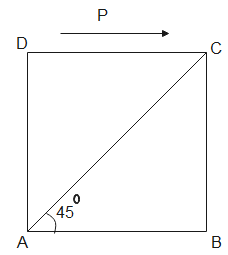
A cube of side $a$ is subjected to shear stress P as shown in the figure. Determine tangential and normal stress along diagonal AC.
Answer
 Verified
597.9k+ views
Hint: Stress acting on a body is the force applied per unit area. It causes the shape, area or volume of a body. A shearing force is being applied on the cube; this means that it will change the shape of the cube along its diagonal. The shearing stress is parallel to the area.
Formulas used:
$\tau =\dfrac{F}{A}$
Complete answer:
When a force is applied on a body such that the body gets deformed by slipping between planes, such a force applied per unit area is called the shearing or tangential stress. Its SI unit is $N{{m}^{-2}}$. It is given by-
$\tau =\dfrac{F}{A}$ - (1)
Here, $\tau $ is the shearing stress
$F$ is the force applied parallel to its side
$A$ is the displaced area
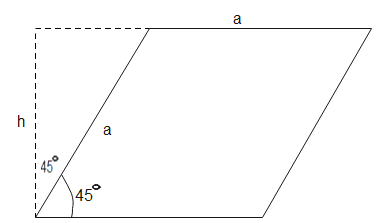
When a tangential stress, $P$ is applied on cube of side a, it changes its shape as sown in the figure below
From the above figure,
$\begin{align}
& h=a\cos {{45}^{o}} \\
& \Rightarrow h=\dfrac{a}{\sqrt{2}} \\
\end{align}$
The area of the deformed figure will be-
$\begin{align}
& A=b\times h \\
& \Rightarrow A=a\times \dfrac{a}{\sqrt{2}} \\
& \therefore A=\dfrac{{{a}^{2}}}{\sqrt{2}} \\
\end{align}$
The area of the figure is $\dfrac{{{a}^{2}}}{\sqrt{2}}$ sq units.
From eq (1), the shearing stress acting on the cube will be-
$\begin{align}
& \tau =\dfrac{P}{\dfrac{{{a}^{2}}}{\sqrt{2}}} \\
& \Rightarrow \tau =\dfrac{\sqrt{2}P}{{{a}^{2}}} \\
\end{align}$
Therefore, the shearing or tangential stress acting on the cube is $\dfrac{\sqrt{2}P}{{{a}^{2}}}$.
As there is no tension or compression acting on the cube, the normal stress acting on it is zero.
Therefore, the tangential stress on the cube is $\dfrac{\sqrt{2}P}{{{a}^{2}}}$ and the normal stress is zero.
Note:
Normal stress occurs when a body is kept under compression or tension due to which its dimensions change. The force applied in a shearing stress is parallel to the cross sectional area. After stress is applied, a restoring force is developed in the body which tends to bring it back to its original shape.
Formulas used:
$\tau =\dfrac{F}{A}$
Complete answer:
When a force is applied on a body such that the body gets deformed by slipping between planes, such a force applied per unit area is called the shearing or tangential stress. Its SI unit is $N{{m}^{-2}}$. It is given by-
$\tau =\dfrac{F}{A}$ - (1)
Here, $\tau $ is the shearing stress
$F$ is the force applied parallel to its side
$A$ is the displaced area
When a tangential stress, $P$ is applied on cube of side a, it changes its shape as sown in the figure below
From the above figure,
$\begin{align}
& h=a\cos {{45}^{o}} \\
& \Rightarrow h=\dfrac{a}{\sqrt{2}} \\
\end{align}$
The area of the deformed figure will be-
$\begin{align}
& A=b\times h \\
& \Rightarrow A=a\times \dfrac{a}{\sqrt{2}} \\
& \therefore A=\dfrac{{{a}^{2}}}{\sqrt{2}} \\
\end{align}$
The area of the figure is $\dfrac{{{a}^{2}}}{\sqrt{2}}$ sq units.
From eq (1), the shearing stress acting on the cube will be-
$\begin{align}
& \tau =\dfrac{P}{\dfrac{{{a}^{2}}}{\sqrt{2}}} \\
& \Rightarrow \tau =\dfrac{\sqrt{2}P}{{{a}^{2}}} \\
\end{align}$
Therefore, the shearing or tangential stress acting on the cube is $\dfrac{\sqrt{2}P}{{{a}^{2}}}$.
As there is no tension or compression acting on the cube, the normal stress acting on it is zero.
Therefore, the tangential stress on the cube is $\dfrac{\sqrt{2}P}{{{a}^{2}}}$ and the normal stress is zero.
Note:
Normal stress occurs when a body is kept under compression or tension due to which its dimensions change. The force applied in a shearing stress is parallel to the cross sectional area. After stress is applied, a restoring force is developed in the body which tends to bring it back to its original shape.
Recently Updated Pages
Master Class 11 English: Engaging Questions & Answers for Success

Master Class 11 Social Science: Engaging Questions & Answers for Success
Master Class 11 Maths: Engaging Questions & Answers for Success
Master Class 11 Biology: Engaging Questions & Answers for Success
Master Class 11 Physics: Engaging Questions & Answers for Success
Master Class 11 Chemistry: Engaging Questions & Answers for Success
Trending doubts
One Metric ton is equal to kg A 10000 B 1000 C 100 class 11 physics CBSE
What is cell theory Who formulated it class 11 biology CBSE
Phyllotaxy is the arrangement of ALeaflets BLeaves class 11 biology CBSE
Difference Between Prokaryotic Cells and Eukaryotic Cells
The symbiotic association of fungi and algae is called class 11 biology CBSE
Cell theory was formulated by A Schleiden and Schwann class 11 biology CBSE