




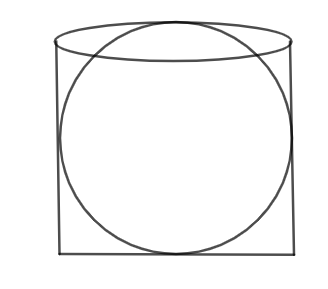
A cricket ball of radius r is exactly fitted in a cylindrical tin as shown in the figure below. The ratio of the surface area of the cricket ball to the surface area of the tin is?
Answer
 Verified
586.5k+ views
Hint: Use the given information to determine the relationship between the height of the cylinder (h) and the radius of the cricket ball (r). Now, find the total surface area of the cylinder by using the formula TSA of cylinder \[=2\pi r\left( h+r \right).\] Similarly, use the formula for the total surface area of the sphere given as TSA of sphere \[=4\pi {{r}^{2}}.\] Take the ratio of these surface areas considering the sphere’s area in the numerator and substitute h in terms of r to get the answer.
Complete step by step answer:
Here, we have been provided with a figure of a cricket ball fitted in a cylindrical tin. We have to determine the ratio of the surface area of the cricket ball to the surface area of the tin.
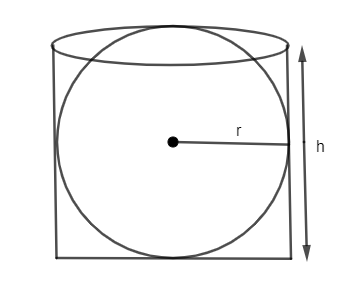
In the above figure, clearly, we can see that if the sphere is fitted exactly in the tin then the radius of the cylinder and the sphere must be the same. Apart from this, we have also one more parameter that is the height (h) of the cylinder. We can see that the height of the cylinder is equal to the diameter of the sphere. So, we have,
\[\Rightarrow h=2r......\left( i \right)\]
Now, we know that the total surface area of the sphere is given as:
\[\Rightarrow \text{Area of sphere}=4\pi {{r}^{2}}\]
\[\Rightarrow \text{Area of cricket ball}=4\pi {{r}^{2}}\]
Also, we know that the total surface area of the cylinder is given as
\[\Rightarrow \text{Area of cylinder}=2\pi r\left( r+h \right)\]
\[\Rightarrow \text{Area of tin}=2\pi r\left( r+h \right)\]
Now, taking the ratio of the area of the ball to the area of the tin, we get,
\[\Rightarrow \dfrac{\text{Surface area of the ball}}{\text{Surface area of the tin}}=\dfrac{4\pi {{r}^{2}}}{2\pi r\left( r+h \right)}\]
So, using the relation (i), we get,
\[\Rightarrow \dfrac{\text{Surface area of the ball}}{\text{Surface area of the tin}}=\dfrac{4\pi {{r}^{2}}}{2\pi r\left( r+2r \right)}\]
\[\Rightarrow \dfrac{\text{Surface area of the ball}}{\text{Surface area of the tin}}=\dfrac{4\pi {{r}^{2}}}{6\pi {{r}^{2}}}\]
\[\Rightarrow \dfrac{\text{Surface area of the ball}}{\text{Surface area of the tin}}=\dfrac{2}{3}\]
Hence, the required ratio is 2:3.
Note:
One may note that we were not provided in the question as to consider which type of area, the total surface area, or lateral surface area. The only term was ‘surface area’. So, we have to consider the total surface area. You must remember the formula of surface areas of basic shapes like cube, cuboid, sphere, cylinder, cone, etc. as they are used everywhere. Now, the relation between h and r was very necessary to solve the question because we had to cancel all the parameters and determine the ratio as a pure number.
Complete step by step answer:
Here, we have been provided with a figure of a cricket ball fitted in a cylindrical tin. We have to determine the ratio of the surface area of the cricket ball to the surface area of the tin.
In the above figure, clearly, we can see that if the sphere is fitted exactly in the tin then the radius of the cylinder and the sphere must be the same. Apart from this, we have also one more parameter that is the height (h) of the cylinder. We can see that the height of the cylinder is equal to the diameter of the sphere. So, we have,
\[\Rightarrow h=2r......\left( i \right)\]
Now, we know that the total surface area of the sphere is given as:
\[\Rightarrow \text{Area of sphere}=4\pi {{r}^{2}}\]
\[\Rightarrow \text{Area of cricket ball}=4\pi {{r}^{2}}\]
Also, we know that the total surface area of the cylinder is given as
\[\Rightarrow \text{Area of cylinder}=2\pi r\left( r+h \right)\]
\[\Rightarrow \text{Area of tin}=2\pi r\left( r+h \right)\]
Now, taking the ratio of the area of the ball to the area of the tin, we get,
\[\Rightarrow \dfrac{\text{Surface area of the ball}}{\text{Surface area of the tin}}=\dfrac{4\pi {{r}^{2}}}{2\pi r\left( r+h \right)}\]
So, using the relation (i), we get,
\[\Rightarrow \dfrac{\text{Surface area of the ball}}{\text{Surface area of the tin}}=\dfrac{4\pi {{r}^{2}}}{2\pi r\left( r+2r \right)}\]
\[\Rightarrow \dfrac{\text{Surface area of the ball}}{\text{Surface area of the tin}}=\dfrac{4\pi {{r}^{2}}}{6\pi {{r}^{2}}}\]
\[\Rightarrow \dfrac{\text{Surface area of the ball}}{\text{Surface area of the tin}}=\dfrac{2}{3}\]
Hence, the required ratio is 2:3.
Note:
One may note that we were not provided in the question as to consider which type of area, the total surface area, or lateral surface area. The only term was ‘surface area’. So, we have to consider the total surface area. You must remember the formula of surface areas of basic shapes like cube, cuboid, sphere, cylinder, cone, etc. as they are used everywhere. Now, the relation between h and r was very necessary to solve the question because we had to cancel all the parameters and determine the ratio as a pure number.
Recently Updated Pages
Master Class 10 Social Science: Engaging Questions & Answers for Success

Master Class 10 Science: Engaging Questions & Answers for Success
Master Class 10 Maths: Engaging Questions & Answers for Success
Master Class 10 General Knowledge: Engaging Questions & Answers for Success
Master Class 10 Computer Science: Engaging Questions & Answers for Success
Class 10 Question and Answer - Your Ultimate Solutions Guide
Trending doubts
What is the full form of PNG A Petrol Natural Gas B class 10 chemistry CBSE
Explain the Treaty of Vienna of 1815 class 10 social science CBSE
In cricket, how many legal balls are there in a standard over?
Why is there a time difference of about 5 hours between class 10 social science CBSE
Who Won 36 Oscar Awards? Record Holder Revealed
What is the median of the first 10 natural numbers class 10 maths CBSE