



A cord is wound around the circumference of the wheel of radius ‘r’. The axis of the wheel is horizontal and the moment of inertia about it is ‘I’. The weight ‘mg’ is attached to the end of the cord and falls from rest. After falling through a distance ‘h’, the angular velocity of the wheel will be
(A) \[{\left[ {mgh} \right]^{\dfrac{1}{2}}}\]
(B) \[{\left[ {\dfrac{{mgh}}{{I + 2m{r^2}}}} \right]^{\dfrac{1}{2}}}\]
(C) \[{\left[ {\dfrac{{2mgh}}{{I + m{r^2}}}} \right]^{\dfrac{1}{2}}}\]
(D) \[{\left[ {\dfrac{{mgh}}{{I + m{r^2}}}} \right]^{\dfrac{1}{2}}}\]
Answer
 Verified
592.5k+ views
Hint: In this question, we need to determine the angular velocity of the wheel such that it falls through a distance of ‘h’. For this, we will use the relation between the potential energy and the kinetic energy of the translational body.
Complete step by step answer:
The radius of the wheel is ‘r’ and the moment of inertia of the wheel is ‘I’.
Since, the weight which was attached to the cord initially was at rest, hence its initial velocity will be zero; hence its kinetic energy will also be zero.
Hence its potential energy initially at rest will be \[P.E = mgh - - (i)\]
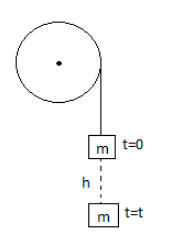
Now, we know that if the body falls from the rest; then it will gain velocity so its potential energy will converted into the kinetic energy which is due to the kinetic energy of rotation of the wheel and the kinetic energy of translation of the cord; hence this can be written as
\[P.E = K.{E_{translation}} + K.{E_{rotation}} - - (ii)\]
Hence we can write equation (ii) as
\[
\Rightarrow P.E = K.{E_{translation}} + K.{E_{rotation}} \\
\Rightarrow mgh = \dfrac{1}{2}m{v^2} + \dfrac{1}{2}I{\omega ^2} - - (iii) \\
\]
Since the wheel is in rolling motion whose radius is R, hence its velocity can be written as
\[v = \omega R\]
Now substitute the value of velocity in equation (iii), we get
\[
\Rightarrow mgh = \dfrac{1}{2}m{v^2} + \dfrac{1}{2}I{\omega ^2} \\
\Rightarrow mgh = \dfrac{1}{2}m{\left( {\omega R} \right)^2} + \dfrac{1}{2}I{\omega ^2} \\
\Rightarrow\dfrac{1}{2}{\omega ^2}\left( {m{R^2} + I} \right) = mgh \\
\Rightarrow{\omega ^2} = \dfrac{{2mgh}}{{\left( {m{R^2} + I} \right)}} \\
\therefore\omega = \sqrt {\dfrac{{2mgh}}{{\left( {m{R^2} + I} \right)}}} \\
\]
Hence, the angular velocity of the wheel will be \[\omega = \sqrt {\dfrac{{2mgh}}{{\left( {m{R^2} + I} \right)}}} \]
Hence,option C is the correct answer.
Note: It should be noted here that the kinetic energy of the translational rotating body is due to the sum of the rotational kinetic energy and the translational kinetic energy.
Complete step by step answer:
The radius of the wheel is ‘r’ and the moment of inertia of the wheel is ‘I’.
Since, the weight which was attached to the cord initially was at rest, hence its initial velocity will be zero; hence its kinetic energy will also be zero.
Hence its potential energy initially at rest will be \[P.E = mgh - - (i)\]
Now, we know that if the body falls from the rest; then it will gain velocity so its potential energy will converted into the kinetic energy which is due to the kinetic energy of rotation of the wheel and the kinetic energy of translation of the cord; hence this can be written as
\[P.E = K.{E_{translation}} + K.{E_{rotation}} - - (ii)\]
Hence we can write equation (ii) as
\[
\Rightarrow P.E = K.{E_{translation}} + K.{E_{rotation}} \\
\Rightarrow mgh = \dfrac{1}{2}m{v^2} + \dfrac{1}{2}I{\omega ^2} - - (iii) \\
\]
Since the wheel is in rolling motion whose radius is R, hence its velocity can be written as
\[v = \omega R\]
Now substitute the value of velocity in equation (iii), we get
\[
\Rightarrow mgh = \dfrac{1}{2}m{v^2} + \dfrac{1}{2}I{\omega ^2} \\
\Rightarrow mgh = \dfrac{1}{2}m{\left( {\omega R} \right)^2} + \dfrac{1}{2}I{\omega ^2} \\
\Rightarrow\dfrac{1}{2}{\omega ^2}\left( {m{R^2} + I} \right) = mgh \\
\Rightarrow{\omega ^2} = \dfrac{{2mgh}}{{\left( {m{R^2} + I} \right)}} \\
\therefore\omega = \sqrt {\dfrac{{2mgh}}{{\left( {m{R^2} + I} \right)}}} \\
\]
Hence, the angular velocity of the wheel will be \[\omega = \sqrt {\dfrac{{2mgh}}{{\left( {m{R^2} + I} \right)}}} \]
Hence,option C is the correct answer.
Note: It should be noted here that the kinetic energy of the translational rotating body is due to the sum of the rotational kinetic energy and the translational kinetic energy.
Recently Updated Pages
Basicity of sulphurous acid and sulphuric acid are

Master Class 11 Business Studies: Engaging Questions & Answers for Success
Master Class 11 Computer Science: Engaging Questions & Answers for Success
Master Class 11 Economics: Engaging Questions & Answers for Success
Master Class 11 Social Science: Engaging Questions & Answers for Success
Master Class 11 English: Engaging Questions & Answers for Success
Trending doubts
One Metric ton is equal to kg A 10000 B 1000 C 100 class 11 physics CBSE
The largest wind power cluster is located in the state class 11 social science CBSE
Explain zero factorial class 11 maths CBSE
State and prove Bernoullis theorem class 11 physics CBSE
What steps did the French revolutionaries take to create class 11 social science CBSE
Which among the following are examples of coming together class 11 social science CBSE