




A copper rod of diameter 1 cm and length 8 cm is drawn into a wire of length 18 m of uniform thickness. Find the thickness of the wire.
Answer
 Verified
604.4k+ views
Hint: It is said that a copper rod is converted into a wire. So the volume of the copper rod and wire will be the same. The volume of these is similar to that of a cylinder. Find the volume of copper rod and equate it to the volume of wire, to get the diameter of wire.
Complete step-by-step answer:
Consider the 2 figures drawn. Thus we can say that the volume of the copper rod will be equal to the volume of wire.
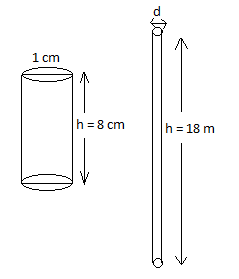
\[\therefore \]Volume of copper rod = Volume of wire.
First let us find the volume of copper rod. The copper rod is in the form of a cylinder with a diameter of 1 cm. Let’s take the radius of the rod as ‘r’.
Diameter of rod = 1 cm.
Radius of rod \[=r=\dfrac{d}{2}=\dfrac{1cm}{2}=0.5cm.\]
The length of the rod is equal to the height ‘h’ of the rod.
\[\therefore \]Height of rod \[=h=8cm.\]
Thus we can find the volume of the rod, which is in the shape of a cylinder.
\[\therefore \]Volume of rod \[=\pi {{r}^{2}}h.\]
We know r = 0.5 cm and h = 8 cm. Substitute and get the volume of rod.
Volume of rod \[\begin{align}
& =\pi \times {{(0.5)}^{2}}\times 8 \\
& =\pi \times 0.5\times 0.5\times 8=2\pi c{{m}^{3}}. \\
\end{align}\]
Volume of rod \[=2\pi c{{m}^{3}}.\]
Now let us find the volume of wire.
The wire is in the form of a cylinder with radius ‘r’ and height ‘h’.
The length of wire is equal to the height of wire, h = 8 m.
\[\begin{align}
& h=18m=18\times 100cn=1800cm. \\
& \therefore 1m=100cm. \\
\end{align}\]
Volume of wire \[\begin{align}
& =\pi {{r}^{2}}h \\
& =\pi \times {{r}^{2}}\times 1800 \\
& =1800\pi {{r}^{2}}c{{m}^{3}}. \\
\end{align}\]
Let us find that,
Volume of copper rod = Volume of wire
\[\begin{align}
& 2\pi c{{m}^{3}}=1800\pi {{r}^{2}}c{{m}^{3}} \\
& \Rightarrow 1800\pi {{r}^{2}}=2\pi . \\
\end{align}\]
Let us cancel out common terms and simplify it.
\[{{r}^{2}}=\dfrac{2}{1800}=\dfrac{1}{900}\Rightarrow \sqrt{{{r}^{2}}}=\sqrt{\dfrac{1}{900}}.\]
Taking square on both sides, we get,
\[r=\dfrac{1}{30}cm.\]
Hence the radius of the wire is \[\dfrac{1}{30}cm\].
Thickness of wire = Diameter of wire\[=2\times \]radius of wire\[=2\times \dfrac{1}{30}=\dfrac{1}{15}cm.\]
We got the thickness of the wire as \[\dfrac{1}{15}cm\].
Note:
Here the same quantity of the material is used to reshape the copper rod to wire. So we can say that their volume will be the same irrespective of their height and radius. We have used the volume of the cylinder as copper rod and wire similar to it.
Complete step-by-step answer:
Consider the 2 figures drawn. Thus we can say that the volume of the copper rod will be equal to the volume of wire.
\[\therefore \]Volume of copper rod = Volume of wire.
First let us find the volume of copper rod. The copper rod is in the form of a cylinder with a diameter of 1 cm. Let’s take the radius of the rod as ‘r’.
Diameter of rod = 1 cm.
Radius of rod \[=r=\dfrac{d}{2}=\dfrac{1cm}{2}=0.5cm.\]
The length of the rod is equal to the height ‘h’ of the rod.
\[\therefore \]Height of rod \[=h=8cm.\]
Thus we can find the volume of the rod, which is in the shape of a cylinder.
\[\therefore \]Volume of rod \[=\pi {{r}^{2}}h.\]
We know r = 0.5 cm and h = 8 cm. Substitute and get the volume of rod.
Volume of rod \[\begin{align}
& =\pi \times {{(0.5)}^{2}}\times 8 \\
& =\pi \times 0.5\times 0.5\times 8=2\pi c{{m}^{3}}. \\
\end{align}\]
Volume of rod \[=2\pi c{{m}^{3}}.\]
Now let us find the volume of wire.
The wire is in the form of a cylinder with radius ‘r’ and height ‘h’.
The length of wire is equal to the height of wire, h = 8 m.
\[\begin{align}
& h=18m=18\times 100cn=1800cm. \\
& \therefore 1m=100cm. \\
\end{align}\]
Volume of wire \[\begin{align}
& =\pi {{r}^{2}}h \\
& =\pi \times {{r}^{2}}\times 1800 \\
& =1800\pi {{r}^{2}}c{{m}^{3}}. \\
\end{align}\]
Let us find that,
Volume of copper rod = Volume of wire
\[\begin{align}
& 2\pi c{{m}^{3}}=1800\pi {{r}^{2}}c{{m}^{3}} \\
& \Rightarrow 1800\pi {{r}^{2}}=2\pi . \\
\end{align}\]
Let us cancel out common terms and simplify it.
\[{{r}^{2}}=\dfrac{2}{1800}=\dfrac{1}{900}\Rightarrow \sqrt{{{r}^{2}}}=\sqrt{\dfrac{1}{900}}.\]
Taking square on both sides, we get,
\[r=\dfrac{1}{30}cm.\]
Hence the radius of the wire is \[\dfrac{1}{30}cm\].
Thickness of wire = Diameter of wire\[=2\times \]radius of wire\[=2\times \dfrac{1}{30}=\dfrac{1}{15}cm.\]
We got the thickness of the wire as \[\dfrac{1}{15}cm\].
Note:
Here the same quantity of the material is used to reshape the copper rod to wire. So we can say that their volume will be the same irrespective of their height and radius. We have used the volume of the cylinder as copper rod and wire similar to it.
Recently Updated Pages
Master Class 10 Computer Science: Engaging Questions & Answers for Success

Differentiate between voluntary action and reflex class 10 biology CBSE
The uses of bleaching powder are A It is used bleaching class 10 chemistry CBSE
Fill in the blanks with abstract nouns of the words class 10 english CBSE
How many threedigit numbers are there class 10 maths CBSE
What is a reflex arc class 10 biology CBSE
Trending doubts
Explain the Treaty of Vienna of 1815 class 10 social science CBSE
10 examples of evaporation in daily life with explanations
What is the full form of POSCO class 10 social science CBSE
Make a sketch of the human nerve cell What function class 10 biology CBSE
GST is a direct or indirect tax?
The sum of all even numbers between 21 and 51 is a class 10 maths CBSE