




What is a convex mirror?
A.) Curved or bowed outward like outside of a bowl or sphere
B.) Curved like inner surface of a bowl or sphere
C.) Curved inward
D.) None
Answer
 Verified
637.8k+ views
Hint: Recall the differences between convex and concave mirrors in which the reflective surface bulged outward and in which it is recessed inward.
Complete step by step answer:
The convex mirror has a reflecting surface that curves outward resembling a portion of the outside of a ball or sphere.
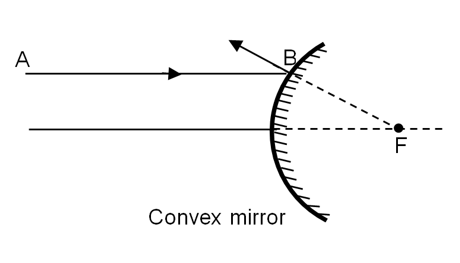
Light rays parallel to the optical axis are reflected from the surface in a manner that diverges from the focal point, which is behind the mirror.
Images formed with convex mirrors are always right side up and reduced in size. These images are also termed virtual images, because they occur where reflected rays appear to diverge from a focal point behind the mirror.
Hence, the correct option is A, i.e., Curved or bowed outward like outside of a bowl or sphere.
Additional Information:
The mirror whose reflecting surface is flat is a plane mirror whereas a mirror with the curved reflecting surface is termed as a spherical mirror. A spherical mirror is of two types, i.e. convex mirror and a concave mirror. A convex mirror has a reflecting surface that bulges outside.
On the contrary, in a concave mirror, the reflecting surface bulges inwards.
The main difference between a convex and concave mirror lies in the image formed by the two mirrors, i.e. while convex mirror forms diminished image, the concave mirror either forms an enlarged image or a diminished one, depending upon the position of the object.
Convex mirrors are often used in automobile right-hand rear-view applications where the outward mirror curvature produces a smaller, more panoramic view of events occurring behind the vehicle.
Note: Students should understand the differences between the reflecting surfaces of convex and concave mirrors and so that they do not confuse between these types of curved mirrors. If students relate the concept of curved mirrors with the examples of daily life then it will be very easy to remember.
Complete step by step answer:
The convex mirror has a reflecting surface that curves outward resembling a portion of the outside of a ball or sphere.
Light rays parallel to the optical axis are reflected from the surface in a manner that diverges from the focal point, which is behind the mirror.
Images formed with convex mirrors are always right side up and reduced in size. These images are also termed virtual images, because they occur where reflected rays appear to diverge from a focal point behind the mirror.
Hence, the correct option is A, i.e., Curved or bowed outward like outside of a bowl or sphere.
Additional Information:
The mirror whose reflecting surface is flat is a plane mirror whereas a mirror with the curved reflecting surface is termed as a spherical mirror. A spherical mirror is of two types, i.e. convex mirror and a concave mirror. A convex mirror has a reflecting surface that bulges outside.
On the contrary, in a concave mirror, the reflecting surface bulges inwards.
The main difference between a convex and concave mirror lies in the image formed by the two mirrors, i.e. while convex mirror forms diminished image, the concave mirror either forms an enlarged image or a diminished one, depending upon the position of the object.
Convex mirrors are often used in automobile right-hand rear-view applications where the outward mirror curvature produces a smaller, more panoramic view of events occurring behind the vehicle.
Note: Students should understand the differences between the reflecting surfaces of convex and concave mirrors and so that they do not confuse between these types of curved mirrors. If students relate the concept of curved mirrors with the examples of daily life then it will be very easy to remember.
Recently Updated Pages
Master Class 12 Economics: Engaging Questions & Answers for Success

Master Class 12 English: Engaging Questions & Answers for Success
Master Class 12 Social Science: Engaging Questions & Answers for Success
Master Class 12 Maths: Engaging Questions & Answers for Success
Master Class 12 Physics: Engaging Questions & Answers for Success
Master Class 9 General Knowledge: Engaging Questions & Answers for Success
Trending doubts
Explain the Treaty of Vienna of 1815 class 10 social science CBSE
Who Won 36 Oscar Awards? Record Holder Revealed
What is the median of the first 10 natural numbers class 10 maths CBSE
Why is it 530 pm in india when it is 1200 afternoon class 10 social science CBSE
Make a sketch of the human nerve cell What function class 10 biology CBSE
What is the full form of POSCO class 10 social science CBSE