




What is a convergent beam of light?
Answer
 Verified
634.2k+ views
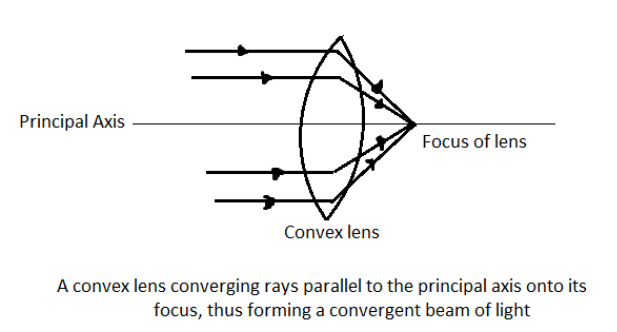
Hint: The word converges or convergent in science generally means meeting or joining of objects or bodies at a point or plane. Therefore, it can be deduced that a convergent beam of light means a beam of light, whose individual rays keep on coming closer constantly and finally meet at a point.
Complete step by step answer:
When light rays from different points constantly keep coming closer together and finally meet at a point, then the light beam is known as a convergent beam of light. As the beam of light keeps travelling in space, its coverage area keeps on decreasing. This is an obvious property of a convergent beam of light.
Convergent beams of light are produced in general by convex lenses and concave mirrors.
Additional information:
An interesting experiment that students can perform easily to understand convergent beams of light is by using a simple magnifying glass (a convex lens), a piece of paper and sunlight. Hold the magnifying glass in such a way, so that the sun’s rays fall on it and converge onto a point on the ground. Keep a paper on this point and the paper will slowly heat up and may even catch fire. A simple paper kept in the sun will not catch fire, but due to the magnifying class a concentrated convergent beam focuses all the heat energy on the paper.
Note: Students can keep in mind that convex lenses and concave mirrors produce convergent beams of light by thinking or actually performing the experiment described above. The experiment can also be performed with a concave mirror, but a few tweaks will have to be made. The paper will have to be held above the mirror, between the sun and the mirror.
Many students get confused between the converging and diverging effects of the different kinds of lenses and mirrors. However, by thinking of the experiments and their results, a lot of scope for confusion can get eliminated.
Complete step by step answer:
When light rays from different points constantly keep coming closer together and finally meet at a point, then the light beam is known as a convergent beam of light. As the beam of light keeps travelling in space, its coverage area keeps on decreasing. This is an obvious property of a convergent beam of light.
Convergent beams of light are produced in general by convex lenses and concave mirrors.
Additional information:
An interesting experiment that students can perform easily to understand convergent beams of light is by using a simple magnifying glass (a convex lens), a piece of paper and sunlight. Hold the magnifying glass in such a way, so that the sun’s rays fall on it and converge onto a point on the ground. Keep a paper on this point and the paper will slowly heat up and may even catch fire. A simple paper kept in the sun will not catch fire, but due to the magnifying class a concentrated convergent beam focuses all the heat energy on the paper.
Note: Students can keep in mind that convex lenses and concave mirrors produce convergent beams of light by thinking or actually performing the experiment described above. The experiment can also be performed with a concave mirror, but a few tweaks will have to be made. The paper will have to be held above the mirror, between the sun and the mirror.
Many students get confused between the converging and diverging effects of the different kinds of lenses and mirrors. However, by thinking of the experiments and their results, a lot of scope for confusion can get eliminated.
Recently Updated Pages
Master Class 11 English: Engaging Questions & Answers for Success

Master Class 11 Social Science: Engaging Questions & Answers for Success
Master Class 11 Maths: Engaging Questions & Answers for Success
Master Class 11 Chemistry: Engaging Questions & Answers for Success
Master Class 11 Biology: Engaging Questions & Answers for Success
Master Class 11 Physics: Engaging Questions & Answers for Success
Trending doubts
Explain the Treaty of Vienna of 1815 class 10 social science CBSE
Why is it 530 pm in india when it is 1200 afternoon class 10 social science CBSE
What is the full form of CNG A Complete Natural Gas class 10 social science CBSE
In cricket, what is a "Yorker" designed to do?
What is the full form of POSCO class 10 social science CBSE
Define Potential, Developed, Stock and Reserved resources