




A constant function is a periodic function.
A. True
B. False
Answer
 Verified
608.7k+ views
Hint: We need to check whether the given statement is true or false. A periodic function can be defined as a function returning to the same value at regular intervals. A function $f$ is said to be periodic if, for some non-zero constant $P$ , it satisfies the equation, \[f\left( x+P \right)=\text{ }f\left( x \right)\] , for all values of $x$ in the domain . $P$ is the period of the function. A constant function, $f(x)=c$ repeats its values at regular intervals.
Complete step by step answer:
We need to check whether the statement “ a constant function is a periodic function” is true or false.
Let us see what a periodic function is.
A periodic function can be defined as a function returning to the same value at regular intervals.
For example, $\sin x$ .
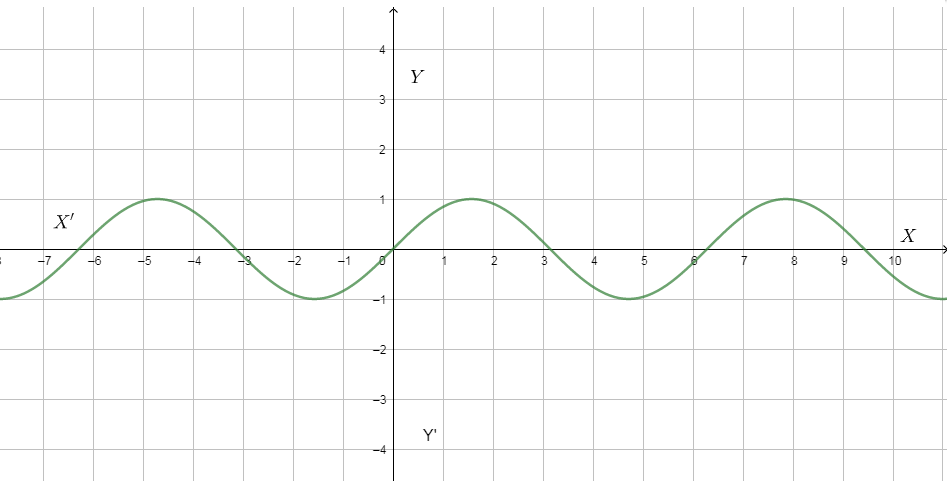
The function repeats continuously in a similar fashion. For example, from the figure, the wave begins from 0 to 3 goes to the negative part from 3 to 6. This fashion is repeated again.
A function $f$ is said to be periodic if, for some non-zero constant $P$ , it satisfies the equation, \[f\left( x+P \right)=\text{ }f\left( x \right)\] , for all values of $x$ in the domain . $P$ is the period of the function.
Constant function a real-valued function of a real-valued argument, denoted by $f(x)=c$ .
The below figure shows the graph of constant function $f(x)=2$ .
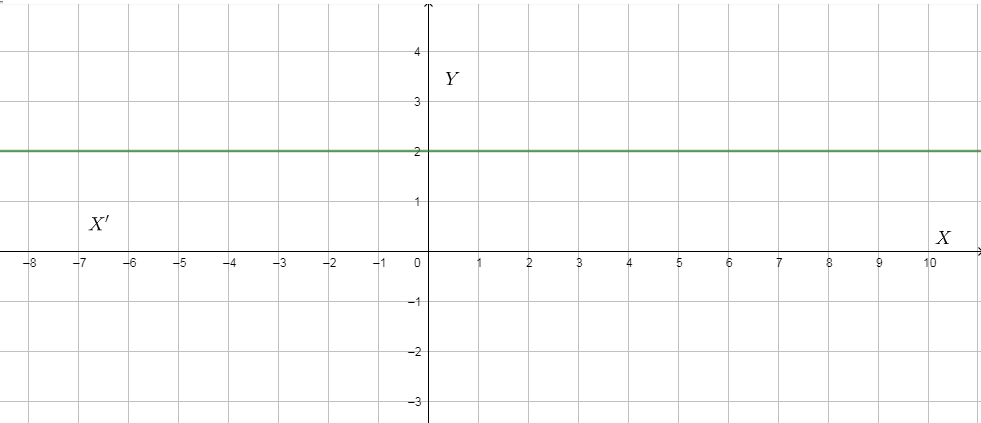
$f(x)=2$ repeats its values at regular intervals like for $x=1,2,....n$ , where $n=Z$ , an integer.
Hence, a constant function is a periodic function with a period $n$.
Hence, the given statement is True.
Note:
All constant functions are periodic irrespective of its type, that is, whether it is an integer, a fraction, or real number. \[f\left( x+P \right)=\text{ }f\left( x \right)\] is the equation of a periodic function. All constant functions repeat its values at regular intervals like for $x=1,2,....n$ , where $n=Z$ .
Complete step by step answer:
We need to check whether the statement “ a constant function is a periodic function” is true or false.
Let us see what a periodic function is.
A periodic function can be defined as a function returning to the same value at regular intervals.
For example, $\sin x$ .
The function repeats continuously in a similar fashion. For example, from the figure, the wave begins from 0 to 3 goes to the negative part from 3 to 6. This fashion is repeated again.
A function $f$ is said to be periodic if, for some non-zero constant $P$ , it satisfies the equation, \[f\left( x+P \right)=\text{ }f\left( x \right)\] , for all values of $x$ in the domain . $P$ is the period of the function.
Constant function a real-valued function of a real-valued argument, denoted by $f(x)=c$ .
The below figure shows the graph of constant function $f(x)=2$ .
$f(x)=2$ repeats its values at regular intervals like for $x=1,2,....n$ , where $n=Z$ , an integer.
Hence, a constant function is a periodic function with a period $n$.
Hence, the given statement is True.
Note:
All constant functions are periodic irrespective of its type, that is, whether it is an integer, a fraction, or real number. \[f\left( x+P \right)=\text{ }f\left( x \right)\] is the equation of a periodic function. All constant functions repeat its values at regular intervals like for $x=1,2,....n$ , where $n=Z$ .
Recently Updated Pages
Master Class 10 Computer Science: Engaging Questions & Answers for Success

Master Class 10 General Knowledge: Engaging Questions & Answers for Success
Master Class 10 English: Engaging Questions & Answers for Success
Master Class 10 Social Science: Engaging Questions & Answers for Success
Master Class 10 Maths: Engaging Questions & Answers for Success
Master Class 10 Science: Engaging Questions & Answers for Success
Trending doubts
Explain the Treaty of Vienna of 1815 class 10 social science CBSE
Who Won 36 Oscar Awards? Record Holder Revealed
What is the median of the first 10 natural numbers class 10 maths CBSE
Why is it 530 pm in india when it is 1200 afternoon class 10 social science CBSE
Select the word that is correctly spelled a Twelveth class 10 english CBSE
Why is there a time difference of about 5 hours between class 10 social science CBSE