



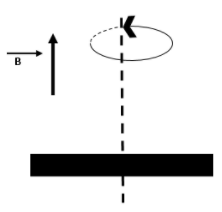
A conducting rod of length 2l is rotating with constant singular, speed about its perpendicular bisector. A uniform magnetic field \[\overrightarrow{B}\] exists parallel to the axis of rotation. The emf Induced between two ends of the rod is
A) \[Bw{{l}^{2}}\]
B) \[\dfrac{1}{2}Bw{{l}^{2}}\]
C) \[\dfrac{1}{8}Bw{{l}^{2}}\]
D) Zero
Answer
 Verified
585.9k+ views
Hint: Since, a conducting rod of length 2l is rotating with constant angular speed w about its \[\bot ar\] bisector and a uniform magnetic field \[\overrightarrow{B}\] exists \[\parallel r\] to the axis of rotation. So, we used the formula of induced emf due to rotation.
Complete answer:
Let us assume a small element dx of a distance x from the rod rotating with an angular speed w about its perpendicular bisectors. Due to the rotation, the emf induced in the small amount element is given by
\[de=Bwxdx\]
Where de = induced emf in the small element
Since, the rod is rotating. So the emf induced between the centre of the rod and one of its side is given by \[de=\int_{0}^{1}{aw}dx\]
On integrating both sides, we get
\[e=Bw\left[ \dfrac{{{x}^{2}}}{2} \right]_{0}^{l}\]
\[e=Bw\left[ \dfrac{{{1}^{2}}-{{0}^{2}}}{2} \right] \]
\[e=\dfrac{1}{2}Bw{{l}^{2}} \]
From the fig. \[AO=OB=l\]
So, the potential at rod OA \[{{V}_{a}}-{{V}_{0}}=\dfrac{1}{2}Bw{{l}^{2}}\text{ }\left( 1 \right)\]
And the potential at rod OB
\[{{V}_{B}}-{{V}_{0}}=\dfrac{1}{2}Bw{{l}^{2}}\text{ }\left( 2 \right)\]
Subtracting equation 2 from 1 we get
\[{{V}_{A}}-{{V}_{B}}=0\]
Hence, the correct option is D.
Note:
Be careful while calculating the formula induced emf \[e=\dfrac{1}{2}Bw{{l}^{2}}\] and a rod of length 2l is rotating about its bisector. So its length from the centre is taken to be l and calculate the potential on each side of the rod. Use the value provided exactly at the same time.
Complete answer:
Let us assume a small element dx of a distance x from the rod rotating with an angular speed w about its perpendicular bisectors. Due to the rotation, the emf induced in the small amount element is given by
\[de=Bwxdx\]
Where de = induced emf in the small element
Since, the rod is rotating. So the emf induced between the centre of the rod and one of its side is given by \[de=\int_{0}^{1}{aw}dx\]
On integrating both sides, we get
\[e=Bw\left[ \dfrac{{{x}^{2}}}{2} \right]_{0}^{l}\]
\[e=Bw\left[ \dfrac{{{1}^{2}}-{{0}^{2}}}{2} \right] \]
\[e=\dfrac{1}{2}Bw{{l}^{2}} \]
From the fig. \[AO=OB=l\]
So, the potential at rod OA \[{{V}_{a}}-{{V}_{0}}=\dfrac{1}{2}Bw{{l}^{2}}\text{ }\left( 1 \right)\]
And the potential at rod OB
\[{{V}_{B}}-{{V}_{0}}=\dfrac{1}{2}Bw{{l}^{2}}\text{ }\left( 2 \right)\]
Subtracting equation 2 from 1 we get
\[{{V}_{A}}-{{V}_{B}}=0\]
Hence, the correct option is D.
Note:
Be careful while calculating the formula induced emf \[e=\dfrac{1}{2}Bw{{l}^{2}}\] and a rod of length 2l is rotating about its bisector. So its length from the centre is taken to be l and calculate the potential on each side of the rod. Use the value provided exactly at the same time.
Recently Updated Pages
Master Class 11 Social Science: Engaging Questions & Answers for Success

Master Class 11 Physics: Engaging Questions & Answers for Success
Master Class 11 Maths: Engaging Questions & Answers for Success
Master Class 11 Economics: Engaging Questions & Answers for Success
Master Class 11 Computer Science: Engaging Questions & Answers for Success
Master Class 11 Chemistry: Engaging Questions & Answers for Success
Trending doubts
One Metric ton is equal to kg A 10000 B 1000 C 100 class 11 physics CBSE
There are 720 permutations of the digits 1 2 3 4 5 class 11 maths CBSE
1 Quintal is equal to a 110 kg b 10 kg c 100kg d 1000 class 11 physics CBSE
State and prove Bernoullis theorem class 11 physics CBSE
Difference Between Prokaryotic Cells and Eukaryotic Cells
Which among the following are examples of coming together class 11 social science CBSE