




A carbon resistance has the following color code. What is the value of the resistance?

A. $1.64M\Omega \pm 5\% $
B. $530k\Omega \pm 5\% $
C. $64k\Omega \pm 10\% $
D. $5.3M\Omega \pm 5\% $
Answer
 Verified
607.2k+ views
Hint: To solve this question you need to remember the resistor color table and the basic color combination of resistor that from 1st band to 3rd band only color from black to white can represent these bands but the 4th band represented by the color like gold, silver, and no color, these color shows the tolerance of the resistor.
Complete Step-by-Step solution:
Let first find the color combination of the carbon resistance
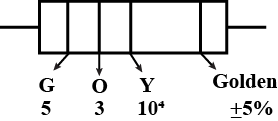
Now to find the resistance of the carbon resistance we have to find the values of the color code
By the resistor colour code table we know that in the given color combination G stands for green, O stands for Orange and Y represent yellow and
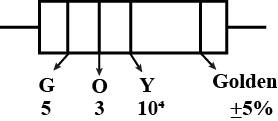
In the 4 bands type resistor 1 digit is represented by 1st colour in the resistor similarly 2nd color represents 2nd digit but in the 4 bands resistor 3rd color works as a multiplier and the last color represents the tolerance of the resistor.
Therefore $R = 53 \times {10^4} \pm 5\% $ = $530k\Omega \pm 5\% $
Hence, B is the correct option.
Note: In the above solution we used a term tolerance many times where the tolerance is the maximum difference between its actual value and the required value these errors generally expressed as + and – percentage value. Inherently, the resistors have no tolerance. They 're built up to those tolerances. This is the degree the resistance could have changed from the value specified. So if you have a 1 K\[\Omega \] resistor with 10% tolerance, the resistor's real value will be between 900\[\Omega \]and 1100\[\Omega \].
Complete Step-by-Step solution:
Let first find the color combination of the carbon resistance
Now to find the resistance of the carbon resistance we have to find the values of the color code
By the resistor colour code table we know that in the given color combination G stands for green, O stands for Orange and Y represent yellow and
In the 4 bands type resistor 1 digit is represented by 1st colour in the resistor similarly 2nd color represents 2nd digit but in the 4 bands resistor 3rd color works as a multiplier and the last color represents the tolerance of the resistor.
Therefore $R = 53 \times {10^4} \pm 5\% $ = $530k\Omega \pm 5\% $
Hence, B is the correct option.
Note: In the above solution we used a term tolerance many times where the tolerance is the maximum difference between its actual value and the required value these errors generally expressed as + and – percentage value. Inherently, the resistors have no tolerance. They 're built up to those tolerances. This is the degree the resistance could have changed from the value specified. So if you have a 1 K\[\Omega \] resistor with 10% tolerance, the resistor's real value will be between 900\[\Omega \]and 1100\[\Omega \].
Recently Updated Pages
Master Class 10 Computer Science: Engaging Questions & Answers for Success

Master Class 10 General Knowledge: Engaging Questions & Answers for Success
Master Class 10 English: Engaging Questions & Answers for Success
Master Class 10 Social Science: Engaging Questions & Answers for Success
Master Class 10 Maths: Engaging Questions & Answers for Success
Master Class 10 Science: Engaging Questions & Answers for Success
Trending doubts
What is the median of the first 10 natural numbers class 10 maths CBSE
Which women's tennis player has 24 Grand Slam singles titles?
Who is the Brand Ambassador of Incredible India?
Why is there a time difference of about 5 hours between class 10 social science CBSE
Write a letter to the principal requesting him to grant class 10 english CBSE
A moving boat is observed from the top of a 150 m high class 10 maths CBSE