




A capacitor of capacitance C = 15pF is charged with voltage V = 500V. The electric field inside the capacitor with the dielectric is ${10^6}V{m^{ - 1}}$ and the area of the plate is ${10^{ - 4}}{m^2}$, the dielectric constant of the medium is: (${\varepsilon _0} = 8.85 \times {10^{ - 12}}$in SI units)
A. $12.47$
B. $8.47$
C. $10.85$
D. $14.85$
Answer
 Verified
607.8k+ views
Hint: To solve this problem, we have to use the definition of capacitance in terms of the material of the capacitor and the external conditions it is connected in, like potential and the electric field.
Capacitance of a capacitor in terms of material:
$C = \dfrac{{K{\varepsilon _0}A}}{d}$
where K = dielectric constant, ${\varepsilon _0}$= absolute permittivity, $A$= area of the plates and d = distance between the plates.
When a capacitor is connected to an external potential difference, the capacitance is calculated by the charge developed in the capacitor per unit potential difference.
$C = \dfrac{q}{V}$
where $q$ = charge stored in the capacitor and V = potential difference applied.
Complete step by step answer:
The capacitor is an electronic device that is used to store electric charge. It consists of two conductor plates separated by a very small distance.
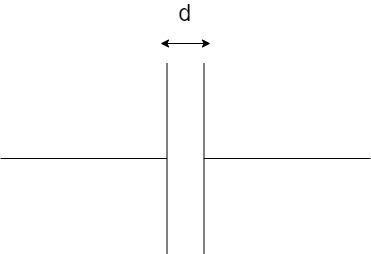
The capacitance is the effect produced by the capacitor which is equal to the amount of charge stored in the plates of the capacitor per unit potential difference.
If V is the potential difference applied across a capacitor and the charge q is stored in the plates, the expression for capacitance is –
$C = \dfrac{q}{V}$
However, this is not the method used to calculate the capacitance.
The capacitance is dependent on three factors:
i) Area of the plates, A
ii) Distance of separation, d
iii) Permittivity, $\varepsilon $
The relation is given by –
$C = \dfrac{{\varepsilon A}}{d}$
The space between the capacitor plates can be empty or filled with insulating material known as dielectric such as glass, ceramic, aluminium oxide, mica, paper or even plastic.
Permittivity, $\varepsilon = K{\varepsilon _0}$
where ${\varepsilon _0} = 8.85 \times {10^{ - 12}}F{m^{ - 1}}$, the absolute permittivity of free space/air.
The constant K is called the dielectric constant, which is a representation of the ability of the material to be polarised i.e. aligned itself along the electric field, in the presence of an electric field.
Hence, if we introduce a dielectric in between the plates, the capacitance is given by –
$C = \dfrac{{K{\varepsilon _0}A}}{d}$
Given in the problem, we have –
Voltage applied, $V = 500V$
Field between the capacitor, $E = {10^6}V{m^{ - 1}}$
The relation between them,
$E = \dfrac{V}{d}$
where d is the distance of separation.
This distance of separation can be substituted in the above formula with the formula for capacitance above.
$C = \dfrac{{K{\varepsilon _0}A}}{d}$
$ \Rightarrow d = \dfrac{{K{\varepsilon _0}A}}{C}$
Substituting,
$E = \dfrac{V}{d}$
$E = \dfrac{{V \times C}}{{K{\varepsilon _0}A}}$
$ \Rightarrow K = \dfrac{{V \times C}}{{E{\varepsilon _0}A}}$
Given,
Capacitance, $C = 15pF = 15 \times {10^{ - 12}}F$
Area between the plates, $A = {10^{ - 4}}{m^2}$
Substituting the values, we get –
$\Rightarrow K = \dfrac{{500 \times 15 \times {{10}^{ - 12}}}}{{{{10}^6} \times 8.85 \times {{10}^{ - 12}} \times {{10}^{ - 4}}}} = \dfrac{{7500}}{{8.85 \times {{10}^2}}} = 8.47$
Hence, the correct option is Option B.
Note:
In this solution, we have deduced the formula of capacitance with respect to the material filled in the gap of the capacitor.
$C = \dfrac{{K{\varepsilon _0}A}}{d}$
$ \Rightarrow C \propto K$
We can see that the capacitance is directly proportional to the dielectric constant. So, by introducing a material whose dielectric constant is higher, we can achieve higher capacitance for the same size of the capacitor.
Hence, the capacitance of a capacitor can be increased by introducing a material of high dielectric constant K, with the same area of the plates and the same distance of separation.
Capacitance of a capacitor in terms of material:
$C = \dfrac{{K{\varepsilon _0}A}}{d}$
where K = dielectric constant, ${\varepsilon _0}$= absolute permittivity, $A$= area of the plates and d = distance between the plates.
When a capacitor is connected to an external potential difference, the capacitance is calculated by the charge developed in the capacitor per unit potential difference.
$C = \dfrac{q}{V}$
where $q$ = charge stored in the capacitor and V = potential difference applied.
Complete step by step answer:
The capacitor is an electronic device that is used to store electric charge. It consists of two conductor plates separated by a very small distance.
The capacitance is the effect produced by the capacitor which is equal to the amount of charge stored in the plates of the capacitor per unit potential difference.
If V is the potential difference applied across a capacitor and the charge q is stored in the plates, the expression for capacitance is –
$C = \dfrac{q}{V}$
However, this is not the method used to calculate the capacitance.
The capacitance is dependent on three factors:
i) Area of the plates, A
ii) Distance of separation, d
iii) Permittivity, $\varepsilon $
The relation is given by –
$C = \dfrac{{\varepsilon A}}{d}$
The space between the capacitor plates can be empty or filled with insulating material known as dielectric such as glass, ceramic, aluminium oxide, mica, paper or even plastic.
Permittivity, $\varepsilon = K{\varepsilon _0}$
where ${\varepsilon _0} = 8.85 \times {10^{ - 12}}F{m^{ - 1}}$, the absolute permittivity of free space/air.
The constant K is called the dielectric constant, which is a representation of the ability of the material to be polarised i.e. aligned itself along the electric field, in the presence of an electric field.
Hence, if we introduce a dielectric in between the plates, the capacitance is given by –
$C = \dfrac{{K{\varepsilon _0}A}}{d}$
Given in the problem, we have –
Voltage applied, $V = 500V$
Field between the capacitor, $E = {10^6}V{m^{ - 1}}$
The relation between them,
$E = \dfrac{V}{d}$
where d is the distance of separation.
This distance of separation can be substituted in the above formula with the formula for capacitance above.
$C = \dfrac{{K{\varepsilon _0}A}}{d}$
$ \Rightarrow d = \dfrac{{K{\varepsilon _0}A}}{C}$
Substituting,
$E = \dfrac{V}{d}$
$E = \dfrac{{V \times C}}{{K{\varepsilon _0}A}}$
$ \Rightarrow K = \dfrac{{V \times C}}{{E{\varepsilon _0}A}}$
Given,
Capacitance, $C = 15pF = 15 \times {10^{ - 12}}F$
Area between the plates, $A = {10^{ - 4}}{m^2}$
Substituting the values, we get –
$\Rightarrow K = \dfrac{{500 \times 15 \times {{10}^{ - 12}}}}{{{{10}^6} \times 8.85 \times {{10}^{ - 12}} \times {{10}^{ - 4}}}} = \dfrac{{7500}}{{8.85 \times {{10}^2}}} = 8.47$
Hence, the correct option is Option B.
Note:
In this solution, we have deduced the formula of capacitance with respect to the material filled in the gap of the capacitor.
$C = \dfrac{{K{\varepsilon _0}A}}{d}$
$ \Rightarrow C \propto K$
We can see that the capacitance is directly proportional to the dielectric constant. So, by introducing a material whose dielectric constant is higher, we can achieve higher capacitance for the same size of the capacitor.
Hence, the capacitance of a capacitor can be increased by introducing a material of high dielectric constant K, with the same area of the plates and the same distance of separation.
Recently Updated Pages
Master Class 12 Business Studies: Engaging Questions & Answers for Success

Master Class 12 Chemistry: Engaging Questions & Answers for Success
Master Class 12 Biology: Engaging Questions & Answers for Success
Class 12 Question and Answer - Your Ultimate Solutions Guide
Master Class 11 Social Science: Engaging Questions & Answers for Success
Master Class 11 Chemistry: Engaging Questions & Answers for Success
Trending doubts
Which are the Top 10 Largest Countries of the World?
Draw a labelled sketch of the human eye class 12 physics CBSE
Name the crygenes that control cotton bollworm and class 12 biology CBSE
Differentiate between homogeneous and heterogeneous class 12 chemistry CBSE
How many molecules of ATP and NADPH are required information class 12 biology CBSE
In a transcription unit the promoter is said to be class 12 biology CBSE