




What is a calorimeter? Name the material of which it is made of. Give two reasons for using the material stated by you.
Answer
 Verified
647.4k+ views
Hint: Calorimeter is a device which is used for the science of calorimetry. The calorimetry is the branch of science that deals with determining the change in the state variables of a body for the purpose of deriving the value of heat transfer during a thermodynamic process.
Complete step-by-step answer:
During a physical or a chemical reaction, it is natural that there is heat transfer towards and from the reaction system. This heat energy in the form of a quantity called enthalpy is measured using the device called calorimeter.
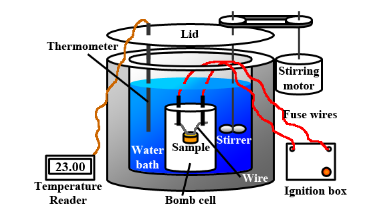
To calculate the enthalpy, the reactants are put into the calorimeter separately and the reaction is ignited. The initial and final temperatures are recorded and the formula is used to calculate the enthalpy change –
$\Delta H = C\Delta t$
where C – specific heat capacity of the materials used and $\Delta t$ is the change in the temperature.
The material used for calorimeter construction is copper.
The main reason for using copper as the material for construction of the calorimeter is –
High Thermal conductivity:
Since the heat has to be conducted evenly, uniformly, and quickly to the materials, the material used, should have a higher value of thermal conductivity. Copper has one of the best thermal conductivities among the metals.
Low specific heat capacity:
Copper has low thermal specific heat capacity because it should not take in the heat to increase its own temperature, thereby adding to the heat produced and producing error in the calculation of the enthalpy change.
Note: In this answer, only the generic specific heat capacity is mentioned as C. However, there are different values of specific heat when the system is at constant volume and constant pressure.
${C_v}\& {C_p}$ are the specific heats at constant volume and pressure respectively. In this case of calorimeter, the specific heat taken is of ${C_v}$ since the calorimeter when closed, becomes a constant volume enclosure for the reaction to happen at constant volume condition.
The difference between ${C_p}\& {C_v}$ is equal to the universal gas constant R.
${C_p} - {C_v} = R$
Complete step-by-step answer:
During a physical or a chemical reaction, it is natural that there is heat transfer towards and from the reaction system. This heat energy in the form of a quantity called enthalpy is measured using the device called calorimeter.
To calculate the enthalpy, the reactants are put into the calorimeter separately and the reaction is ignited. The initial and final temperatures are recorded and the formula is used to calculate the enthalpy change –
$\Delta H = C\Delta t$
where C – specific heat capacity of the materials used and $\Delta t$ is the change in the temperature.
The material used for calorimeter construction is copper.
The main reason for using copper as the material for construction of the calorimeter is –
High Thermal conductivity:
Since the heat has to be conducted evenly, uniformly, and quickly to the materials, the material used, should have a higher value of thermal conductivity. Copper has one of the best thermal conductivities among the metals.
Low specific heat capacity:
Copper has low thermal specific heat capacity because it should not take in the heat to increase its own temperature, thereby adding to the heat produced and producing error in the calculation of the enthalpy change.
Note: In this answer, only the generic specific heat capacity is mentioned as C. However, there are different values of specific heat when the system is at constant volume and constant pressure.
${C_v}\& {C_p}$ are the specific heats at constant volume and pressure respectively. In this case of calorimeter, the specific heat taken is of ${C_v}$ since the calorimeter when closed, becomes a constant volume enclosure for the reaction to happen at constant volume condition.
The difference between ${C_p}\& {C_v}$ is equal to the universal gas constant R.
${C_p} - {C_v} = R$
Recently Updated Pages
Class 10 Question and Answer - Your Ultimate Solutions Guide

Master Class 12 Economics: Engaging Questions & Answers for Success
Master Class 12 Social Science: Engaging Questions & Answers for Success
Master Class 12 English: Engaging Questions & Answers for Success
Master Class 12 Maths: Engaging Questions & Answers for Success
Master Class 12 Physics: Engaging Questions & Answers for Success
Trending doubts
Explain the Treaty of Vienna of 1815 class 10 social science CBSE
The slogan Jai Hind was given by A Lal Bahadur Shastri class 10 social science CBSE
10 examples of evaporation in daily life with explanations
What is the full form of POSCO class 10 social science CBSE
Identify the feminine form of noun nephew a shenephew class 10 english CBSE
CSIR full form?