




A boy standing on an open car throws a ball vertically upwards with a velocity of $9.8{\text{m}}{{\text{s}}^{ - 1}}$ while moving horizontally with a uniform acceleration of ${\text{1m}}{{\text{s}}^{ - 2}}$ starting from rest. Find the distance at which the ball falls behind the boy in the car.
A) 1 m
B) 2 m
C) 3 m
D) 4 m
Answer
 Verified
605.1k+ views
Hint:The ball thrown vertically upwards by the boy on the moving car can be considered as a projectile and thus the path of the ball describes a parabola. Since the car has a constant acceleration the distance covered by the car forward during the time of flight of the ball will be equal to the distance at which the ball falls behind the boy.
Formulas used:
-The time of flight of a projectile is given by, $T = \dfrac{{2{u_y}}}{g}$ where ${u_y}$ is the initial vertical velocity of the projectile and $g$ is the acceleration due to gravity.
-The distance covered by a body is given by Newton’s equation of motion as $s = ut + \dfrac{1}{2}a{t^2}$ where $u$ is the initial velocity of the body, $a$ is its acceleration and $t$ is the time taken to cover the distance $s$ .
Complete step by step answer.
Step 1: Sketch a rough figure of the problem and list the parameters known from the question.
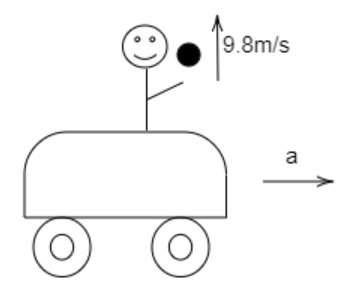
The figure represents a ball being thrown by a boy standing on the car.
The ball constitutes a projectile motion as it is thrown vertically upwards from a car moving horizontally.
The initial vertical velocity of the ball is given to be ${u_y} = 9.8{\text{m}}{{\text{s}}^{ - 1}}$ .
The uniform acceleration of the car moving horizontally is given to be $a = 1{\text{m}}{{\text{s}}^{ - 2}}$.
It is mentioned that the car starts its journey from rest. So, its initial velocity $u = 0{\text{m}}{{\text{s}}^{ - 1}}$ .
Let $T$ be the time of flight of the ball.
Step 2: Find the time of flight of the ball.
The time of flight of the ball is given by, $T = \dfrac{{2{u_y}}}{g}$ ------- (1) where ${u_y}$ is its initial vertical velocity and $g$ is the acceleration due to gravity.
Substituting the values for ${u_y} = 9.8{\text{m}}{{\text{s}}^{ - 1}}$ and $g = 9.8{\text{m}}{{\text{s}}^{ - 2}}$ in equation (1) we get, $T = \dfrac{{2 \times 9.8}}{{9.8}} = 2{\text{s}}$
Thus the time of flight of the ball is $T = 2{\text{s}}$ .
Step 3: Find the distance covered by the boy as the ball falls down.
Let $t$ be the time taken to cover the required distance. Then this time taken is equal to the time of flight of the ball i.e., $t = T = 2{\text{s}}$ .
Newtons’ equation of motion gives the distance covered by the boy as $s = ut + \dfrac{1}{2}a{t^2}$ ------ (2)
where $u$ is his initial velocity, $a$ is his acceleration and $t$ is the time taken to cover the distance $s$.
Substituting values for $u = 0{\text{m}}{{\text{s}}^{ - 1}}$, $a = 1{\text{m}}{{\text{s}}^{ - 2}}$ and $t = 2{\text{s}}$ in equation (2) we get $s = \left( {0 \times 2} \right) + \left( {\dfrac{1}{2} \times 1 \times {2^2}} \right) = 2{\text{m}}$
Thus the ball will fall at a distance of 2 m behind the boy.
So the correct option is B.
Note: The time flight refers to the time from when the ball was projected upwards to the time it reaches the surface. In this time the car would have moved 2 m forward and correspondingly the ball would fall 2 m behind the boy as per our calculations. The boy standing on the car possesses the same acceleration as that of the car. The horizontal velocity of the ball will be the same as that of the velocity of the car but it is irrelevant in our calculations.
Formulas used:
-The time of flight of a projectile is given by, $T = \dfrac{{2{u_y}}}{g}$ where ${u_y}$ is the initial vertical velocity of the projectile and $g$ is the acceleration due to gravity.
-The distance covered by a body is given by Newton’s equation of motion as $s = ut + \dfrac{1}{2}a{t^2}$ where $u$ is the initial velocity of the body, $a$ is its acceleration and $t$ is the time taken to cover the distance $s$ .
Complete step by step answer.
Step 1: Sketch a rough figure of the problem and list the parameters known from the question.
The figure represents a ball being thrown by a boy standing on the car.
The ball constitutes a projectile motion as it is thrown vertically upwards from a car moving horizontally.
The initial vertical velocity of the ball is given to be ${u_y} = 9.8{\text{m}}{{\text{s}}^{ - 1}}$ .
The uniform acceleration of the car moving horizontally is given to be $a = 1{\text{m}}{{\text{s}}^{ - 2}}$.
It is mentioned that the car starts its journey from rest. So, its initial velocity $u = 0{\text{m}}{{\text{s}}^{ - 1}}$ .
Let $T$ be the time of flight of the ball.
Step 2: Find the time of flight of the ball.
The time of flight of the ball is given by, $T = \dfrac{{2{u_y}}}{g}$ ------- (1) where ${u_y}$ is its initial vertical velocity and $g$ is the acceleration due to gravity.
Substituting the values for ${u_y} = 9.8{\text{m}}{{\text{s}}^{ - 1}}$ and $g = 9.8{\text{m}}{{\text{s}}^{ - 2}}$ in equation (1) we get, $T = \dfrac{{2 \times 9.8}}{{9.8}} = 2{\text{s}}$
Thus the time of flight of the ball is $T = 2{\text{s}}$ .
Step 3: Find the distance covered by the boy as the ball falls down.
Let $t$ be the time taken to cover the required distance. Then this time taken is equal to the time of flight of the ball i.e., $t = T = 2{\text{s}}$ .
Newtons’ equation of motion gives the distance covered by the boy as $s = ut + \dfrac{1}{2}a{t^2}$ ------ (2)
where $u$ is his initial velocity, $a$ is his acceleration and $t$ is the time taken to cover the distance $s$.
Substituting values for $u = 0{\text{m}}{{\text{s}}^{ - 1}}$, $a = 1{\text{m}}{{\text{s}}^{ - 2}}$ and $t = 2{\text{s}}$ in equation (2) we get $s = \left( {0 \times 2} \right) + \left( {\dfrac{1}{2} \times 1 \times {2^2}} \right) = 2{\text{m}}$
Thus the ball will fall at a distance of 2 m behind the boy.
So the correct option is B.
Note: The time flight refers to the time from when the ball was projected upwards to the time it reaches the surface. In this time the car would have moved 2 m forward and correspondingly the ball would fall 2 m behind the boy as per our calculations. The boy standing on the car possesses the same acceleration as that of the car. The horizontal velocity of the ball will be the same as that of the velocity of the car but it is irrelevant in our calculations.
Recently Updated Pages
Master Class 11 English: Engaging Questions & Answers for Success

Master Class 11 Maths: Engaging Questions & Answers for Success
Class 11 Question and Answer - Your Ultimate Solutions Guide
Master Class 11 Biology: Engaging Questions & Answers for Success
Master Class 11 Physics: Engaging Questions & Answers for Success
Master Class 11 Accountancy: Engaging Questions & Answers for Success
Trending doubts
Differentiate between an exothermic and an endothermic class 11 chemistry CBSE
One Metric ton is equal to kg A 10000 B 1000 C 100 class 11 physics CBSE
Difference Between Prokaryotic Cells and Eukaryotic Cells
There are 720 permutations of the digits 1 2 3 4 5 class 11 maths CBSE
Draw a diagram of a plant cell and label at least eight class 11 biology CBSE
1 Quintal is equal to a 110 kg b 10 kg c 100kg d 1000 class 11 physics CBSE