




A boy has the blood group O. what is true of the inheritance of this blood group in this case?
A. His mother should be with AB blood group.
B. Both his parents could be heterozygous A group.
C. His father could be homozygous B group.
D. His mother could be homozygous A group.
Answer
 Verified
644.7k+ views
Hint: Codominance is an allelic relationship that enables the phenotype to be expressed in the heterozygous form of both the alleles. Human blood shows codominance. In the case of the type O blood group, the genotype is ${I^O}{I^O}$.
Complete step by step answer: In codominance, both the alleles are expressed equally. It usually occurs when both forms of the same gene don’t mask the effect of the other allele. This is commonly found in human ABO blood groups, where both the alleles are equally expressed. The $\beta $ chain of haemoglobin shows three types of molecular phenotypes- $\dfrac{{H{b_A}}}{{H{b_A}}}$ $\dfrac{{H{b_A}}}{{H{b_S}}}$ $\dfrac{{H{b_S}}}{{H{b_S}}}$
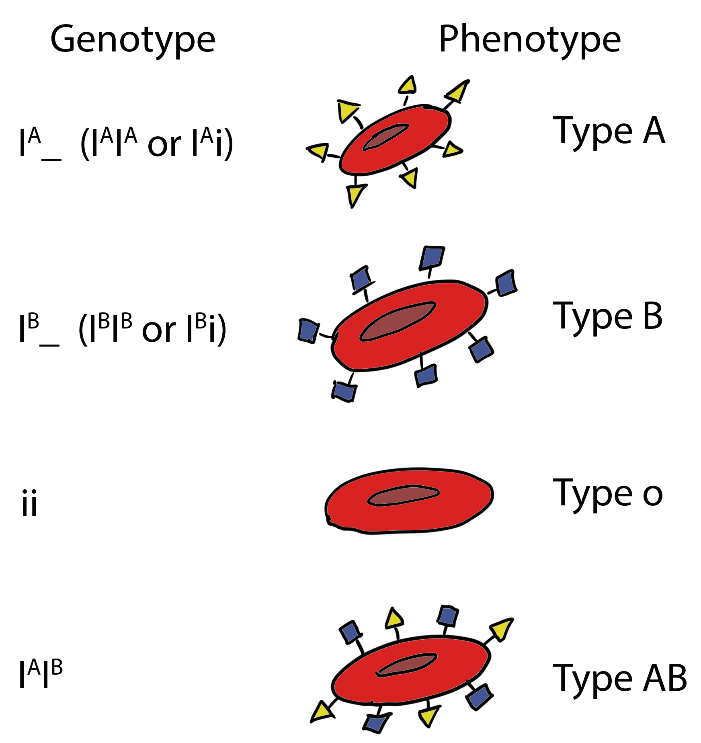
According to the information provided in the question, if the boy has blood group O, then its genotype is ${I^O}{I^O}$, which implies that both of his parents have the blood with heterozygous A group. The genotype for heterozygous A blood group is ${I^A}{I^O}$. So, the offspring will inherit the O allele from father and mother, as a result of which, the offspring will have an O blood group.
Hence, the correct answer is option is B.
Note: People having the blood group O are also called universal donor because they have the ability to donate their blood to anyone. Type O positive blood is one of the first to run out during a shortage due to its high demand.
Complete step by step answer: In codominance, both the alleles are expressed equally. It usually occurs when both forms of the same gene don’t mask the effect of the other allele. This is commonly found in human ABO blood groups, where both the alleles are equally expressed. The $\beta $ chain of haemoglobin shows three types of molecular phenotypes- $\dfrac{{H{b_A}}}{{H{b_A}}}$ $\dfrac{{H{b_A}}}{{H{b_S}}}$ $\dfrac{{H{b_S}}}{{H{b_S}}}$
According to the information provided in the question, if the boy has blood group O, then its genotype is ${I^O}{I^O}$, which implies that both of his parents have the blood with heterozygous A group. The genotype for heterozygous A blood group is ${I^A}{I^O}$. So, the offspring will inherit the O allele from father and mother, as a result of which, the offspring will have an O blood group.
Hence, the correct answer is option is B.
Note: People having the blood group O are also called universal donor because they have the ability to donate their blood to anyone. Type O positive blood is one of the first to run out during a shortage due to its high demand.
Recently Updated Pages
If x a + bt + ct2 where x is in meters and t is in class 11 physics CBSE

A car covers the first half distance between two places class 11 physics CBSE
The resultant of two vectors overrightarrow P and overrightarrow class 11 physics CBSE
Find the value of cos 135 class 11 maths CBSE
A mass M is held in place by an applied force F and class 11 physics CBSE
A solution of glucose in water is labelled as 10 dfracwv class 11 chemistry CBSE
Trending doubts
One Metric ton is equal to kg A 10000 B 1000 C 100 class 11 physics CBSE
Find the value of the expression given below sin 30circ class 11 maths CBSE
What do you mean by retardation What is its SI uni class 11 physics CBSE
Draw a diagram of nephron and explain its structur class 11 biology CBSE
10 examples of friction in our daily life
Difference between physical and chemical change class 11 chemistry CBSE