




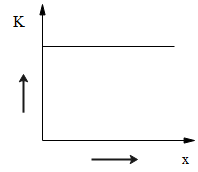
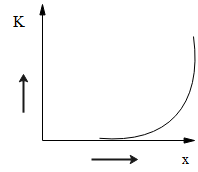
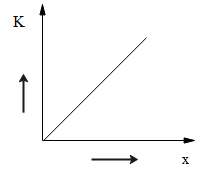
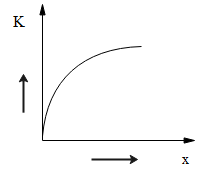
A body moves from rest with a constant acceleration. Which one of the following graphs represents the variation of its kinetic energy K with the distance travelled (x)?
A.
B.
C.
D.
Answer
 Verified
611.1k+ views
Hint: We will make use of the formulae like the kinetic energy of the particle and one of the laws of motion equations to solve this graphical problem. We will derive the expression using these equations, such that, the equation represents the relation between the kinetic energy K with the distance travelled (x), which is needed to determine the type of graph.
Formula used:
\[\begin{align}
& K=\dfrac{1}{2}m{{v}^{2}} \\
& {{v}^{2}}={{u}^{2}}+2as \\
\end{align}\]
Complete step-by-step answer:
The formulae used are as follows:
The kinetic energy of the body is given as follows.
\[K=\dfrac{1}{2}m{{v}^{2}}\]…… (1)
Where m is the mass of the body and v is the velocity of the body.
The law of motion formula is given as follows.
\[{{v}^{2}}={{u}^{2}}+2as\]…… (2)
Where v is the final velocity of the body, u is the initial velocity of the body, a is the acceleration and s is the distance travelled.
From given, we have the data as follows:
A body moves from rest with a constant acceleration.
\[\begin{align}
& \Rightarrow u=0 \\
& \Rightarrow a=a \\
\end{align}\]
The distance travelled is x
\[\Rightarrow s=x\]
Substitute these values in the equation (2)
\[\begin{align}
& {{v}^{2}}={{(0)}^{2}}+2(a)(x) \\
& \Rightarrow {{v}^{2}}=2ax \\
\end{align}\]
Now substitute this value of the final velocity in the expression of the kinetic energy of the body given in the equation (1). So, we get,
\[\begin{align}
& K=\dfrac{1}{2}m(2ax) \\
& \Rightarrow K=\max \\
\end{align}\]
Therefore, the relation between the kinetic energy and the distance travelled by the body is given to be,
\[\begin{align}
& K=(\operatorname{ma})x \\
& \Rightarrow K\propto x \\
\end{align}\]
Thus, the kinetic energy and the distance travelled are directly proportional to each other.
As the kinetic energy and the distance travelled are directly proportional to each other, thus, the option (C) is correct.
So, the correct answer is “Option (C)”.
Note: In order to solve these types of questions, the formulae or the equations that can be used to determine the relationship between the energies and the parameters of the motion should be known. Here, the relation between the kinetic energy and the distance travelled is asked, even they can ask the relation between the other parameters mentioned above.
Formula used:
\[\begin{align}
& K=\dfrac{1}{2}m{{v}^{2}} \\
& {{v}^{2}}={{u}^{2}}+2as \\
\end{align}\]
Complete step-by-step answer:
The formulae used are as follows:
The kinetic energy of the body is given as follows.
\[K=\dfrac{1}{2}m{{v}^{2}}\]…… (1)
Where m is the mass of the body and v is the velocity of the body.
The law of motion formula is given as follows.
\[{{v}^{2}}={{u}^{2}}+2as\]…… (2)
Where v is the final velocity of the body, u is the initial velocity of the body, a is the acceleration and s is the distance travelled.
From given, we have the data as follows:
A body moves from rest with a constant acceleration.
\[\begin{align}
& \Rightarrow u=0 \\
& \Rightarrow a=a \\
\end{align}\]
The distance travelled is x
\[\Rightarrow s=x\]
Substitute these values in the equation (2)
\[\begin{align}
& {{v}^{2}}={{(0)}^{2}}+2(a)(x) \\
& \Rightarrow {{v}^{2}}=2ax \\
\end{align}\]
Now substitute this value of the final velocity in the expression of the kinetic energy of the body given in the equation (1). So, we get,
\[\begin{align}
& K=\dfrac{1}{2}m(2ax) \\
& \Rightarrow K=\max \\
\end{align}\]
Therefore, the relation between the kinetic energy and the distance travelled by the body is given to be,
\[\begin{align}
& K=(\operatorname{ma})x \\
& \Rightarrow K\propto x \\
\end{align}\]
Thus, the kinetic energy and the distance travelled are directly proportional to each other.
As the kinetic energy and the distance travelled are directly proportional to each other, thus, the option (C) is correct.
So, the correct answer is “Option (C)”.
Note: In order to solve these types of questions, the formulae or the equations that can be used to determine the relationship between the energies and the parameters of the motion should be known. Here, the relation between the kinetic energy and the distance travelled is asked, even they can ask the relation between the other parameters mentioned above.
Recently Updated Pages
Master Class 11 English: Engaging Questions & Answers for Success

Master Class 11 Social Science: Engaging Questions & Answers for Success
Master Class 11 Maths: Engaging Questions & Answers for Success
Master Class 11 Biology: Engaging Questions & Answers for Success
Master Class 11 Physics: Engaging Questions & Answers for Success
Master Class 11 Chemistry: Engaging Questions & Answers for Success
Trending doubts
One Metric ton is equal to kg A 10000 B 1000 C 100 class 11 physics CBSE
Difference Between Prokaryotic Cells and Eukaryotic Cells
1 ton equals to A 100 kg B 1000 kg C 10 kg D 10000 class 11 physics CBSE
Find the value of the expression given below sin 30circ class 11 maths CBSE
Two of the body parts which do not appear in MRI are class 11 biology CBSE
What are hard magnetic materials class 11 physics CBSE