




A body is moving with a velocity $72\;kmh^{-1}$ on a rough horizontal surface of coefficient of friction 0.5. If the acceleration due to gravity is $10\;ms^{-2}$, find the distance it covers before it comes to rest.
A.10m
B.20m
C.30m
D.40m
Answer
 Verified
607.5k+ views
Hint: First calculate the effective acceleration of the body while accounting for the frictional retardation offered to the motion of the body. Then, use a kinematic equation relating velocity, acceleration and distance travelled to ultimately arrive at the distance that the body covers before retarding to a halt. Note that the frictional acceleration (retardation) will be in a direction opposite to the motion of the body, so assign directional signs accordingly.
Formula Used:
Frictional force $F_{frictional} = \mu N$
Kinematic equation of motion $v^2 -u^2 =2as$
Complete answer:
We are given that the initial velocity of the body is $u = 72\;kmh^{-1} = 72 \times \dfrac{10^3}{3600} = 20\;ms^{-1}$.
The coefficient of friction $\mu = 0.5$. This means that the acceleration of the body and consequently the force acting on it is impeded by a frictional force.
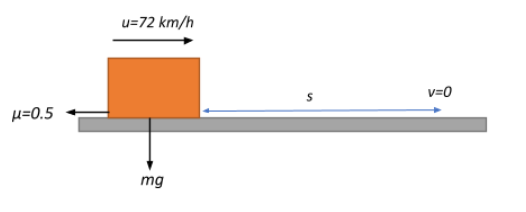
The magnitude of the frictional force is given as $F_{frictional} = \mu N$, where N is the normal reaction force on the body, equivalent to the gravitational force in magnitude.
$\Rightarrow F_{frictional} = -\mu mg \Rightarrow a_{frictional} = -\mu g = -0.5 \times 10 = -5\;ms^{-2}$ where the negative sign indicates that it acts in a direction opposite to the motion of the body.
Now that we have the effective acceleration of the block as $a = -5\;ms^{-2}$, we can determine the distance it travels before coming to a complete stop $v=0$ by using a kinematic equation of motion:
$v^2 – u^2 = 2as \Rightarrow s = \dfrac{v^2-u^2}{2a}$
$\Rightarrow s = \dfrac{0-20^2}{2\times -5} = \dfrac{-400}{-10} = 40\;m$
Therefore, the correct option would be D. 40m
Note:
Note that though we termed the impedance offered to the body by the coefficient friction as an effective acceleration, it is technically a retardation that brings out the stopping of the body, without which the body would continue to execute its motion incessantly. Thus, always remember to assign proper signs to acceleration and retardation components to avoid any conceptual confusion that may lead to numerical inconsistencies.
Formula Used:
Frictional force $F_{frictional} = \mu N$
Kinematic equation of motion $v^2 -u^2 =2as$
Complete answer:
We are given that the initial velocity of the body is $u = 72\;kmh^{-1} = 72 \times \dfrac{10^3}{3600} = 20\;ms^{-1}$.
The coefficient of friction $\mu = 0.5$. This means that the acceleration of the body and consequently the force acting on it is impeded by a frictional force.
The magnitude of the frictional force is given as $F_{frictional} = \mu N$, where N is the normal reaction force on the body, equivalent to the gravitational force in magnitude.
$\Rightarrow F_{frictional} = -\mu mg \Rightarrow a_{frictional} = -\mu g = -0.5 \times 10 = -5\;ms^{-2}$ where the negative sign indicates that it acts in a direction opposite to the motion of the body.
Now that we have the effective acceleration of the block as $a = -5\;ms^{-2}$, we can determine the distance it travels before coming to a complete stop $v=0$ by using a kinematic equation of motion:
$v^2 – u^2 = 2as \Rightarrow s = \dfrac{v^2-u^2}{2a}$
$\Rightarrow s = \dfrac{0-20^2}{2\times -5} = \dfrac{-400}{-10} = 40\;m$
Therefore, the correct option would be D. 40m
Note:
Note that though we termed the impedance offered to the body by the coefficient friction as an effective acceleration, it is technically a retardation that brings out the stopping of the body, without which the body would continue to execute its motion incessantly. Thus, always remember to assign proper signs to acceleration and retardation components to avoid any conceptual confusion that may lead to numerical inconsistencies.
Recently Updated Pages
Three beakers labelled as A B and C each containing 25 mL of water were taken A small amount of NaOH anhydrous CuSO4 and NaCl were added to the beakers A B and C respectively It was observed that there was an increase in the temperature of the solutions contained in beakers A and B whereas in case of beaker C the temperature of the solution falls Which one of the following statements isarecorrect i In beakers A and B exothermic process has occurred ii In beakers A and B endothermic process has occurred iii In beaker C exothermic process has occurred iv In beaker C endothermic process has occurred

Master Class 11 Social Science: Engaging Questions & Answers for Success
Master Class 11 Physics: Engaging Questions & Answers for Success
Master Class 11 Maths: Engaging Questions & Answers for Success
Master Class 11 Economics: Engaging Questions & Answers for Success
Master Class 11 Computer Science: Engaging Questions & Answers for Success
Three beakers labelled as A B and C each containing 25 mL of water were taken A small amount of NaOH anhydrous CuSO4 and NaCl were added to the beakers A B and C respectively It was observed that there was an increase in the temperature of the solutions contained in beakers A and B whereas in case of beaker C the temperature of the solution falls Which one of the following statements isarecorrect i In beakers A and B exothermic process has occurred ii In beakers A and B endothermic process has occurred iii In beaker C exothermic process has occurred iv In beaker C endothermic process has occurred
Master Class 11 Social Science: Engaging Questions & Answers for Success
Master Class 11 Physics: Engaging Questions & Answers for Success
Trending doubts
One Metric ton is equal to kg A 10000 B 1000 C 100 class 11 physics CBSE
There are 720 permutations of the digits 1 2 3 4 5 class 11 maths CBSE
State and prove Bernoullis theorem class 11 physics CBSE
Draw a diagram of a plant cell and label at least eight class 11 biology CBSE
Difference Between Prokaryotic Cells and Eukaryotic Cells
1 Quintal is equal to a 110 kg b 10 kg c 100kg d 1000 class 11 physics CBSE