




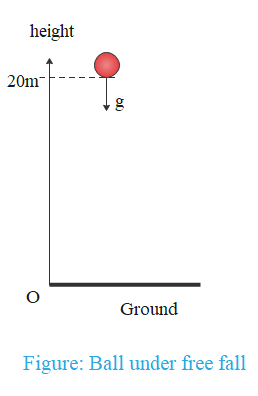
A body is dropped from a height of 20 m from the ground. Then, check which of the following options are correct. ($g=10\,m/{{s}^{2}}$)
A. the time taken by the body in reaching the ground is 2 s
B. the time taken by the body in reaching the ground is 4 s
C. the velocity of the body on reaching the ground is 20 m/s
D. the velocity of the body on reaching the ground is 40 m/s
Answer
 Verified
620.4k+ views
Hint: The force acting on the ball immediately after it is dropped is the gravitational force which accelerates the ball by acceleration due to gravity, g.
The time and velocity of the ball at any point can be determined using equations of motion.
Formula used: For a body under free fall, ${{v}^{2}}=2gh$ ; $t=\dfrac{v}{g}$
Complete step by step answer:
When an object is dropped from a height, it moves under the sole influence of gravitational force due to earth. This motion of objects under the influence of gravity is known as free fall. The object accelerates with a constant acceleration due to gravity.
The velocity of a freely falling body at any position is given by
${{v}^{2}}-{{u}^{2}}=2gh$
Where
$h=$ Vertical distance covered
$u=$ Initial velocity
$g=$ Acceleration due to gravity $\approx 10m{{s}^{-2}}$
Here the object is dropped so the initial velocity of the object is zero. Therefore the equation becomes
${{v}^{2}}=2gh$
Since, the ball is dropped from height 20 m, the vertical distance travelled by ball on reaching the ground is the height from which it is dropped i.e. 20 m. Therefore,
${{v}^{2}}=2\times 10\times 20=400\,{{m}^{2}}/{{s}^{2}}$
The velocity of ball on reaching the ground is 20 m/s
Velocity of a freely falling body is related to its time as
$v=u+gt$
Since, u = 0, we have
$v=gt\Rightarrow t=\dfrac{v}{g}$
Therefore,
$t=\dfrac{20}{10}=2\,s$
$\Rightarrow v=\sqrt{400}=20m/s$
Time taken by the ball to reach the ground is 2 s.
So, the correct answer is “Option A and C”.
Note: In such types of questions, sometimes students forget to consider the initial velocity of the object during free fall as zero. So here initial velocity won’t affect but that might mislead the concept.
When an object is dropped from a height, it moves under the sole influence of gravitational force due to earth.
The time and velocity of the ball at any point can be determined using equations of motion.
Formula used: For a body under free fall, ${{v}^{2}}=2gh$ ; $t=\dfrac{v}{g}$
Complete step by step answer:
When an object is dropped from a height, it moves under the sole influence of gravitational force due to earth. This motion of objects under the influence of gravity is known as free fall. The object accelerates with a constant acceleration due to gravity.
The velocity of a freely falling body at any position is given by
${{v}^{2}}-{{u}^{2}}=2gh$
Where
$h=$ Vertical distance covered
$u=$ Initial velocity
$g=$ Acceleration due to gravity $\approx 10m{{s}^{-2}}$
Here the object is dropped so the initial velocity of the object is zero. Therefore the equation becomes
${{v}^{2}}=2gh$
Since, the ball is dropped from height 20 m, the vertical distance travelled by ball on reaching the ground is the height from which it is dropped i.e. 20 m. Therefore,
${{v}^{2}}=2\times 10\times 20=400\,{{m}^{2}}/{{s}^{2}}$
The velocity of ball on reaching the ground is 20 m/s
Velocity of a freely falling body is related to its time as
$v=u+gt$
Since, u = 0, we have
$v=gt\Rightarrow t=\dfrac{v}{g}$
Therefore,
$t=\dfrac{20}{10}=2\,s$
$\Rightarrow v=\sqrt{400}=20m/s$
Time taken by the ball to reach the ground is 2 s.
So, the correct answer is “Option A and C”.
Note: In such types of questions, sometimes students forget to consider the initial velocity of the object during free fall as zero. So here initial velocity won’t affect but that might mislead the concept.
When an object is dropped from a height, it moves under the sole influence of gravitational force due to earth.
Recently Updated Pages
Master Class 11 English: Engaging Questions & Answers for Success

Master Class 11 Social Science: Engaging Questions & Answers for Success
Master Class 11 Maths: Engaging Questions & Answers for Success
Master Class 11 Biology: Engaging Questions & Answers for Success
Master Class 11 Physics: Engaging Questions & Answers for Success
Master Class 11 Chemistry: Engaging Questions & Answers for Success
Trending doubts
One Metric ton is equal to kg A 10000 B 1000 C 100 class 11 physics CBSE
Difference Between Prokaryotic Cells and Eukaryotic Cells
Find the value of the expression given below sin 30circ class 11 maths CBSE
1 ton equals to A 100 kg B 1000 kg C 10 kg D 10000 class 11 physics CBSE
Two of the body parts which do not appear in MRI are class 11 biology CBSE
What are hard magnetic materials class 11 physics CBSE