




: A boat moves relative to water with velocity \[v\] , and the river is flowing with\[2v\]. At what angle the boat shall move with the stream to have minimum drift?
A. \[{30^ \circ }\]
B. \[{60^ \circ }\]
C. \[{90^ \circ }\]
D. \[{120^ \circ }\]
Answer
 Verified
602.7k+ views
Hint: In this question, we need to determine the angle at which the boat should move with the stream with the minimum drift to reach the opposite bank of the river. For this, we will use the concept of relative velocity which is the velocity of an object with respect to another object.
Complete step by step answer:
Let the relative velocity of the boat is \[{u_b} = v\]
The velocity of the river is \[{u_r} = 2v\]in the horizontal direction
Now let the angle be \[\theta \]made by boat to have minimum drift
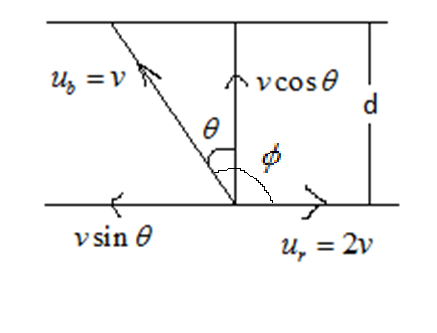
Hence we can write the horizontal and vertical component of velocity of the boat as
\[{v_x} = 2v - v\sin \theta - - (i)\]
\[{v_y} = v\cos \theta - - (ii)\]
Let the width of the river be ‘d’.
So the time required to cross the river will be
\[t = \dfrac{d}{{\cos \theta }} - - (iii)\][Since\[time = \dfrac{{dis\tan ce}}{{speed}}\]]
Since we have observed that\[{v_x} > 0\], so we can say drift is not equal to 0.
As we know, drift is\[X = {v_x} \times t\], hence by solving, we get
\[
X = {v_x} \times t \\
= \left( {2v - v\sin \theta } \right) \times \dfrac{d}{{v\cos \theta }} - - (iv) \\
\]
Now for x to be minimum, let’s differentiate equation (iv) w.r.t \[\theta \]
\[
\dfrac{{dX}}{{d\theta }} = 0 \\
\dfrac{{d\left[ {\left( {2v - v\sin \theta } \right) \times \dfrac{d}{{v\cos \theta }}} \right]}}{{d\theta }} = 0 \\
\dfrac{d}{{d\theta }}\left[ {\dfrac{{2vd}}{{v\cos \theta }}} \right] - \dfrac{d}{{d\theta }}\left[ {\dfrac{{d \times v\sin \theta }}{{v\cos \theta }}} \right] = 0 \\
d\left( {2\dfrac{d}{{d\theta }}\left[ {\sec \theta } \right] - \dfrac{d}{{d\theta }}\left[ {\tan \theta } \right]} \right) = 0 \\
d\left[ {2\sec \theta \tan \theta - {{\sec }^2}\theta } \right] = 0 \\
2\sec \theta \tan \theta - {\sec ^2}\theta = 0 \\
\]
By further solving this equation, we get
\[
2\sec \theta \tan \theta = {\sec ^2}\theta \\
2\tan \theta = \sec \theta \\
2\dfrac{{\sin \theta }}{{\cos \theta }} = \dfrac{1}{{\cos \theta }} \\
\sin \theta = \dfrac{1}{2} \\
\]
So the values of the angle \[\theta \]will be
\[
\theta = {\sin ^{ - 1}}\left( {\dfrac{1}{2}} \right) \\
= {30^ \circ } \\
\]
This angle is made with the vertical so, to make the angle with the horizontal axis, add 90 degrees with the 30 degrees to get the result.
Hence, the angle at which the boat shall move with the stream to have minimum drift
\[\theta + \phi = {90^ \circ } + {30^ \circ } = {120^ \circ }\]
Option D is correct.
Note: It is worth noting down here that, the boat can also move with other angles also, but to satisfy the need to the question that there should be minimum drift to reach at directly opposite bank of the river we need to move the boat at an angle of 120 degrees with the horizontal.
Complete step by step answer:
Let the relative velocity of the boat is \[{u_b} = v\]
The velocity of the river is \[{u_r} = 2v\]in the horizontal direction
Now let the angle be \[\theta \]made by boat to have minimum drift
Hence we can write the horizontal and vertical component of velocity of the boat as
\[{v_x} = 2v - v\sin \theta - - (i)\]
\[{v_y} = v\cos \theta - - (ii)\]
Let the width of the river be ‘d’.
So the time required to cross the river will be
\[t = \dfrac{d}{{\cos \theta }} - - (iii)\][Since\[time = \dfrac{{dis\tan ce}}{{speed}}\]]
Since we have observed that\[{v_x} > 0\], so we can say drift is not equal to 0.
As we know, drift is\[X = {v_x} \times t\], hence by solving, we get
\[
X = {v_x} \times t \\
= \left( {2v - v\sin \theta } \right) \times \dfrac{d}{{v\cos \theta }} - - (iv) \\
\]
Now for x to be minimum, let’s differentiate equation (iv) w.r.t \[\theta \]
\[
\dfrac{{dX}}{{d\theta }} = 0 \\
\dfrac{{d\left[ {\left( {2v - v\sin \theta } \right) \times \dfrac{d}{{v\cos \theta }}} \right]}}{{d\theta }} = 0 \\
\dfrac{d}{{d\theta }}\left[ {\dfrac{{2vd}}{{v\cos \theta }}} \right] - \dfrac{d}{{d\theta }}\left[ {\dfrac{{d \times v\sin \theta }}{{v\cos \theta }}} \right] = 0 \\
d\left( {2\dfrac{d}{{d\theta }}\left[ {\sec \theta } \right] - \dfrac{d}{{d\theta }}\left[ {\tan \theta } \right]} \right) = 0 \\
d\left[ {2\sec \theta \tan \theta - {{\sec }^2}\theta } \right] = 0 \\
2\sec \theta \tan \theta - {\sec ^2}\theta = 0 \\
\]
By further solving this equation, we get
\[
2\sec \theta \tan \theta = {\sec ^2}\theta \\
2\tan \theta = \sec \theta \\
2\dfrac{{\sin \theta }}{{\cos \theta }} = \dfrac{1}{{\cos \theta }} \\
\sin \theta = \dfrac{1}{2} \\
\]
So the values of the angle \[\theta \]will be
\[
\theta = {\sin ^{ - 1}}\left( {\dfrac{1}{2}} \right) \\
= {30^ \circ } \\
\]
This angle is made with the vertical so, to make the angle with the horizontal axis, add 90 degrees with the 30 degrees to get the result.
Hence, the angle at which the boat shall move with the stream to have minimum drift
\[\theta + \phi = {90^ \circ } + {30^ \circ } = {120^ \circ }\]
Option D is correct.
Note: It is worth noting down here that, the boat can also move with other angles also, but to satisfy the need to the question that there should be minimum drift to reach at directly opposite bank of the river we need to move the boat at an angle of 120 degrees with the horizontal.
Recently Updated Pages
Master Class 11 Social Science: Engaging Questions & Answers for Success

Master Class 11 Physics: Engaging Questions & Answers for Success
Master Class 11 Maths: Engaging Questions & Answers for Success
Master Class 11 Economics: Engaging Questions & Answers for Success
Master Class 11 Computer Science: Engaging Questions & Answers for Success
Master Class 11 Chemistry: Engaging Questions & Answers for Success
Trending doubts
One Metric ton is equal to kg A 10000 B 1000 C 100 class 11 physics CBSE
There are 720 permutations of the digits 1 2 3 4 5 class 11 maths CBSE
1 Quintal is equal to a 110 kg b 10 kg c 100kg d 1000 class 11 physics CBSE
State and prove Bernoullis theorem class 11 physics CBSE
Difference Between Prokaryotic Cells and Eukaryotic Cells
Which among the following are examples of coming together class 11 social science CBSE