




A block of mass $1kg$ is at rest on a horizontal table. The coefficient of static friction between the block and the table is $0.50$ if $g = 10m/{s^2}$ then the magnitude of force acting upwards at an angle of $60^\circ $ from horizontal that will just start the block moving is.
A. $5N$
B. $5.36N$
C. $74.6N$
D. $10N$
Answer
 Verified
597.9k+ views
Hint: We can solve this question by applying a simple law of vector. We have to equate all horizontal forces and all vertical forces which are acting on the block. The coefficient of static friction is given in question with the help of this can calculate the friction force and the force acting opposite to it must be equal to this so the block can just start to move.
Complete step by step answer:
As shown in figure we mark all the forces which can act on the block in this condition
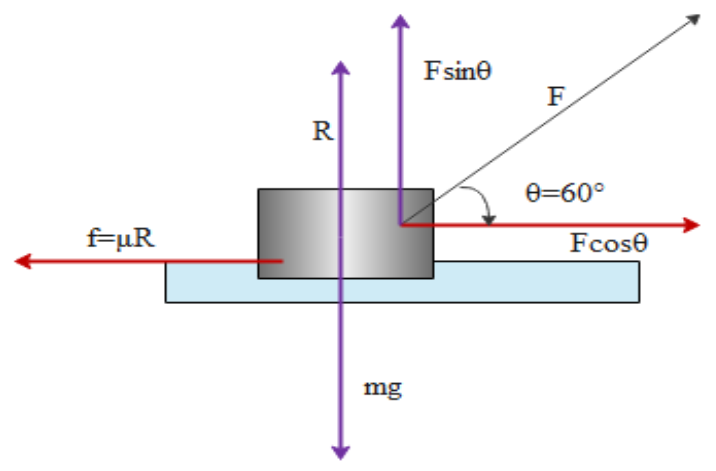
Force acting on the block
Weight of block downward direction
Normal reaction $R$ upward direction
Vertical component of applied force $F\sin \theta $
And horizontal forces
Horizontal component of force $F\cos \theta $
Friction force between block and table $f = \mu R$
Values are given in question
$m = 1kg$ $g = 10m/{s^2}$ $\mu = 0.5 = \dfrac{1}{2}$ $\theta = 60^\circ $
Now equate vertical forces
$ \Rightarrow mg = R + F\sin \theta $
$ \Rightarrow R = mg - F\sin \theta $
Put given value
$ \Rightarrow R = 10 - F\sin 60^\circ $
$ \Rightarrow R = 10 - \dfrac{{\sqrt 3 }}{2}F$
Friction force given as $f = \mu R$
$f = 0.5\left( {10 - \dfrac{{\sqrt 3 }}{2}F} \right)$........... (1)
Now equate all the horizontal forces
$f = F\cos \theta $
$ \Rightarrow f = F\cos 60^\circ $
$ \Rightarrow f = \dfrac{F}{2}$
Put value from equation (1)
$\dfrac{F}{2} = 0.5\left( {10 - \dfrac{{\sqrt 3 }}{2}F} \right)$
$F = 2 \times 0.5\left( {10 - \dfrac{{\sqrt 3 }}{2}F} \right)$
Solving this
$ \Rightarrow F = 10 - \dfrac{{\sqrt 3 }}{2}F$
Rearranging this
$ \Rightarrow F + \dfrac{{\sqrt 3 }}{2}F = 10$
$ \Rightarrow 2F + \sqrt 3 F = 20$
$ \Rightarrow F\left( {2 + \sqrt 3 } \right) = 20$
So the value of applied force
$ \Rightarrow F = \dfrac{{20}}{{\left( {2 + \sqrt 3 } \right)}}$
$\therefore F = 5.36N$
So, the correct answer is “Option B”.
Note:
Sometime student makes a very common mistake while solving this question, calculating friction force friction force given by $f = \mu R$ and some student learn it as $f = \mu mg$ which is not always correct it is correct only when applied force is in horizontal direction so be careful to calculate friction force.
Complete step by step answer:
As shown in figure we mark all the forces which can act on the block in this condition
Force acting on the block
Weight of block downward direction
Normal reaction $R$ upward direction
Vertical component of applied force $F\sin \theta $
And horizontal forces
Horizontal component of force $F\cos \theta $
Friction force between block and table $f = \mu R$
Values are given in question
$m = 1kg$ $g = 10m/{s^2}$ $\mu = 0.5 = \dfrac{1}{2}$ $\theta = 60^\circ $
Now equate vertical forces
$ \Rightarrow mg = R + F\sin \theta $
$ \Rightarrow R = mg - F\sin \theta $
Put given value
$ \Rightarrow R = 10 - F\sin 60^\circ $
$ \Rightarrow R = 10 - \dfrac{{\sqrt 3 }}{2}F$
Friction force given as $f = \mu R$
$f = 0.5\left( {10 - \dfrac{{\sqrt 3 }}{2}F} \right)$........... (1)
Now equate all the horizontal forces
$f = F\cos \theta $
$ \Rightarrow f = F\cos 60^\circ $
$ \Rightarrow f = \dfrac{F}{2}$
Put value from equation (1)
$\dfrac{F}{2} = 0.5\left( {10 - \dfrac{{\sqrt 3 }}{2}F} \right)$
$F = 2 \times 0.5\left( {10 - \dfrac{{\sqrt 3 }}{2}F} \right)$
Solving this
$ \Rightarrow F = 10 - \dfrac{{\sqrt 3 }}{2}F$
Rearranging this
$ \Rightarrow F + \dfrac{{\sqrt 3 }}{2}F = 10$
$ \Rightarrow 2F + \sqrt 3 F = 20$
$ \Rightarrow F\left( {2 + \sqrt 3 } \right) = 20$
So the value of applied force
$ \Rightarrow F = \dfrac{{20}}{{\left( {2 + \sqrt 3 } \right)}}$
$\therefore F = 5.36N$
So, the correct answer is “Option B”.
Note:
Sometime student makes a very common mistake while solving this question, calculating friction force friction force given by $f = \mu R$ and some student learn it as $f = \mu mg$ which is not always correct it is correct only when applied force is in horizontal direction so be careful to calculate friction force.
Recently Updated Pages
Master Class 11 Social Science: Engaging Questions & Answers for Success

Master Class 11 Physics: Engaging Questions & Answers for Success
Master Class 11 Maths: Engaging Questions & Answers for Success
Master Class 11 Economics: Engaging Questions & Answers for Success
Master Class 11 Computer Science: Engaging Questions & Answers for Success
Master Class 11 Chemistry: Engaging Questions & Answers for Success
Trending doubts
One Metric ton is equal to kg A 10000 B 1000 C 100 class 11 physics CBSE
There are 720 permutations of the digits 1 2 3 4 5 class 11 maths CBSE
1 Quintal is equal to a 110 kg b 10 kg c 100kg d 1000 class 11 physics CBSE
State and prove Bernoullis theorem class 11 physics CBSE
Difference Between Prokaryotic Cells and Eukaryotic Cells
Which among the following are examples of coming together class 11 social science CBSE