




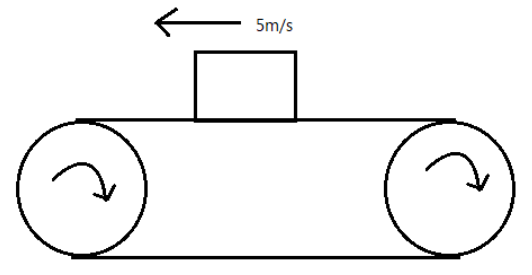
A block lying on a long horizontal conveyor belt moving at a constant velocity receives a velocity $5m/s$ relative to the ground in the direction opposite to the conveyor. After $t=4s$, the velocity of the block becomes equal to the velocity of the belt. If the coefficient of friction between the block and the belt is \[0.2\]. Then the velocity of the conveyor is($g=10m/s ^{2}$)
\[\begin{align}
& A.13m/s \\
& B.-13m/s \\
& C.3m/s \\
& D.6m/s \\
\end{align}\]
Answer
 Verified
591.3k+ views
Hint: We know that friction is the resistive force which tries to oppose the motion of an object. It is a surface phenomenon and is observed only when the object trying to move is in contact with some surface. Which is to say that friction is a contact force.
Formula:
$\mu_{s}=\dfrac{F_{s}}{F_{n}}$
Complete answer:
Coefficient of static friction is a dimensionless quantity. $\mu_{s}$ is the maximum resistive force applied on any given body such that there is no change in state of the motion.
It is given as $\mu_{s}=\dfrac{F_{s}}{F_{n}}$, where $F_{s}$ is the applied force and $F_{n}$ is the normal force acting on the given body.
Let us assume that the motion of the block with respect to the conveyor is fixed, when viewed from the ground. Let $v_{b}$ be the velocity of the block and $v_{c}$ be the velocity of the conveyor.
Given that $\mu_{s}=0.2$, $v_{b}=5m/s$ and after $t=4s$, $v_{b}=v_{c}$.
Then due to friction, we can say, $v_{c}=v_{b}-\mu_{s}gt$
Substituting the values we get, $v_{c}=5-0.2\times10\times 4=-3m/s$
Then $v_{b}=3m/s$ as it is given that the direction of the block is opposite to that of the conveyor.
Hence the answer,\[C.3m/s\]
Note:
Friction is a small quantity that acts in the opposite direction to the force. Static friction is the force responsible for an object to be at rest, whereas the kinetic friction is the force that resists the motion of a moving body. Coefficient of static friction is a ratio and has no dimension. It also has no units. Coefficient of static friction depends on the weight of the object and nature of the surface. More the weight, more the static friction and if the surface is rough, then more is the static friction.
Formula:
$\mu_{s}=\dfrac{F_{s}}{F_{n}}$
Complete answer:
Coefficient of static friction is a dimensionless quantity. $\mu_{s}$ is the maximum resistive force applied on any given body such that there is no change in state of the motion.
It is given as $\mu_{s}=\dfrac{F_{s}}{F_{n}}$, where $F_{s}$ is the applied force and $F_{n}$ is the normal force acting on the given body.
Let us assume that the motion of the block with respect to the conveyor is fixed, when viewed from the ground. Let $v_{b}$ be the velocity of the block and $v_{c}$ be the velocity of the conveyor.
Given that $\mu_{s}=0.2$, $v_{b}=5m/s$ and after $t=4s$, $v_{b}=v_{c}$.
Then due to friction, we can say, $v_{c}=v_{b}-\mu_{s}gt$
Substituting the values we get, $v_{c}=5-0.2\times10\times 4=-3m/s$
Then $v_{b}=3m/s$ as it is given that the direction of the block is opposite to that of the conveyor.
Hence the answer,\[C.3m/s\]
Note:
Friction is a small quantity that acts in the opposite direction to the force. Static friction is the force responsible for an object to be at rest, whereas the kinetic friction is the force that resists the motion of a moving body. Coefficient of static friction is a ratio and has no dimension. It also has no units. Coefficient of static friction depends on the weight of the object and nature of the surface. More the weight, more the static friction and if the surface is rough, then more is the static friction.
Recently Updated Pages
Basicity of sulphurous acid and sulphuric acid are

Master Class 11 Business Studies: Engaging Questions & Answers for Success
Master Class 11 Computer Science: Engaging Questions & Answers for Success
Master Class 11 Economics: Engaging Questions & Answers for Success
Master Class 11 Social Science: Engaging Questions & Answers for Success
Master Class 11 English: Engaging Questions & Answers for Success
Trending doubts
One Metric ton is equal to kg A 10000 B 1000 C 100 class 11 physics CBSE
The largest wind power cluster is located in the state class 11 social science CBSE
Explain zero factorial class 11 maths CBSE
State and prove Bernoullis theorem class 11 physics CBSE
What steps did the French revolutionaries take to create class 11 social science CBSE
Which among the following are examples of coming together class 11 social science CBSE